Unisciti a noi in un viaggio nel mondo dei libri!
Aggiungi questo libro allo scaffale
Grey
Scrivi un nuovo commento Default profile 50px
Grey
Iscriviti per leggere l'intero libro o leggi le prime pagine gratuitamente!
All characters reduced
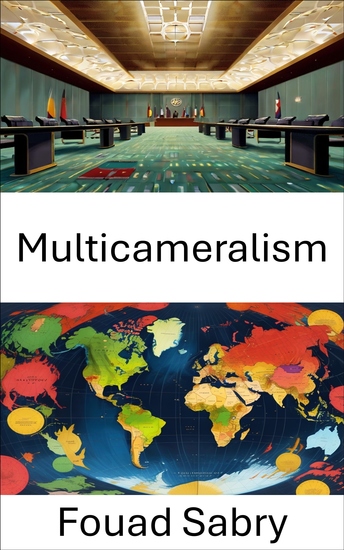
Multicameralism - Exploring Complex Legislative Structures for Modern Governance - cover

Multicameralism - Exploring Complex Legislative Structures for Modern Governance

Fouad Sabry

Casa editrice: One Billion Knowledgeable

  • 0
  • 0
  • 0

Sinossi

Unlock the secrets of political science with "Multicameralism." This insightful volume explores multicameral legislative systems, detailing their structures, functions, and effects on governance. A must-read for those passionate about legislative frameworks, this book serves as an invaluable resource.
 
1: Multicameralism: Begin with a comprehensive overview of multicameralism, its definition, historical evolution, and contrasts with other systems.
 
2: Parliament: Examine the role of parliaments in multicameral systems, including their structure and influence on policy.
 
3: Senate: Delve into the Senate's unique functions and historical context within multicameral frameworks.
 
4: Legislature: Gain insight into legislative bodies, their functions, and their role in multicameralism.
 
5: Bicameralism: Contrast multicameralism with bicameral systems, focusing on their effectiveness and structure.
 
6: Unicameralism: Explore one-chamber systems, highlighting their advantages and limitations.
 
7: Tricameralism: Investigate tricameral systems, discussing their unique structures and associated challenges.
 
8: Upper House: Understand the upper house's significance and impact on legislative processes.
 
9: House of Representatives: Examine the House of Representatives' functions within various legislative frameworks.
 
10: Outline of Government: Understand how multicameral systems integrate into the overall government structure.
 
11: Member of Parliament: Explore the responsibilities of members in multicameral systems and their governance contributions.
 
12: Croatian Parliament: A detailed look at the Croatian Parliament and its multicameral impact on politics.
 
13: Landtag: Study the Landtag and its role in regional multicameral systems.
 
14: Australian Parliaments: Explore the operation of state and territory parliaments within a multicameral framework.
 
15: Supermajority: Understand supermajority concepts and their implications in multicameral systems.
 
16: Dominican Congress: Examine the Dominican Republic's Congress and its multicameral structure.
 
17: Parliament of Serbia and Montenegro: Study the historical and functional aspects of the Parliament of Serbia and Montenegro.
 
18: State Government: Explore state government operations within multicameral frameworks.
 
19: Legislative Chamber: Understand the roles of various legislative chambers in multicameral systems.
 
20: Italian Parliament: Analyze the Italian Parliament's multicameral system and its governance influence.
 
21: Assembly of Yugoslavia: Examine the historical significance of the Assembly of Yugoslavia and its multicameral structure.
 
"Multicameralism" is not just a book; it’s a crucial tool for deepening your understanding of legislative systems and their governance impact. This resource enriches your knowledge of political science and global legislative practices.
Disponibile da: 21/09/2024.
Lunghezza di stampa: 308 pagine.
Altri libri che potrebbero interessarti

  • Embracing Autonomy - Latin American–US Relations in the Twenty-First Century - cover

    Embracing Autonomy - Latin...

    Gregory Weeks

    • 0
    • 0
    • 0
    Gregory Weeks's Embracing Autonomy departs from other general treatments of Latin American-US relations not by putting US policy aside but by bringing in the Latin American and global contexts more closely and thus avoiding the incomplete picture provided by a narrow focus solely on the policies of the United States. 


    The core of autonomy for Latin America from the United States is seen in new, deeper, and more numerous relationships that do not include the United States. The book is not a study of rebellion against the United States, or even a critique of US policy. Instead, it is an examination of the major shifts that have taken place in the region in recent decades and how they have shaped Latin American-US relations. 


    Weeks's book provides a clearer understanding of where Latin America stands vis-à-vis the United States in the early twenty-first century. In doing so, we gain a better sense of the trajectory of Latin American-US relations and how they develop in turbulent times.
    Mostra libro
  • The Dogs of Mariupol - Russia's Invasion and the Forging of Ukraine's Iron Generation - cover

    The Dogs of Mariupol - Russia's...

    Tom Mutch

    • 0
    • 0
    • 0
    When Russia invaded Ukraine in 2022, Kateryna hung up her dresses, Oksana and Stanislav put down their lawyers' briefs and Oksen slammed shut his philosophy textbooks. Alongside thousands of their fellow citizens, they strapped on armour, picked up weapons and chose to risk their lives for the freedom and independence of their homeland. Many would never return.
    Journalist Tom Mutch woke up in Kyiv on 24 February to a world changed for ever. Making a fateful choice to stay and cover the invasion, he witnessed the forging of an 'iron generation' of young Ukrainians. With first-hand reporting from all the major battlegrounds and front lines, The Dogs of Mariupol recounts the war's notorious encounters, such as the Battle of Kyiv and the Siege of Mariupol, but also uncovers untold stories, like the 1st Tank Brigade's desperate defence of Chernihiv and the civilian guerrilla army fighting overwhelming odds in Sumy.
    This is not a triumphalist account of Ukraine's fight, however. It painstakingly documents the immense human catastrophe wrought on Ukrainian society and the divisions between those who fought and those who fled. It also delves deeper into events to answer important historical questions: could the Russian plan to capture Kyiv have succeeded? Did Ukraine make a fatal error by committing for so long to the defence of Bakhmut? And with more western support, could Ukraine have won this terrible war outright?
    Mostra libro
  • Israel: The Last Vestige of European Colonialism in the Middle East - cover

    Israel: The Last Vestige of...

    A.A. Castor

    • 0
    • 0
    • 0
    "Israel: The Last Vestige of European Colonialism in the Middle East" is an in-depth examination of the historical and ongoing impact of European colonialism on the formation and expansion of Israel. Through a critical lens, this book challenges the mainstream narratives that depict Israel as the rightful homeland of the Jewish people and instead explores its colonial roots and the displacement of the indigenous Palestinian population. 
      
    The book delves into the role of European powers, from the Zionist movement's inception in the late 19th century to the political maneuvers that facilitated the establishment of Israel in 1948. It uncovers how Western support, particularly from Britain and the United States, enabled the colonization of Palestine while ignoring the rights of the native population. It also analyzes the demographic changes brought about by waves of European Jewish immigration and presents genetic evidence highlighting the European ancestry of much of the modern Israeli population. 
      
    By exploring topics such as the marginalization of non-European Jewish communities, the ongoing occupation of Palestinian territories, and the influence of Western powers, this book aims to shed light on the historical injustices and colonial dynamics that continue to shape the Israeli-Palestinian conflict. Readers will be encouraged to question established narratives, understand the broader geopolitical implications, and consider the pathways to justice and accountability for the Palestinian people.
    Mostra libro
  • Freedom Riders The: The History of the Civil Rights Activists Who Rode Buses around the South to Protest Segregation - cover

    Freedom Riders The: The History...

    Editors Charles River

    • 0
    • 0
    • 0
    After a 1960 Supreme Court decision in Boynton v. Virginia, bus segregation was made illegal on new grounds: it violated the interstate commerce clause of the Constitution, by regulating the movement of people across state lines. With this victory in hand, the Freedom Rides of 1961 began. Organized primarily by a new group – the Congress on Racial Equality (CORE) – the Freedom Rides followed the same guidance that inspired the Montgomery Boycott and the Greensboro Sit-Ins – non-violent direct action. The purpose of the Freedom Rides was the test the Supreme Court's decision by riding from Virginia to Louisiana on integrated busses. This was notably the first major Civil Rights event that included a large segment of white participants.  
    	Mobs in places like Birmingham and Montgomery firebombed buses and brutally beat the Freedom Riders, sending dozens to the hospital. Mob violence, orchestrated by the KKK and their segregationist allies, erupted endlessly throughout the summer. White activists, who were viewed by the Ku Klux Klan as betraying their race, took the worst beatings of all.  
    	Both black and white Northerners had participated in the Freedom Rides, and civil rights activists sought other ways to harness their energy and activism in 1963. After the Freedom Rides, civil rights leaders initiated voter registration drives that could help register black voters and build community organizations that could help make their votes count. The momentum generated by the Freedom Rides and the following activism would lead to the famous March on Washington and eventually the passage of a historic civil rights bill in 1964. 
    Mostra libro
  • Self-Censorship - cover

    Self-Censorship

    Glenn C. Loury

    • 0
    • 0
    • 0
    There is no such thing as free, unconstrained speech. Laws and constitutions may protect us from the state when we speak our minds. But the state is just one possible constraint. Glenn Loury, one of America's most outspoken and important intellectuals, provides a provocative and dazzling analysis of the powerful social forces that can prevent speakers from voicing unpopular views in public forums.Every society, Loury notes, has norms to enforce. That can be a good thing: There ought to be social sanctions for, say, compulsive liars. When, however, a society shows a low degree of tolerance for speech about matters of political importance, self-censorship proliferates and public discourse and policy suffer. The answer, Loury argues, is for as many of us as possible to be braver and more human—to take a risk and unapologetically "live within the truth".Loury first presented these ideas in the 1990s in a celebrated and prophetic essay about "political correctness." In Self-Censorship he expands and updates the account, deploying his analytical powers and psychological acuity to diagnose our current political climate. The result illuminates prevailing social dynamics with the same brilliant and startling effect that made the paper an instant classic thirty years ago.
    Mostra libro
  • Two Three Words (Do Se Kalameh) - cover

    Two Three Words (Do Se Kalameh)

    Aram Hessami

    • 0
    • 0
    • 0
    Where is the driving force for change? Who envisions a better future, crafts the path to democracy, and strategizes the movement? Who fuels it with revolutionary zeal and the will to power? And where is the force that can fulfill the unfinished promise of Iran's Constitutional Revolution? In three words: The Iranian Citizenry. Thirty years before Iran's Constitutional Revolution, the treatise One Word (Yek Kalameh) ignited a movement—challenging absolute monarchy, advocating the rule of law, and empowering the people. Now, Two, Three Words (Do, Se Kalameh) draws inspiration from the courageous youth of Iran. It articulates their aspirations, forges a new discourse, and unites a narrative that could pave the way for democratic alternatives.
    Mostra libro