Unisciti a noi in un viaggio nel mondo dei libri!
Aggiungi questo libro allo scaffale
Grey
Scrivi un nuovo commento Default profile 50px
Grey
Iscriviti per leggere l'intero libro o leggi le prime pagine gratuitamente!
All characters reduced
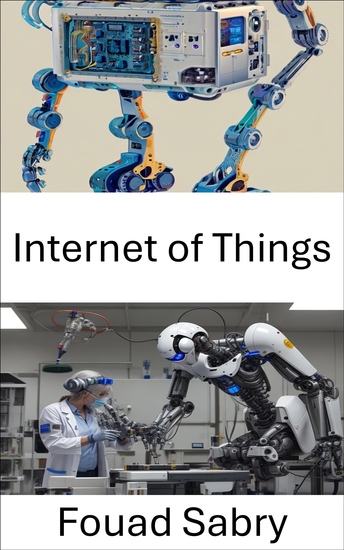
Internet of Things - Connecting Devices for a Smarter Future - cover

Internet of Things - Connecting Devices for a Smarter Future

Fouad Sabry

Casa editrice: One Billion Knowledgeable

  • 0
  • 0
  • 0

Sinossi

The "Internet of Things" explores how connected devices are revolutionizing industries, enhancing everyday life, and driving innovations. This book is a vital resource for professionals, students, and enthusiasts alike, offering a comprehensive guide to understanding the vast field of IoT from a robotics science perspective. Whether you're in engineering, data science, or simply intrigued by the future of smart technologies, this book will elevate your knowledge and skills.
 
Chapters Brief Overview:
 
1: Internet of things: Introduces the concept of IoT, explaining its foundation and growth in modern technology.
 
2: Home automation: Explores the integration of IoT into residential spaces, highlighting automation benefits for comfort and efficiency.
 
3: Wireless sensor network: Examines the role of wireless sensors in IoT systems, enabling realtime data collection and analysis.
 
4: Mutual authentication: Focuses on securing IoT networks through mutual authentication protocols to ensure trust and privacy.
 
5: Linear network coding: Explains the optimization of data transmission in IoT networks through linear network coding techniques.
 
6: Edge computing: Discusses the role of edge computing in IoT, enabling data processing closer to devices for faster and more efficient operations.
 
7: Wireless ad hoc network: Covers decentralized IoT network configurations that support communication without fixed infrastructure.
 
8: Smart transducer: Delivers insights into smart transducers, devices that convert physical data into digital signals for IoT systems.
 
9: Web of Things: Explores the intersection of IoT and the web, enabling better integration and communication across platforms.
 
10: Body area network: Focuses on IoT applications in healthcare, especially wearable devices for monitoring personal health.
 
11: Fog computing: Introduces fog computing as an extension of edge computing, enhancing IoT capabilities with localized data processing.
 
12: Lowpower widearea network: Highlights the role of LPWANs in longrange, lowenergy communication within IoT networks.
 
13: Time Slotted Channel Hopping: Discusses the use of timeslotted channel hopping in IoT networks for reducing interference and improving reliability.
 
14: LoRa: Covers LoRa technology, a key enabler of IoT systems by providing longrange, lowpower communication.
 
15: Industrial internet of things: Examines IoT applications in industries such as manufacturing, where connected devices drive productivity and innovation.
 
16: Subsea Internet of Things: Looks into IoT deployments underwater, enabling monitoring and control in subsea environments.
 
17: Internet of Military Things: Explores IoT in military applications, where data connectivity and realtime decisionmaking are critical.
 
18: Aerial base station: Discusses the use of IoT in aerial base stations, supporting communication and data collection from the sky.
 
19: Internet of vehicles: Explores how IoT enables smart vehicles, revolutionizing transportation with realtime data and automation.
 
20: IoT forensics: Covers the emerging field of IoT forensics, ensuring security and investigating data breaches in IoT networks.
 
21: Internet of Musical Things: Delves into IoT’s role in the music industry, connecting instruments and devices for new creative possibilities.
 
The "Internet of Things" presents a clear pathway to understanding the impact of connected technologies on the world. The insights offered throughout each chapter are indispensable for anyone looking to keep up with the rapidly evolving landscape of robotics and smart systems.
Disponibile da: 02/01/2025.
Lunghezza di stampa: 216 pagine.

Altri libri che potrebbero interessarti

  • How to Make a Killing - Blood Death and Dollars in American Medicine - cover

    How to Make a Killing - Blood...

    Tom Mueller

    • 0
    • 0
    • 0
    Six decades ago, visionary doctors achieved the impossible: the humble kidney, acknowledged since ancient times to be as essential to life as the heart, became the first human organ to be successfully replaced with a machine. Yet huge dialysis corporations, ambitious doctor-entrepreneurs, and Beltway lobbyists soon turned this medical miracle into an early experiment in for-profit medicine—and one of the nation's worst healthcare catastrophes. 


    With powerful insight and on-the-ground reporting, Tom Mueller introduces an unforgettable cast of characters. Heroic patients risk their lives to blow the whistle on how they've been mistreated. An unpaid activist living in a south Georgia trailer park fights to save patients from involuntary discharge from their lifesaving care. Industry insiders put their careers on the line to speak out about the endemic wrongs and pervasive inequality they've witnessed—and about dialysis executives who dress as musketeers and Star Wars characters to exhort their employees to more aggressive profit-seeking. 


    How to Make a Killing reveals dialysis as a microcosm of American medicine and poses a vital challenge: find a way to fix dialysis, and we'll have a fighting chance of fixing our country's dysfunctional healthcare system as a whole, restoring patients, not profits, as its true purpose.
    Mostra libro
  • Hands-on ML Projects with OpenCV - cover

    Hands-on ML Projects with OpenCV

    Mugesh S.

    • 0
    • 0
    • 0
    Be at your A game in building Intelligent systems by leveraging Computer vision and Machine Learning. 
    
    KEY FEATURES 
    - Step-by-step instructions and code snippets for real world ML projects. 
    - Covers entire spectrum from basics to advanced concepts such as deep learning, transfer learning, and model optimization
    - Loaded with practical tips and best practices for implementing machine learning with OpenCV for optimising your workflow. 
    
    DESCRIPTION
    This book is an in-depth guide that merges machine learning techniques with OpenCV, the most popular computer vision library, using Python. The book introduces fundamental concepts in machine learning and computer vision, progressing to practical implementation with OpenCV. Concepts related to image preprocessing, contour and thresholding techniques, motion detection and tracking are explained in a step-by-step manner using code and output snippets. 
    
    Hands-on projects with real-world datasets will offer you an invaluable experience in solving OpenCV challenges with machine learning. It’s an ultimate guide to explore areas like deep learning, transfer learning, and model optimization, empowering readers to tackle complex tasks. Every chapter offers practical tips and tricks to build effective ML models. 
    
    By the end, you would have mastered and applied ML concepts confidently to real-world computer vision problems and will be able to develop robust and accurate machine-learning models for diverse applications. 
    
    Whether you are new to machine learning or seeking to enhance your computer vision skills, This book is an invaluable resource for mastering the integration of machine learning and computer vision using OpenCV and Python. 
    
    WHAT WILL YOU LEARN 
    - Learn how to work with images and perform basic image processing tasks using OpenCV. 
    - Implement machine learning techniques to computer vision tasks such as image classification, object detection, and image segmentation. 
    - Work on real-world projects and datasets to gain hands-on experience in applying machine learning techniques with OpenCV. 
    - Explore the concepts of deep learning using Tensorflow and Keras and how it can be used for computer vision tasks. 
    - Understand the concept of transfer learning and how pre-trained models can be leveraged for new tasks. 
    - Utilize techniques for model optimization and deployment in resource-constrained environments. 
    - Implement end-to-end solutions and address challenges encountered in practical scenarios. 
    
    WHO IS THIS BOOK FOR?
    This book is for everyone with a basic understanding of programming and who wants to apply machine learning in computer vision using OpenCV and Python. Whether you're a student, researcher, or developer, this book will equip you with practical skills for machine learning projects. Some familiarity with Python and machine learning concepts is assumed. Beginners too will find this book valuable as it offers clear examples and explanations for every concept. 
    
    TABLE OF CONTENTS 
    Chapter 1: Getting Started With OpenCV 
    Chapter 2: Basic Image & Video Analytics in OpenCV
    Chapter 3: Image Processing 1 using OpenCV
    Chapter 4: Image Processing 2 using OpenCV
    Chapter 5: Thresholding and Contour Techniques Using OpenCV 
    Chapter 6: Detect Corners and Road Lane using OpenCV
    Chapter 7: Object And Motion Detection Using Opencv
    Chapter 8: Image Segmentation and Detecting Faces Using OpenCV
    Chapter 9: Introduction to Deep Learning with OpenCV
    Chapter 10: Advance Deep Learning Projects with OpenCV
    Chapter 11: Deployment of OpenCV projects
    Mostra libro
  • The Things We Make - The Unknown History of Invention from Cathedrals to Soda Cans - cover

    The Things We Make - The Unknown...

    Bill Hammack

    • 0
    • 0
    • 0
    Discover the secret method used to build the world . . . 


    For millennia, humans have used one simple method to solve problems. Whether it's planting crops, building skyscrapers, developing photographs, or designing the first microchip, all creators follow the same steps to engineer progress. But this powerful method, the "engineering method", is an all but hidden process that few of us have heard of—let alone understand—but that influences every aspect of our lives. 


    Bill Hammack, a Carl Sagan Award–winning professor of engineering and viral "The Engineer Guy" on YouTube, has a lifelong passion for the things we make, and how we make them. Now, for the first time, he reveals the invisible method behind every invention and takes us on a whirlwind tour of how humans built the world we know today. From the grand stone arches of medieval cathedrals to the mundane modern soda can, Hammack explains the golden rule of thumb that underlies every new building technique, every technological advancement, and every creative solution that leads us one step closer to a better, more functional world. Spanning centuries and cultures, Hammack offers a fascinating perspective on how humans engineer solutions in a world full of problems.
    Mostra libro
  • Tech Monopoly - (The MIT Press Essential Knowledge series) - cover

    Tech Monopoly - (The MIT Press...

    Herbert Hovenkamp

    • 0
    • 0
    • 0
    In recent years, the astronomical rise of tech giants like Amazon, Apple, Meta, and Microsoft has been criticized as anticompetitive, and many have wondered if antitrust law can help protect workers and consumers. In Tech Monopoly, Herbert Hovenkamp explores competition problems in a wide range of high-tech firms—from those that sell purely digital products, such as video streaming, search, software, or email services, to others that sell more traditional "tactile" products, such as hardware, clothing, groceries, or rides. He offers a realistic look at the powers and limitations of antitrust law in tech markets with an assessment that is as comprehensive as it is accessible. 


    After a general introduction to antitrust law, Tech Monopoly considers how competitive harm should be assessed in these markets. Then Hovenkamp looks at the role of large digital platforms, including Amazon, Alphabet, Apple, Meta, and Microsoft, and considers whether their size alone is an antitrust problem or if the concern should be limited to market power. Finally, the author addresses the very difficult problem of remedies. Should we "break up" big tech, and if so, how? What kind of breakup of these firms would make users or others better off? And if breakups are not the only possible antitrust fix, are there more effective and less disruptive alternatives?
    Mostra libro
  • The Nature Book - cover

    The Nature Book

    Tom Comitta

    • 0
    • 0
    • 0
    Part sweeping evocation of Earth's rhythms, part literary archive, part post-human novel, The Nature Book collages descriptions of the natural world into a singular symphonic paean to the planet. 


    What does our nature writing say about us, and more urgently, what would it say without us? Tom Comitta investigates these questions and more in The Nature Book, a "literary supercut" that arranges writing about the natural world from three hundred works of fiction into a provocative re-envisioning of the novel. With fiction's traditional background of flora and fauna brought to the fore, people and their structures disappear, giving center stage to animals, landforms, and weather patterns—honored in their own right rather than for their ambient role in human drama. The Nature Book challenges the confines of anthropocentrism with sublime artistic vision, traversing mountains, forests, oceans, and space to shift our attention toward the magnificently complex and interconnected world around us.
    Mostra libro
  • Pure Solfeggio Tones - A Music-Free Compilation of 9 Solfeggio Frequencies for Mental Physical & Spiritual alignment Natural Resonant Vibrations for Chakra Balance Transformation & Sound Healing - cover

    Pure Solfeggio Tones - A...

    Jonas Reed

    • 0
    • 0
    • 0
    Discover the timeless power of sound with Pure Solfeggio: The 9 Healing Frequencies, Uninterrupted—a clean, minimalist audio collection featuring the complete set of Solfeggio tones presented without background music or ambient noise. Each track delivers a single, precisely tuned frequency designed to resonate with the body’s energy centers, support emotional balance, and enhance inner harmony. 
    Used for centuries in spiritual and healing traditions, the Solfeggio frequencies are believed to align the mind and body through vibrational resonance. From 396 Hz for releasing fear and guilt to 963 Hz for activating higher consciousness, this collection offers each tone in its purest form—free from musical distractions—so you can fully absorb the energetic and meditative benefits. 
    Included Frequencies and Their Intended Benefits:396 Hz – Releases fear, guilt, and negative emotions417 Hz – Supports change, clears negativity, and removes emotional blockages528 Hz – Known as the "Love Frequency"; promotes healing, transformation, and DNA repair639 Hz – Enhances connection, relationships, and emotional communication741 Hz – Encourages self-expression, intuition, and detoxification852 Hz – Awakens inner strength, spiritual awareness, and clarity963 Hz – Connects to higher consciousness and universal wisdom174 Hz – Provides physical pain relief and a sense of security285 Hz – Accelerates tissue healing and supports energetic restructuring 
    Whether you're meditating, balancing chakras, engaging in sound therapy, or simply seeking mental clarity, this no-frills sound experience is designed to help you realign, recharge, and restore. 
    No music. No mantras. All Alignment.
    Mostra libro