Unisciti a noi in un viaggio nel mondo dei libri!
Aggiungi questo libro allo scaffale
Grey
Scrivi un nuovo commento Default profile 50px
Grey
Iscriviti per leggere l'intero libro o leggi le prime pagine gratuitamente!
All characters reduced
Grand Coalition - Understanding Power Dynamics and Governance in Multi-Party Alliances - cover

Grand Coalition - Understanding Power Dynamics and Governance in Multi-Party Alliances

Fouad Sabry

Casa editrice: One Billion Knowledgeable

  • 0
  • 0
  • 0

Sinossi

Unlock the political strategies behind "Grand Coalition." This book explores how major parties join forces to create stable governments, highlighting their global influence. It is a must-read for professionals, students, and political enthusiasts. With insights into how grand coalitions function and their lasting impact, this volume offers an essential resource for understanding coalition politics worldwide.
 
Chapters Brief Overview
 
1: Introduction to grand coalitions and their role in ensuring stable governance.
 
2: Examines coalition governments, their advantages, and challenges.
 
3: Focuses on Italy’s experience with grand coalitions in politics.
 
4: Explores red-green alliances and their influence on governance.
 
5: Analyzes the role of Democrats 66 in Dutch political coalitions.
 
6: Discusses Norway's political parties and their coalition involvement.
 
7: Examines the role of Spain's Socialist Workers' Party in coalitions.
 
8: Understands Denmark's Prime Minister's role in grand coalitions.
 
9: Explores Social Democrats' role in Danish political coalitions.
 
10: Analyzes Spain's People's Party in shaping political outcomes.
 
11: Investigates the Social Democrats in Slovenia’s grand coalitions.
 
12: Learn about CDS – People's Party's coalition strategies in Portugal.
 
13: Reviews Spain’s political history post-1975, including coalitions.
 
14: Analyzes Isamaa's strategies in Estonia's coalition governments.
 
15: Reviews the 2015 Croatian election and its coalition impact.
 
16: Explores centrism’s role in forming effective grand coalitions.
 
17: Discusses the 2017 Norwegian election and its coalition dynamics.
 
18: Examines Italy’s centre-left coalition and its political effect.
 
19: Reviews left-wing politics in Croatia and coalition influences.
 
20: Investigates the 2016 Croatian election's impact on coalitions.
 
21: Explores the concept of the cordon sanitaire in coalition politics.
 
"Grand Coalition" provides a thorough exploration of coalition politics, delivering valuable insights into the dynamics of party collaboration. This book equips readers with a deep understanding of how grand coalitions shape political landscapes. Whether you're a political expert or a curious reader, this comprehensive guide adds rich value to any collection focused on governance and political strategy.
Disponibile da: 01/10/2024.
Lunghezza di stampa: 320 pagine.

Altri libri che potrebbero interessarti

  • Party People - Candidates and Party Evolution - cover

    Party People - Candidates and...

    Allan Sikk, Phillip Koker

    • 0
    • 0
    • 0
    Candidates are the literal "face" of political parties, yet they are not wedded to them permanently: candidates can enter or leave politics, switch parties, move along or stay behind when parties split or merge. Even in parties that look stable, candidate change happens below the surface, ultimately altering what the parties stand for. Inspired by evolutionary theories, Party People: Candidates and Party Evolution conceptualizes candidates as "party genes" and develops a candidate-based approach to party evolution. Tracking candidates between elections and parties opens up new perspectives on party development in complex and dynamic settings in Central and Eastern Europe (CEE) and beyond. Based on a new database of 200,000 electoral candidates from over sixty elections across nine CEE democracies, this book presents a groundbreaking study of party evolution using candidate change as an indicator of party change. Allan Sikk and Philipp Köker offer a series of methodological and conceptual advances for the measurement of candidate turnover, party fission and fusion, programmatic change, and party leadership change; the resulting analyses make a significant contribution to the study of CEE party politics as well as to the general scholarship on elections, parties, and political change.
    Mostra libro
  • Thomas Paine - Common Sense and the Age of Reason Explained - cover

    Thomas Paine - Common Sense and...

    Kelly Mass

    • 0
    • 0
    • 0
    Thomas Paine was a political activist, theorist, political theorist, and revolutionary who was born in England. He wrote 2 of the most popular handouts at the beginning of the American Revolution, Common Sense (1776) and The American Crisis (1776-- 1783) and helped motivate patriots to announce independence from Great Britain in 1776. His thoughts echoed the Knowledge's global human rights concepts. 
    Paine, who was born in Thetford, Norfolk, relocated to the British American groups with the support of Benjamin Franklin in 1774, in the nick of time to participate in the American Revolution. Practically each rebel read (or heard to a reading of) his 47-page brochure Good sense, which was proportionally the very popular American title of perpetuity and catalyzed the defiant need for independence from Great Britain. The American Crisis was a pamphlet series that promoted for revolution. Paine spent the most of the 1790s in France, where he ended up being deeply immersed in the Reign of terror. He wrote Rights of Man (1791), which was partially a defense to the challengers of the Reign of terror. In 1792, he was tried and found guilty in England for seditious libel in his lack for his attacks on Anglo-Irish conservative author Edmund Burke. 
    Thomas Paine has certainly left his mark. He’s become a historical figure worth remembering. Let’s explore more about his life and mission in this book.
    Mostra libro
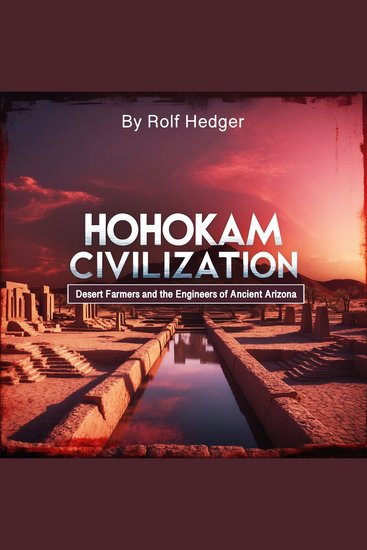
  • Hohokam Civilization - Desert Farmers and the Engineers of Ancient Arizona - cover

    Hohokam Civilization - Desert...

    Rolf Hedger

    • 0
    • 0
    • 0
    The Hohokam civilization, flourishing in the deserts of what is now southern Arizona, represents one of the most fascinating examples of ancient ingenuity in the American Southwest. Known for their advanced irrigation techniques, complex social structures, and distinctive artistic expressions, the Hohokam thrived in a harsh environment for over a thousand years. Their story provides valuable insight into human adaptability and innovation in response to challenging surroundings. 
    The origins of the Hohokam civilization are traced back to around 300 BCE, with their culture emerging as a distinct entity by approximately 600 CE. Archaeologists and researchers have found evidence of their presence in the Sonoran Desert, a region marked by intense heat and little rainfall. Despite these extreme conditions, the Hohokam were able to build thriving communities that relied heavily on farming, with maize, beans, and squash being staple crops. The Hohokam’s ability to create sustainable agricultural systems in the desert is considered one of their greatest achievements. 
    Central to the Hohokam way of life was their mastery of water management. They constructed a vast network of irrigation canals, some of which stretched for miles, to channel water from rivers into their fields. This water was crucial not only for agriculture but also for their communities' survival. The Hohokam’s innovative canal systems transformed the desert landscape, allowing them to cultivate the land and support large populations. These systems remain a testament to their engineering skills and ability to harness the natural environment for their benefit.
    Mostra libro
  • True Love - cover

    True Love

    Peter Walker

    • 0
    • 0
    • 0
    Of the billions of humans now alive and kicking, let two of them fall in love, marry, and yet it can’t stick. They chose each other, and even still…Just two can’t make ‘love’ work – not two lovers, two races, two nations, two siblings, two people. We crave to know true love. That’s the deep well of thirst in every eye, every soul. It’s not in our control, however. Our own spirits are not the source, the spring - that’s why our ‘love’ breaks down.When we see this, when we feel this, our hearts cry out to God to know true love. We need his touch, not just a story. We need the healing Spirit of God’s love, not a religion. In this short book I share with you the simple, powerful story of Jesus and his offer of God’s love and Spirit to you.
    Mostra libro
  • France’s Most Famous Palaces: The History and Legacy of Versailles the Louvre and the Tuileries - cover

    France’s Most Famous Palaces:...

    Editors Charles River

    • 0
    • 0
    • 0
    For the French, and those who study their history, Versailles is a symbol of, as Charles Dickens once put it, “the best of times…the worst of times.” It was here that the Sun King, Louis XIV, built a palace worthy of a great nation during a time when peace was, at best, short-lived. It was at Versailles that Russian Tsar Peter the Great studied the palace’s architecture and gardens so that he could recreate them in his home country. Indeed, the greatest minds and artistic geniuses of the later stages of the Renaissance came to Versailles to build and paint, and it was here that Madame de Pompadour and her successor, Madame du Barry, used their wit and beauty to charm a king into doing their bidding. 
    	France, like all European countries, has had its fair share of palaces over time, but none suffered the rise and fall of fortune like the Tuileries. Built by a widow with a flair for architecture, it grew for more than a decade, along with the royal family that it housed. Then, during the French Revolution, it fell from grace with that family and even became a sight of execution, its famous gardens providing the background for the infamous guillotine.  
    	The Louvre's very name conjures up scenes of art and elegance, and of long halls filled with beauty and people strolling through them whispering quietly among themselves about the glories they are witnessing. Even those who have never been to the Louvre know some of its most prized possessions, from ancient statues to Leonardo Da Vinci’s “Mona Lisa”. As the world’s largest museum, the Louvre is unquestionably the cultural highpoint of Paris, a city that has long been considered the cultural center of Europe. 
    Mostra libro
  • Alarms & Discursions - Reflections on Englishness and humanity - cover

    Alarms & Discursions -...

    G K Chesterton

    • 0
    • 0
    • 0
    The fragments of futile journalism or fleeting impression which are here collected are very like the wrecks and riven blocks that were piled in a heap round my imaginary priest of the sun. They are very like that grey and gaping head of stone that I found overgrown with the grass. Yet I will venture to make even of these trivial fragments the high boast that I am a medievalist and not a modern. That is, I really have a notion of why I have collected all the nonsensical things there are. I have not the patience nor perhaps the constructive intelligence to state the connecting link between all these chaotic papers. But it could be stated. This row of shapeless and ungainly monsters which I now set before the reader does not consist of separate idols cut out capriciously in lonely valleys or various islands. These monsters are meant for the gargoyles of a definite cathedral. I have to carve the gargoyles, because I can carve nothing else; I leave to others the angels and the arches and the spires. But I am very sure of the style of the architecture, and of the consecration of the church. -- From the introduction
    Mostra libro