Unisciti a noi in un viaggio nel mondo dei libri!
Aggiungi questo libro allo scaffale
Grey
Scrivi un nuovo commento Default profile 50px
Grey
Iscriviti per leggere l'intero libro o leggi le prime pagine gratuitamente!
All characters reduced
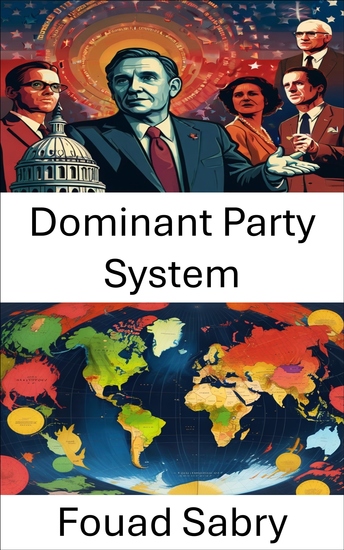
Dominant Party System - Power Persistence and Political Control - cover

Dominant Party System - Power Persistence and Political Control

Fouad Sabry

Casa editrice: One Billion Knowledgeable

  • 0
  • 0
  • 0

Sinossi

Discover the world of political dominance in Dominant Party System, an essential read in Political Science. This book delves into how a single party's sustained control shapes governance, stability, and democracy. Ideal for students, professionals, and enthusiasts, it offers deep insights into dominant party systems across nations.
 
Chapters Overview:
 
1: Explores how sustained control by one party affects political stability and democracy.
 
2: Examines Bulgaria's dominant party and its impact on governance and policy.
 
3: Analyzes dominant parties in Lithuania, focusing on political influence.
 
4: Investigates how a dominant party shapes Mauritania's governance and stability.
 
5: Discusses Mexico’s dominant party and its historical and current influences.
 
6: Looks into Romania’s political dynamics under dominant party rule.
 
7: Compares dominant and two-party systems, highlighting operational contrasts.
 
8: Studies minority governments’ interaction with dominant party systems.
 
9: Discusses national unity governments within dominant party systems.
 
10: Explores particracy and how dominant parties shape participation and representation.
 
11: Analyzes coalition governments in dominant party contexts.
 
12: Reviews the Democratic Party’s role in South Africa’s dominant party system.
 
13: Lists Mauritania’s political parties under a dominant party system.
 
14: Explores political realignment within dominant party systems.
 
15: Investigates the impact of hung parliaments on dominant party systems.
 
16: Discusses Australia’s coalition politics and its dominant party influence.
 
17: Analyzes conservative coalitions within dominant party systems.
 
18: Examines how the balance of power operates under dominant party systems.
 
19: Investigates the role of minor parties in dominant party systems.
 
20: Delves into the politics of Massachusetts under dominant party control.
 
21: Explores how landslide victories reinforce dominant party systems.
 
With real-world examples and comprehensive analysis, Dominant Party System provides a clear understanding of how political structures shape governance. This book offers practical insights into the dynamics of power and its effect on global political landscapes.
Disponibile da: 02/10/2024.
Lunghezza di stampa: 420 pagine.

Altri libri che potrebbero interessarti

  • Hidden Agendas - Secret Motives behind Outward Behavior or Actions - cover

    Hidden Agendas - Secret Motives...

    Cito Harder

    • 0
    • 0
    • 0
    Hidden agendas exist in nearly every aspect of life, shaping decisions, influencing behavior, and often determining the outcomes of interactions without those involved fully realizing it. A hidden agenda refers to a concealed motive or underlying intention that differs from what is outwardly expressed. Unlike open and transparent objectives, hidden agendas operate beneath the surface, often serving personal, financial, or strategic interests that are not explicitly stated. 
    At their core, hidden agendas stem from the fundamental human need for control, advantage, or self-preservation. People may withhold their true intentions out of fear of rejection, loss of power, or diminished influence. In many cases, hidden agendas are not inherently malicious; they can be driven by self-interest, strategic planning, or the need to protect sensitive information. However, when used manipulatively, they can undermine trust, deceive others, and lead to unethical or harmful consequences. 
    One of the key characteristics of a hidden agenda is deception or misdirection. A person or group may present one set of intentions while secretly pursuing another. This is common in politics, business, and even personal relationships, where individuals may disguise their true motivations to gain support, manipulate outcomes, or secure an advantage. For example, a corporate leader advocating for a policy change may claim it is for the benefit of employees, while in reality, it serves to increase profits or consolidate power.
    Mostra libro
  • Summary: Peril by Bob Woodward and Robert Costa - cover

    Summary: Peril by Bob Woodward...

    Scott Campbell

    • 0
    • 0
    • 0
    First-hand witnesses quickly shape  Peril to become a classic Washington study. Readers find themselves ushered into Trump’s White House, Biden’s White House, the workings of the 2020 presidential campaign, the Pentagon, and Congress. 
    The intrigue bubbles up from previously unpublished narratives about covert missions, transcripts of private talks, diaries, emails, meeting minutes, and other personal and public materials. 
    As he navigates through a bitter and inactivating partisan divide, it’s also the first look at Biden’s presidency as he confronts the most difficult challenges of his life. The one-two punch: the ongoing deadly pandemic and millions of Americans suffering from soul-crushing economic hardship, 
    The danger is heightened by previously unpublished information from covert missions, transcripts of private talks, diaries, emails, meeting minutes, and other personal and public materials that convey a previously unpublished narrative. As well, it’s the first look at Biden’s presidency as he confronts the most difficult challenges of his life: the lingering deadly pandemic and millions of Americans suffering from soul-crushing economic hardship, all while navigating through a bitter and debilitating partisan divide, an increasingly dangerous world plagued by threats and the looming, dark shadow of the two previous presidents. “We have so much to do in this winter of danger,” President Biden remarked on the eve of his inauguration, which was marred by a worrisome security scare and the prospect of domestic terrorism. “We have so much to accomplish in this winter of peril,” he said. Peril is a fascinating tale about the end of one administration and the beginning of another. Bob Woodward’s trilogy about the Trump presidency began with Fear, continued with Rage, and treks further with Peril.
    Mostra libro
  • Containing Big Tech - How to Protect Our Civil Rights Economy and Democracy - cover

    Containing Big Tech - How to...

    Tom Kemp

    • 0
    • 0
    • 0
    The path forward to rein in online surveillance, AI, and tech monopoliesTechnology is a gift and a curse. The five Big Tech companies—Meta, Apple, Amazon, Microsoft, and Google—have built innovative products that improve many aspects of our lives. But their intrusiveness and our dependence on them have created pressing threats to our civil rights, economy, and democracy.Coming from an extensive background building Silicon Valley–based tech startups, Tom Kemp eloquently and precisely weaves together the threats posed by Big Tech:• the overcollection and weaponization of our most sensitive data• the problematic ways Big Tech uses AI to process and act upon our data• the stifling of competition and entrepreneurship due to Big Tech’s dominant market positionThis richly detailed book exposes the consequences of Big Tech’s digital surveillance, exploitative use of AI, and monopolistic and anticompetitive practices. It offers actionable solutions to these problems and a clear path forward for individuals and policymakers to advocate for change. By containing the excesses of Big Tech, we will ensure our civil rights are respected and preserved, our economy is competitive, and our democracy is protected.
    Mostra libro
  • Turning Points - The Role of the State Department in Vietnam (1945–75) - cover

    Turning Points - The Role of the...

    Ambassador Thomas J. Corcoran,...

    • 0
    • 0
    • 0
    Details how the US State Department attempted, and failed, to save South Vietnam from North Vietnamese aggression and the powerful domestic political influences that ultimately led to America's defeat. 


    Ten years after the end of the American involvement in the Vietnam War, a career Foreign Service officer, Thomas J. Corcoran, set down in writing his thoughts on the history of US State Department policy during America's involvement with South Vietnam. Like many Americans of his generation, he was perplexed by the failure of America to achieve its goals in South Vietnam. As an ambassador and with over thirty years of diplomatic experience—beginning in 1948 when he was assigned to Hanoi and involving other postings in Southeast Asia—he brought to his analysis a long and rich personal experience with events in Laos, Cambodia, and Vietnam. 


    The result is a thoughtful, objective, and well-researched study that chronicles the key policy decisions made by the US State Department throughout the entire period from 1945 to 1975; decisions that ultimately led to the first war lost by the United States. In his extensive study, Corcoran does an excellent job of exposing many of the myths and falsehoods found in orthodox histories of US involvement in Vietnam.
    Mostra libro
  • Leadership from Bad to Worse - What Happens When Bad Festers - cover

    Leadership from Bad to Worse -...

    Barbara Kellerman

    • 0
    • 0
    • 0
    Leadership from Bad to Worse is about how leadership that is bad, invariably, inexorably, gets worse—unless it is somehow, by someone or something, stopped or slowed. 


    This work draws on four cases of bad leadership—two in political leadership, two in business leadership—to show how it goes from bad to worse. Kellerman finds that bad leadership and bad followership go through four phases of development: 1) Onward and Upward; 2) Followers Join In; 3) Leaders Start In; and 4) Bad to Worse. These findings correctly suggest that the book, in addition to being of theoretical interest, is of practical import. It is intended, deliberately, to serve as an early warning system. By breaking bad leadership and followership into phases—each more ominous and ultimately dangerous than the one preceding—their progression will be easier to predict and detect. And easier, therefore, to slow or, preferably, to stop before they turn toxic. 


    Bad leadership is a social disease. But unlike diseases that are physical or psychological, it remains at the margins of our collective concerns. Leadership from Bad to Worse is, then, a corrective. Knowing that bad leadership can be checked before it corrupts is knowing that bad and then worse can be, if not completely precluded, then sometimes short-circuited.
    Mostra libro
  • The Man Behind The Fascist Doctrine - cover

    The Man Behind The Fascist Doctrine

    Benito Mussolini

    • 0
    • 0
    • 0
    “It’s better to live one day as a lion than 100 years as a sheep.” 
     
    "I am the most terrible animal that's ever existed." 
     
    "Democracy is beautiful in theory; in practice, it is a fallacy. You in America will see that someday." 
     
    "It's good to trust others but, not to do so is much better." 
     
    “I feel, when we have no friends upon whom to lean, or to look for moral guidance." (Mussolini) 
     
    The Doctrine of Fascism" is an essay attributed to Benito Mussolini. In truth, the first part of the essay, entitled "Idee Fondamentali", was written by the Italian philosopher Giovanni Gentile, while only the second part is the work of Mussolini himself. 
     
    Benito Amilcare Andrea Mussolini, born on July 29, 1883, who went by the nickname “Il Duce” (“the Leader”), was a deeply unbalanced tyrannical Italian dictator who created the dreaded Fascist Party in 1919. Eventually, he held all power in Italy as the country’s prime minister from 1922 to 1943. An ardent socialist as a youth, Mussolini followed in his father's political footsteps but was expelled by the party for his overt support of World War I. As an evil dictator during World War II (even murdering his own son by lethal injection) he greatly overextended his forces and was eventually killed by his own people in Mezzegra, Italy. Here, for the first time, are the words of the great dictator himself in his twisted manifesto on the political movement he started and is still so feared to this very day. A rare audiobook adventure in politics, history, and outrage!
    Mostra libro