Unisciti a noi in un viaggio nel mondo dei libri!
Aggiungi questo libro allo scaffale
Grey
Scrivi un nuovo commento Default profile 50px
Grey
Iscriviti per leggere l'intero libro o leggi le prime pagine gratuitamente!
All characters reduced
Psychological Influence Tools - cover

Psychological Influence Tools

Forest Greenpath

Traduttore A AI

Casa editrice: Publifye

  • 0
  • 0
  • 0

Sinossi

Psychological Influence Tools explores the core principles of persuasion, emphasizing how understanding human behavior can lead to more effective and ethical communication. It dives into the psychology behind why certain messages resonate, revealing how cognitive biases and emotional responses shape our decisions. The book argues that effective persuasion isn't about manipulation but about understanding and addressing the other person's motivations and needs.

 
The book's approach is grounded in empirical evidence, drawing from psychology, social science, and communication studies. The book introduces foundational concepts like cognitive dissonance and social proof, demonstrating how these principles influence our perceptions. It then progresses to explore specific influence tools, such as framing and the use of emotional appeals, illustrating how subtle changes can dramatically alter outcomes.

 
A key focus is rapport-building, as trust is essential for lasting influence. Ultimately, the book integrates these diverse perspectives into a holistic framework for ethical persuasion, providing readers with actionable insights applicable to various real-world scenarios.
Disponibile da: 21/02/2025.
Lunghezza di stampa: 88 pagine.


Altri libri che potrebbero interessarti

  • On Account of Sex - Ruth Bader Ginsburg and the Making of Gender Equality Law - cover

    On Account of Sex - Ruth Bader...

    Philippa Strum

    • 0
    • 0
    • 0
    Before she became the "Notorious R.B.G." famous for her passionate dissents while serving as an associate justice of the United States Supreme Court, Ruth Bader Ginsburg made her most significant contributions as a lawyer who litigated cases on gender equality before the high court in the 1970s. Beginning with Reed v. Reed (1971)—for which Ginsburg wrote her first full Supreme Court brief, and which was the first time the Court held a sex-based classification to be unconstitutional—Ginsburg became known for her work on the issue of gender equality. Ginsburg established the Women's Rights Project at the ACLU in 1972 and coedited the first law school casebook on sex discrimination as a professor at Columbia Law School. 


    Drawing on interviews with RBG and those who knew her, as well as extensive knowledge of the cases themselves, Philippa Strum has provided a legal history of Ginsburg's landmark litigation on behalf of women's rights and gender equality. Those cases changed the meaning of the Fourteenth Amendment and, along with two Supreme Court cases of the 1980s and 1990s (Mississippi v. Hogan and United States v. Virginia), remain the foundation of constitutional gender jurisprudence today. On Account of Sex shows why RBG became the rock star of the legal world and gives listeners an accessible guide to these widely forgotten but momentous decisions.
    Mostra libro
  • The Greatest Mysteries of History - cover

    The Greatest Mysteries of History

    World History

    • 0
    • 0
    • 0
    Hidden in the lush vegetation of the Central American rainforest lie the remnants of the Mayan civilisation. These ruins bear witness to a thriving society that flourished for almost four millennia. Here, rulers presided over communities with millions of inhabitants, scholars developed advanced mathematical calendars, and slaves toiled to raise pyramids so towering that they surpassed even the great structures of the Egyptians. Yet, inexplicably, the Mayans vanished from their cities, and their once-mighty civilization faded into obscurity. Even now, 500 years after their downfall, archaeologists, scribes, and historians are still in pursuit of the truth behind the abrupt demise of the Mayans. 
    This mystery is just one of many that continue to elude the grasp of scientists. Despite the constant advance of modern research, the past remains steeped in myth and mystery, with innumerable questions arising from the monuments and people of ancient times. 
    World History invites you on a fascinating journey to bygone eras, allowing you to explore the greatest events in history. Take a trip back in time - to the frontlines of World War 2, to the Viking raids, and to the religious rituals of ancient Egypt. World History is for everyone who would like to know more about the exciting and dramatic events of the past.
    Mostra libro
  • Trail of Tears - A History from Beginning to End - cover

    Trail of Tears - A History from...

    Hourly History

    • 0
    • 0
    • 0
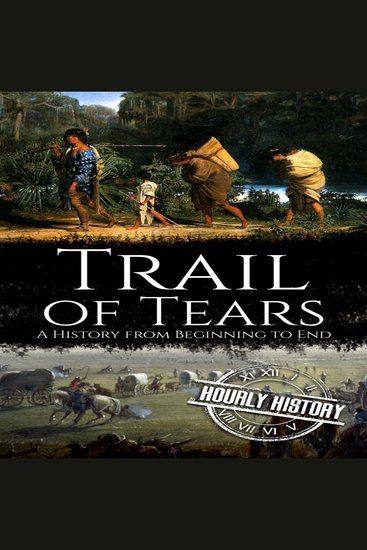
    In the early 1800s, the Five Civilized Tribes—the Cherokee, Seminole, Chickasaw, Muscogee-Creek, and Choctaw—were living in lands allocated to them by the United States government in present-day Florida, Georgia, Alabama, Mississippi, and Tennessee. In general, the Native American people lived in peace with the increasing numbers of white settlers coming to these areas, though there were occasional conflicts as settlers took lands that belonged to the tribes. 
    To many white Americans, the existence of these people in lands that could be used for the expansion of the United States was unacceptable, and many wanted the Native American to be removed and relocated to a new area, west of the Mississippi River which was not then of interest to settlers. In 1830, the administration of President Andrew Jackson signed into law a new piece of legislation, the Indian Removal Act, which gave the government the power to force these tribes to relocate to new lands in Indian Territory in present-day Oklahoma. 
    The forced relocations that followed have become known as the Trail of Tears. Some were conducted with extreme brutality, and many thousands of Native American people died as a direct result. Once they had been uprooted from their homelands, many tribes found themselves unable to continue with ways of life which they had followed for thousands of years, and the nature and character of Native American culture and society was forever changed. 
    This is an account of the privations of these forced relocations and the indifference of the U.S. government and the majority of Americans to the suffering they caused to the Native American people. This is the story of the Trail of Tears.
    Mostra libro
  • Alexander the Great - cover

    Alexander the Great

    Jacob Abbott

    • 0
    • 0
    • 0
    "Alexander the Great  was a king of the ancient Greek kingdom of Macedon. He succeeded his father Philip II to the throne in 336 BC at the age of 20 and spent most of his ruling years conducting a lengthy military campaign throughout Western Asia, Central Asia, parts of South Asia, and Egypt. By the age of 30, he had created one of the largest empires in history, stretching from Greece to northwestern India12.    Here are some key points about Alexander the Great:    Military Conquests: Alexander was undefeated in battle and is widely considered to be one of history's greatest and most successful military commanders. His campaigns included victories at Issus and Gaugamela, where he overthrew Darius III and conquered the entire Achaemenid Empire.    Education    Education: Until the age of 16, Alexander was tutored by the philosopher Aristotle.  Empire Building: He expanded his empire through relentless military campaigns, forging connections between different cultures and leaving a lasting impact on the regions he conquered.    Alexander's Balkan campaign    Legacy: Alexander's legacy extends beyond military conquests. He promoted the fusion of Greek and Persian cultures, leading to the Hellenistic period. His influence on art, architecture, and literature reverberated for centuries.    Death of Alexander the Great    Death: Alexander died in Babylon at the age of 32, leaving behind a legacy that continues to captivate historians and enthusiasts alike."
    Mostra libro
  • The Chemical Marriage - cover

    The Chemical Marriage

    Manly Palmer Hall

    • 0
    • 0
    • 0
    The self-admitted author of The Chemical Marriage, Johann Valentin Andreæ, born in Württemberg in 1586, was twenty-eight years of age when that work was first published. It was presumably written about twelve years prior to its publication--or when the author was fifteen or sixteen years old. The fact is almost incredible that one so young could produce a volume containing the wealth of symbolic thought and philosophy hidden between the lines of The Chemical Marriage. This book makes the earliest known reference to Christian Rosencreutz, and is generally regarded as the third of the series of original Rosicrucian manifestoes. As a symbolic work, the book itself is hopelessly irreconcilable with the statements made by Andreæ concerning it. The story of The Chemical Marriage relates in detail a series of incidents occurring to an aged man, presumably the Father C.R.C. of the Fama and Confessio. If Father C.R.C. was born in 1378, as stated in the Confessio, and is identical with the Christian Rosencreutz of The Chemical Marriage, he was elevated to the dignity of a Knight of the Golden Stone in the eighty-first year of his life (1459). In the light of his own statements, it is inconceivable that Andreæ could have been Father Rosy Cross.
    Mostra libro
  • Feeling Big Feeling Small - The Human Yearning for Significance and Wonder - cover

    Feeling Big Feeling Small - The...

    Arie W. Kruglanski, Sophia...

    • 0
    • 0
    • 0
    Why do we sometimes feel powerful, expansive, and driven—only to feel small, humbled, or overwhelmed moments later? This book proposes that much of human experience is shaped by a fundamental psychological rhythm between two states the authors call Bigness and Smallness. 
     
    Blending psychology with insights from biology, development, culture, religion, history, and mental health, the book introduces a theory of Dynamic Magnitude: the idea that human flourishing depends on our ability to move fluidly between striving for significance and yielding to forces greater than ourselves. Through vivid examples drawn from everyday life, art, love, parenting, politics, extremism, ritual, and belief systems, the authors show how modern societies have come to privilege Bigness while neglecting the human need for Smallness. They explore how imbalance between these states fuels burnout, polarization, addiction, anxiety, depression, and radicalization, while their healthy alternation underlies creativity, intimacy, resilience, and meaning. Rather than offering self-help prescriptions or single-factor explanations, the book provides a unifying lens that connects personal psychology with larger cultural and historical patterns. 
     
    Written for psychologists and social scientists, this book also speaks to a wider audience of intellectually curious listeners—students of culture and history, philosophers, clinicians, and thoughtful observers of contemporary life—interested in how inner experience, social forces, and meaning-making intersect.
    Mostra libro