Unisciti a noi in un viaggio nel mondo dei libri!
Aggiungi questo libro allo scaffale
Grey
Scrivi un nuovo commento Default profile 50px
Grey
Iscriviti per leggere l'intero libro o leggi le prime pagine gratuitamente!
All characters reduced
The Life of Johannes Brahms (Vol 1&2) - Complete Edition - cover

The Life of Johannes Brahms (Vol 1&2) - Complete Edition

Florence May

Casa editrice: DigiCat

  • 0
  • 0
  • 0

Sinossi

In "The Life of Johannes Brahms (Vol. 1&2)", Florence May provides an extensive and illuminating exploration of the life and works of the eminent composer, Johannes Brahms. Written with a meticulous attention to detail, May's biographical narrative seamlessly intertwines Brahms's personal experiences with his artistic evolution, encapsulating the socio-cultural landscape of the 19th century. The dual volumes employ a rich literary style that balances scholarly rigor with accessible storytelling, positioning Brahms not just as a musical genius but as a complex figure traversing the turbulent terrain of his time. Florence May, a prominent figure in the musicological community, brings her profound knowledge and passion for classical music to this extensive biography. As a Victorian-era woman, she faced the challenges of a predominantly male intellectual sphere, perhaps motivating her to delve deeply into the lives of her subjects—Brahms being a central figure in her studies. May's closeness to the artistic community of the time, alongside her literary acumen, allows her to present a deeply resonant portrait of Brahms that is both comprehensive and enlightening. For anyone interested in the intersections of art and life, May's biography of Brahms is indispensable. It offers not only a nuanced understanding of a composer whose influence endures but also a window into the cultural paradigms of an era. Readers will find themselves enriched, whether they approach from musical, historical, or literary perspectives.
Disponibile da: 16/11/2023.
Lunghezza di stampa: 525 pagine.


Altri libri che potrebbero interessarti

  • The Daughter of Lilith - From their pens to your ears genius in every story - cover

    The Daughter of Lilith - From...

    Anatole France

    • 0
    • 0
    • 0
    François-Anatole Thibault was born on the 16th April 1844 in Paris, France, the son of a bookseller and bibliophile. 
    He studied at the Collège Stanislas, a private Catholic school, and after graduating joined his father in the bookstore, which specialised in works on the French Revolution.  Several years later he secured a position as cataloguer at Bacheline-Deflorenne and at Lemerre before being appointed librarian for the French Senate in 1876. 
    His literary career had begun as a journalist and as a poet before publishing his novel ‘Le Crime de Sylvestre Bonnard’ in 1881.  Praised for its elegant prose, it won him a prestigious prize from the Académie Française, which later elected him to its storied ranks. 
    His works were profound and thoughtful and often couched in surreal and outlandish expressions; whether penguins baptized by a near-blind Abbott transformed themselves into humans or of a guardian angel who becomes an atheist, his stories turned established thought into startling literature. 
    His short stories run in the same vein.  The premise may seem plausible but his distinctive style turns them into an individual viewpoint which invokes both discussion and admiration. 
    In his private life his relationships with women were often turbulent.  A Socialist, he was a fervent supporter of the Russian Revolution and the early years of the French Communist party. 
    He was awarded the Nobel Prize in 1921 but the following year his entire canon of works was placed on the prohibited list of the Catholic Church, which he thought of as a credit to his name. 
    Anatole France died on the 12th October 1924 in Tours.  He was 80.
    Mostra libro
  • I have been the bad guy - Neuroqueer Self-Realizations in the Algorithmic Envirusment - cover

    I have been the bad guy -...

    Dr. Bernadette 'bird' Bowen

    • 0
    • 0
    • 0
    Have you ever been made to feel like the bad guy? Dr. bird has too. In this brief memoir, they reveal secrets about their life that they have kept hidden for over thirty years regarding compulsory heterosexuality, repressed/unexplored queernesses, and the late in life realization that -- turns out -- they're #actuallyautistic! Retold from their 33-year-old Dr. bird’s eye view, these extensively brave disclosures add one whole lifetime of flesh onto the U.S. body politic. This timely manuscript illuminates, historicizes, and contextualizes the f***ing fact that autism is not “just a trend” taking off just on TikTok recently, but that there are massive neuroqueer self-realizations happening worldwide in the algorithmic envirusment (environment + virus = envirusment). Dr. bird’s unmasked writing voice puts the “cut-the-shit” into “slice-of-life,” providing deep and raw disclosures of lifelong confusion, gaslighting, and struggles with family dysfunction, friendship loss, vulnerability, intimacy, sexual violence, and substance abuse. After extensive sharing, it’s time to grieve. They usher in a eulogy for their lifetimes that once were, by diagnosing how foundational U.S. ideas did and continue to dehumanize, sicken, disable, and deaden us. Then, they preach to the global choir about the single most connected time in history. Dr. bird has a lot more puns and trauma than answers, but in the end, recommends some liberatory antibodies for moving forward, far less miserably.
    Mostra libro
  • A Dead Woman's Secret - From their pens to your ears genius in every story - cover

    A Dead Woman's Secret - From...

    Guy de Maupassant

    • 0
    • 0
    • 0
    Henri René Albert Guy de Maupassant was born on August 5th, 1850 near Dieppe in France.  
    Maupassant’s early life was badly torn when at age 11 (his younger brother Hervé was then five) his mother, Laure, a headstrong and independent-minded woman, risked social disgrace in order to obtain a legal separation from her husband. 
    After the separation, Laure kept custody of her two boys. With the father now forcibly absent, Laure became the most influential and important figure in the young boy's life.   
    Maupassant’s education was such that he rebelled against religion and other societal norms but a developing friendship with Gustave Flaubert began to turn his mind towards creativity and writing. 
    After graduation he volunteered for the Franco-Prussian war. With its end he moved to Paris to work as a clerk in the Navy Department.  Gustave Flaubert now took him under his wing.  Acting as a literary guardian to him, he guided the eager Maupassant to debuts in journalism and literature.  For Maupassant these were exciting times and the awakening of his creative talents and ambitions. 
    In 1880 he published what is considered his first great work, ‘Boule de Suif’, (translated as as ‘Dumpling’, ‘Butterball’, ‘Ball of Fat’, or ‘Ball of Lard’) which met with a success that was both instant and overwhelming.  Flaubert at once acknowledged that it was ‘a masterpiece that will endure.’ Maupassant had used his talents and experiences in the war to create something unique.  
    This decade from 1880 to 1891 was to be the most pivotal of his career.  With an audience now made available by the success of ‘Boule de Suif’ Maupassant organised himself to work methodically and relentlessly to produce between two and four volumes of work a year.  The melding of his talents and business sense and the continual hunger of sources for his works made him wealthy. 
    In his later years he developed a desire for solitude, an obsession for self-preservation, and a fear of death as well as a paranoia of persecution caused by the syphilis he had contracted in his youth.  
    On January 2nd, 1892, Maupassant tried to commit suicide by cutting his throat.  Unsuccessful he was committed to the private asylum of Esprit Blanche at Passy, in Paris.  It was here on July 6th, 1893 that Henri René Albert Guy de Maupassant died at the age of only 42.
    Mostra libro
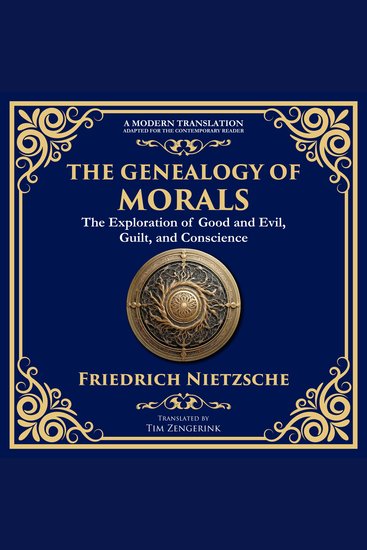
  • The Genealogy of Morals - Understanding Ethics Power and Human Nature - cover

    The Genealogy of Morals -...

    Friedrich Nietzsche, Tim Zengerink

    • 0
    • 0
    • 0
    What defines “good” and “evil”? Where do our moral values come from? How do power and societal structures shape our view of the world? 
    The Genealogy of Morals is Nietzsche’s groundbreaking analysis of morality’s origins and evolution. This modern translation offers a clearer path to understanding his profound insights, making them more accessible for real-world application. 
    More than a critique of traditional ethics, The Genealogy of Morals explores human nature, power dynamics, and the social forces that influence our values. Nietzsche encourages us to challenge long-held assumptions and embrace intellectual courage. 
    What You’ll Discover: 
    - Origins of Morality – See how historical and cultural forces have shaped our notions of right and wrong. 
    - Power and Human Nature – Understand how power dynamics affect society and learn to navigate them personally and professionally. 
    - Question Conventional Thinking – Free yourself from restrictive norms and expand your perspective. 
    - Philosophy for Modern Challenges – Apply Nietzsche’s ideas to inform decisions, overcome obstacles, and inspire personal growth. 
    Imagine gaining the clarity to question societal expectations, the courage to challenge outdated beliefs, and the insight to discover your true self. The Genealogy of Morals has inspired generations of thinkers—now it’s your turn. 
    Begin your journey into morality, power, and freedom. Get your copy today and unlock the transformative wisdom that could forever change your perspective on the world.
    Mostra libro
  • A Piece of Steak - American author of The Call Of The Wild & White Fang brings a biting story about a poverty stricken aging boxer and his plight - cover

    A Piece of Steak - American...

    Jack London

    • 0
    • 0
    • 0
    John Griffith Chaney was born on January 12th, 1876 in San Francisco.   
     
    His father, William Chaney, was living with Flora Wellman when she became pregnant.  Chaney insisted she have an abortion.  Flora's response was to turn a gun on herself.  Although her wounds were not severe the trauma made her temporarily deranged. 
     
    In late 1876 his mother married John London and the young child was brought to live with them as they moved around the Bay area, eventually settling in Oakland where now, calling himself Jack, he completed grade school. 
     
    Jack worked hard at several jobs, sometimes 12-18 hours a day, but his dream was university.  He studied hard and borrowed the money to enrol in the summer of 1896 at the University of California in Berkeley. 
     
    In 1897, at 21, Jack searched out newspaper accounts of his mother's suicide attempt and for the name of his biological father. He wrote to Chaney, then living in Chicago, who claimed he could not be Jack’s father because he was impotent and casually asserted that London's mother had relations with other men.  Jack, devastated by the response, quit Berkeley and went to the Klondike. Other accounts suggest that his dire finances presented Jack with the excuse he needed to leave. 
     
    In the Klondike Jack began to gather material for his writing but also accumulated many health problems, including scurvy, which together with hip and leg problems he would carry for the rest of his life. 
     
    During the late 1890's Jack was regularly publishing short stories and by the turn of the century full blown novels. 
     
    By 1904 Jack had married, fathered two children and was now in the process of divorcing.  A stint as a reporter on the Russo-Japanese war of 1904 was equal amounts trouble and experience. But that experience was always put to good use in a continuing and remarkable output of work. 
     
    In 1905 he married Charmian Kittredge who at last was a soul and companion who brought him some semblance of peace despite his advancing alcoholism and his incurable wanderlust. 
     
    Twelve years later Jack had amassed both wealth and a literary reputation through such classics as ‘The Call of the Wild’, ‘White Fang’ and many others. He had a reputation as a social activist and was a tireless friend of the workers.   
     
    Jack London died suffering from dysentery, late-stage alcoholism and uremia, aged only 40, on November 22nd 1916 at his property in Glen Elen in California 
     
    In ‘A piece of Steak’ an ageing prizefighter seeks one last win. Not for glory, or to revisit fame, but simply to put food on the table and keep his family together.  But to do that he must beat a highly rated up and coming adversary.
    Mostra libro
  • Pancho Villa - The Bandit That Fought in the Mexican Revolution - cover

    Pancho Villa - The Bandit That...

    Kelly Mass

    • 0
    • 0
    • 0
    Francisco Villa, better known as Pancho Villa, was a key figure in the Mexican Revolution, known for his transformation from a bandit to one of the revolution’s most influential commanders. Villa’s rise to prominence in the early 20th century marked him as a central player in the violent upheavals that reshaped Mexico’s political landscape. In 1911, Villa became a significant actor in the revolutionary violence that led to the overthrow of President Porfirio Díaz, ushering in Francisco I. Madero’s government. Villa, initially a leader of outlaw groups, aligned himself with Madero’s revolutionary cause, contributing to the instability that culminated in the fall of Díaz’s long-standing dictatorship. 
    The power dynamics in the revolution shifted again when General Victoriano Huerta attempted a right-wing coup in February 1913. As Madero’s government crumbled under Huerta’s forces, Madero led anti-Huerta soldiers in the Constitutionalist Army from 1913 to 1914. The civilian governor of Coahuila, Venustiano Carranza, became the leader of this anti-Huerta coalition. After Huerta’s eventual defeat and exile in July 1914, Villa and Carranza began to diverge politically. Villa, alongside other revolutionary leaders, assembled a gathering of generals in a bid to form a new government, but the resulting coalition was weak and inefficient. Though Villa and Emiliano Zapata, another revolutionary leader, were formally allied during this period, their partnership was largely theoretical. Both men supported land reform, but Villa’s reforms remained unrealized during his tenure of influence.
    Mostra libro