Unisciti a noi in un viaggio nel mondo dei libri!
Aggiungi questo libro allo scaffale
Grey
Scrivi un nuovo commento Default profile 50px
Grey
Iscriviti per leggere l'intero libro o leggi le prime pagine gratuitamente!
All characters reduced
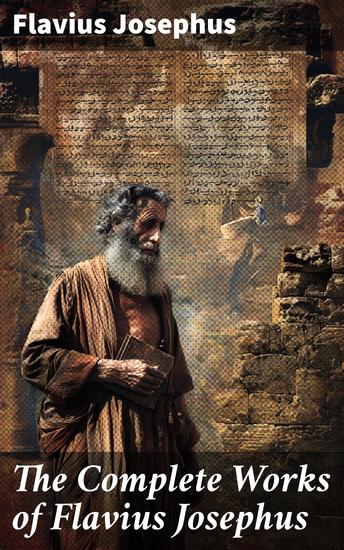
The Complete Works of Flavius Josephus - Enriched edition Exploring Ancient Jewish Customs and Beliefs in the First Century AD - cover

The Complete Works of Flavius Josephus - Enriched edition Exploring Ancient Jewish Customs and Beliefs in the First Century AD

Flavius Josephus

Traduttore William Whiston

Casa editrice: Good Press

  • 0
  • 0
  • 0

Sinossi

Flavius Josephus's "The Complete Works of Flavius Josephus" presents a comprehensive compilation of his historical writings, which serve as crucial primary sources for understanding Jewish history, culture, and the tumultuous events surrounding the First Jewish-Roman War. The literary style is characterized by a blend of rich narrative and scholarly exposition, navigating the complexities of Jewish identity in the Hellenistic world. Josephus employs a sophisticated rhetorical approach, interweaving personal reflection and detailed observation, thus grounding his accounts in a deeply felt historical consciousness. His works reflect the broader socio-political tensions of the time, offering insights into both Jewish traditions and Roman governance. Josephus, born in 37 CE, was a Jewish priest and soldier who became a Roman citizen after failing to quell the Jewish revolt. His dual identity enables him to provide a unique perspective on the struggles between the Jewish population and Roman authority. His experiences during the siege of Jerusalem and subsequent capture profoundly influenced his writings, enhancing their emotional depth and urgent relevance. By blending personal narrative with historical analysis, Josephus sought to advocate for his people while navigating the complexities of his allegiance to Rome. For scholars and general readers alike, "The Complete Works of Flavius Josephus" is an indispensable resource that invites a deeper appreciation of the intricate tapestry of ancient history. Engaging with Josephus's nuanced perspectives allows readers to become intimately acquainted with the perennial themes of faith, identity, and conflict, making this collection a vital addition to any historical or literary exploration.

In this enriched edition, we have carefully created added value for your reading experience:
- A comprehensive Introduction outlines these selected works' unifying features, themes, or stylistic evolutions.
- The Author Biography highlights personal milestones and literary influences that shape the entire body of writing.
- A Historical Context section situates the works in their broader era—social currents, cultural trends, and key events that underpin their creation.
- A concise Synopsis (Selection) offers an accessible overview of the included texts, helping readers navigate plotlines and main ideas without revealing critical twists.
- A unified Analysis examines recurring motifs and stylistic hallmarks across the collection, tying the stories together while spotlighting the different work's strengths.
- Reflection questions inspire deeper contemplation of the author's overarching message, inviting readers to draw connections among different texts and relate them to modern contexts.
- Lastly, our hand‐picked Memorable Quotes distill pivotal lines and turning points, serving as touchstones for the collection's central themes.
Disponibile da: 16/11/2023.
Lunghezza di stampa: 2196 pagine.

Altri libri che potrebbero interessarti

  • Royal Navy Versus the Slave Traders - Enforcing Abolition at Sea 1808–1898 - cover

    Royal Navy Versus the Slave...

    Bernard Edwards

    • 0
    • 0
    • 0
    On 16 March 1807, the British Parliament passed The Abolition of the Slave Trade Act. In the following year the Royal Navy's African Squadron was formed, its mission to stop and search ships at sea suspected of carrying slaves from Africa to the Americas and the Middle East. With typical thoroughness, the Royal Navy went further, and took the fight to the enemy, sailing boldly up uncharted rivers and creeks to attack the barracoons where the slaves were assembled ready for shipment. 


    For much of its long campaign against the evil of slavery, Britain's Navy fought alone and unrecognized. Its enemies were many and formidable. Ranged against it were the African chiefs, who sold their own people into slavery, the Arabs, who rode shotgun on the slave caravans to the coast, and the slave ships of the rest of the world, heavily armed, and prepared to do battle to protect their right to traffic in the forbidden so-called "black ivory." 


    The war was long and bitter and the cost to the Royal Navy in ships and men heavy, but the result was worthy of the sacrifices made. The abolition of the slave trade led to a scramble for empires and, in place of slaves, Africa began to export cocoa, coffee, timber, palm oil, cotton and ores, all very much in demand in the West.
    Mostra libro
  • Your Coping Skills Aren't Working - How to Break Free from the Habits That Once Helped You But Now Hold You Back - cover

    Your Coping Skills Aren't...

    LCSW Richard Brouillette, LCSW...

    • 0
    • 0
    • 0
    It's time to move beyond the self-destructive coping "skills" that hold you back! 


    The coping styles we develop in childhood are often the result of stressful or traumatic experiences. And while they once worked to keep us feeling safe, they do not serve us well in adulthood. This guide offers an innovative and evidence-based approach grounded in cognitive behavioral therapy, schema therapy, and attachment theory to help you break free from the coping habits that keep you stuck in a cycle of self-sabotaging negative thoughts and behaviors. 


    In this book, you'll identify the maladaptive coping patterns you developed in childhood, understand why you developed them, and learn how to change those destructive habits standing between you and a happier life. You'll also discover powerful strategies to help you give voice to your unmet needs; and learn to cultivate clarity, security, and confidence in yourself and what you need. 


    Dysfunctional coping styles are often the relics of damaging childhood experiences. With this guide, you can finally get unstuck from the habits that hinder your personal growth, get in the way of healthy relationships, and keep you from reaching your highest potential.
    Mostra libro
  • The poetics of Aristotle - cover

    The poetics of Aristotle

    Aristotle

    • 0
    • 0
    • 0
    "The Poetics" is a book written by the ancient Greek philosopher Aristotle, which is believed to have been composed around 335 BCE. The book is an important work of literary criticism and is considered one of the earliest surviving discussions of dramatic theory. 
    In "The Poetics," Aristotle explores the nature of tragedy and offers insights into the elements that make up successful works of literature, such as plot, character, language, and spectacle. He discusses the purpose and function of tragedy, and argues that its ultimate goal is to elicit a cathartic response in the audience. 
    Aristotle's ideas on the principles of drama and the nature of tragedy have had a profound impact on Western literary theory and have influenced the works of countless writers, playwrights, and critics over the centuries.
    Mostra libro
  • Genius of Home The: Teaching Your Children at Home with the Waldorf Curriculum - cover

    Genius of Home The: Teaching...

    PhD Catherin Read

    • 0
    • 0
    • 0
    To instruct means to draw forward; the educator should draw forward, be that as it may, likewise, should meet the new person at her or his own level. Be that as it may, what does the instructor draw forward from the youngster? Is the educator like the sun that draws forward the plants? Youngsters in all actuality do grow up, and yet, they descend. Imagine a scenario in which one is showing one's own kids. 
    There are as numerous potential ways to deal with showing kids at home, that is to say, "self-teaching", as there are homes and families who decide to adopt up this individualized strategy to training. Catherine Read decided to display her School-at-Home on the educational plan utilized in Waldorf schools. 
    This book is the narrative of her excursion as the essential instructor of her two girls through the Waldorf educational program from youth through secondary school grade eleven: what she did, when she did it, and why. 
    En route, this adaptable, imaginative, testing, and eventually remunerating way to deal with instruction comes into the center. Rousing and educational, the record of her years as both parent and instructor will be an aid to anybody considering establishing their own School-at-Home.
    Mostra libro
  • Freyja - An Illustrated Guide to the Goddess of Magic Love and War - cover

    Freyja - An Illustrated Guide to...

    L. Dean Lee

    • 0
    • 0
    • 0
    Learn more about Freyja, the revered Seid-speaker, prosperity-giver, and lady of the Slain, and explore the wyrd world of Norse mythology with this beautifully illustrated guide as your companion.   This is a culturally informed introduction to Freyja, the Norse goddess of love, war, and sensuality, and one of the most highly revered figures in Nordic folklore.  Discover who Freyja is, what her origins as a deity are, her personality, and her associations.  Explore the role of mythology in pre-Chrisitan Viking and Norse life, its survival in folklore, and how its significance continues in modern times.  Learn more about the Norse cosmos and gain an understanding of the different beings, realms, and gods that inhabit it.  Dive into the captivating stories surrounding Freyja as she tricks, barters, and beguiles until the grisly events of Ragnarok.  Receive expert guidance from a practicing Norse Heathen on how to interact with and venerate Freyja with offerings and altars.  Discover how Freyja uses her wits in her dealings with gods and men and how she looks after those who have been slain in battle. Along the way, you will learn about all the enchanting beings and realms of Norse cosmology.   Written by practicing Norse Heathen L. Dean Lee and illustrated by The Saxon Storyteller, this guide covers Freyja not only in ancient times, but through the ages, sharing how she became one of the most venerated mythological goddesses.
    Mostra libro
  • Sumerians - The History of Sumerian and Hittite Nations (2 in 1) - cover

    Sumerians - The History of...

    Kelly Mass

    • 0
    • 0
    • 0
    This book contains 2 topics, which are: 
    1 - Sumerians: The Sumerians were the people from Sumer, the first recognized society in the historic area of southern Mesopotamia (now southern Iraq), developed throughout the 6th and 5th centuries BC throughout the Chalcolithic and early Bronze Ages. In addition to age-old Egypt, the Caral-Supe culture, the Indus Valley civilization, the Minoan civilization, and age-old China, it is also one of the world's early civilizations. Sumerian farmers who lived along the Tigris and Euphrates valleys grew a great deal of grain and other items, which allowed them to establish metropolitan towns. Before 3000 BC, there was proto-writing. The earliest files date from between 3500 and 3000 BC and are from the cities of Uruk and Jemdet Nasr. 
    2 - Hittites: The Hittites were mentioned in the Bible. They were an Anatolian people that contributed to creating a kingdom in Kussara before 1750 BC, the Kanesh or Nesha kingdom between 1750 and 1650 BC, and finally an empire based upon Hattusa in north-central Anatolia around 1650 BC. Under uppiluliuma I, the empire reached its peak in the mid-14th century BC, when it ruled over much of Anatolia and areas of the northern Levant and Upper Mesopotamia. 
    Between the 15th and 13th centuries BC, the Hattusa Empire, also called the Hittite Empire, defended control of the Near East with the New Kingdom of Egypt, the Middle Assyrian Empire, and the Mitanni Empire. The Middle Assyrian Empire ultimately emerged as the dominant power, took much of the Hittite Empire, and ransacked the rest by Phrygian newbies to the area. The Hittites separated into numerous self-governing Syro-Hittite countries around c. 1180 BC, at the time of the Late Bronze Age collapse, some of which stayed till the 8th century BC before giving up to the Neo-Assyrian Empire.
    Mostra libro