Join us on a literary world trip!
Add this book to bookshelf
Grey
Write a new comment Default profile 50px
Grey
Subscribe to read the full book or read the first pages for free!
All characters reduced
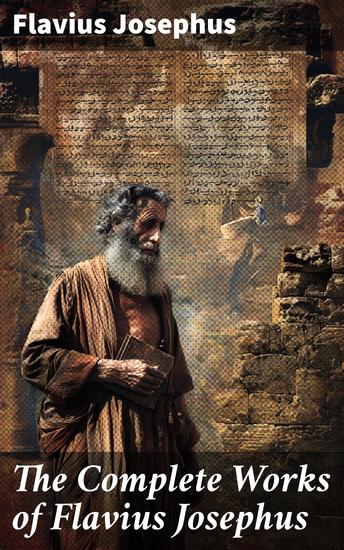
The Complete Works of Flavius Josephus - Enriched edition Exploring Ancient Jewish Customs and Beliefs in the First Century AD - cover

The Complete Works of Flavius Josephus - Enriched edition Exploring Ancient Jewish Customs and Beliefs in the First Century AD

Flavius Josephus

Translator William Whiston

Publisher: Good Press

  • 0
  • 0
  • 0

Summary

Flavius Josephus's "The Complete Works of Flavius Josephus" presents a comprehensive compilation of his historical writings, which serve as crucial primary sources for understanding Jewish history, culture, and the tumultuous events surrounding the First Jewish-Roman War. The literary style is characterized by a blend of rich narrative and scholarly exposition, navigating the complexities of Jewish identity in the Hellenistic world. Josephus employs a sophisticated rhetorical approach, interweaving personal reflection and detailed observation, thus grounding his accounts in a deeply felt historical consciousness. His works reflect the broader socio-political tensions of the time, offering insights into both Jewish traditions and Roman governance. Josephus, born in 37 CE, was a Jewish priest and soldier who became a Roman citizen after failing to quell the Jewish revolt. His dual identity enables him to provide a unique perspective on the struggles between the Jewish population and Roman authority. His experiences during the siege of Jerusalem and subsequent capture profoundly influenced his writings, enhancing their emotional depth and urgent relevance. By blending personal narrative with historical analysis, Josephus sought to advocate for his people while navigating the complexities of his allegiance to Rome. For scholars and general readers alike, "The Complete Works of Flavius Josephus" is an indispensable resource that invites a deeper appreciation of the intricate tapestry of ancient history. Engaging with Josephus's nuanced perspectives allows readers to become intimately acquainted with the perennial themes of faith, identity, and conflict, making this collection a vital addition to any historical or literary exploration.

In this enriched edition, we have carefully created added value for your reading experience:
- A comprehensive Introduction outlines these selected works' unifying features, themes, or stylistic evolutions.
- The Author Biography highlights personal milestones and literary influences that shape the entire body of writing.
- A Historical Context section situates the works in their broader era—social currents, cultural trends, and key events that underpin their creation.
- A concise Synopsis (Selection) offers an accessible overview of the included texts, helping readers navigate plotlines and main ideas without revealing critical twists.
- A unified Analysis examines recurring motifs and stylistic hallmarks across the collection, tying the stories together while spotlighting the different work's strengths.
- Reflection questions inspire deeper contemplation of the author's overarching message, inviting readers to draw connections among different texts and relate them to modern contexts.
- Lastly, our hand‐picked Memorable Quotes distill pivotal lines and turning points, serving as touchstones for the collection's central themes.
Available since: 11/16/2023.
Print length: 2196 pages.


Other books that might interest you

  • The Art of War - cover

    The Art of War

    Sun Tzu

    • 0
    • 0
    • 0
    The Art of War is an ancient Chinese military treatise dating from the late Spring and Autumn Period (roughly 5th century BC). The work, which is attributed to the ancient Chinese military strategist Sun Tzu, is composed of 13 chapters. Each one is devoted to a different set of skills or art related to warfare and how it applies to military strategy and tactics.  
    The Art of War remains the most influential strategy text in East Asian warfare, has influenced both East Asian and Western military theory and thinking, and has found a variety of applications in a myriad of competitive non-military endeavors across the modern world including espionage, culture, politics, business, and sports. 
    Considered one of history's finest military tacticians and analysts, his teachings and strategies formed the basis of advanced military training throughout the world.
    Show book
  • Indie Author Blueprint The: Build Publish and Thrive - cover

    Indie Author Blueprint The:...

    Billy Grady

    • 0
    • 0
    • 0
    Indie publishing isn’t just a backup plan—it’s a revolution. 
    With the right strategy, independent authors can build thriving careers, reach global readers, and keep full control of their creative vision. The Indie Author Blueprint is your step-by-step guide to making it happen. 
    In this comprehensive roadmap, bestselling author and publishing coach Billy Grady reveals how to: 
    - Build your author brand and create a professional presence from day one 
    - Publish with confidence, from formatting and cover design to distribution platforms 
    - Market your books effectively, using smart tactics that actually sell 
    - Grow multiple income streams for a sustainable, long-term career 
    Packed with actionable strategies, insider insights, and inspiring success stories, The Indie Author Blueprint gives you everything you need to launch—and thrive—as a modern independent author. 
    Your publishing dreams don’t need permission. 
    This is your blueprint to make them real.
    Show book
  • Carolingian Empire - The Influence and Expansion of the Franks during the Middle Ages - cover

    Carolingian Empire - The...

    Kelly Mass

    • 0
    • 0
    • 0
    The Carolingian Empire, which existed from 800 to 888, was a dominant force in western and central Europe during the early Middle Ages. Founded by the Carolingian dynasty, this empire emerged from the Frankish kingdom, which had been ruled by this lineage since 751 and included control over the Lombards in Italy starting in 774. The empire's significance was amplified when Pope Leo III crowned Charlemagne, the Frankish king, as emperor in Rome on Christmas Day in 800, marking a pivotal moment in the attempt to reestablish a western counterpart to the Roman Empire. This event not only solidified Charlemagne's power but also laid the groundwork for what would eventually become the Holy Roman Empire. 
    At its zenith, the Carolingian Empire stretched across a vast expanse, covering approximately 1,112,000 square kilometers (429,000 square miles) and supporting a population estimated between 10 to 20 million people. Charlemagne's reign was characterized by military conquests, administrative reforms, and cultural revival, known as the Carolingian Renaissance, which fostered the preservation and promotion of learning and the arts. 
    However, the empire faced challenges after the death of Emperor Louis the Pious in 840. A civil war erupted among his heirs, leading to the Treaty of Verdun in 843, which partitioned the empire into three distinct kingdoms. Although one monarch was still recognized as emperor, his authority was significantly limited, confining his power mainly to his own realm. This division undermined the unity that Charlemagne had worked hard to establish.
    Show book
  • The Art of Delivery - The Inside Story of How the Blair Government Transformed Britain's Public Services - cover

    The Art of Delivery - The Inside...

    Michelle Clement

    • 0
    • 0
    • 0
    The Art of Delivery ventures inside 10 Downing Street at the turn of the millennium to unveil how Tony Blair's government successfully transformed the public services we value most.
    Though the Blair government had a huge mandate, there remained fundamental challenges to success – not least the Blair–Brown rivalry, which manifested itself in a proxy war over the direction of public service reform. Nevertheless, over four years, the Prime Minister's Delivery Unit, led by Sir Michael Barber, upgraded the way in which the British government implemented improvements to the NHS and the education system. It also represented a watershed for how Prime Ministers engage with the real-world delivery of their priorities.
    Until now, much of this narrative has remained untold. Based on brand-new research and analysis, Michelle Clement uncovers the full story, drawing on 600,000 words of Sir Michael Barber's unpublished, handwritten private diaries as well as exclusive interviews and government papers. Filled with revealing insider detail, this is a human account of what it takes to effect change from behind that famous black door.
    Show book
  • So Who is God Anyway? - An (UN)orthodox Theory for Doubters Skeptics and Recovering Fundamentalists - cover

    So Who is God Anyway? - An...

    G.S. Payne

    • 0
    • 0
    • 0
    "Boldly blows the lid off a taboo topic. If there’s one book on God to read this year, please make it ‘So Who is God Anyway?’ by G.S. Payne.” —Reader Views 
    "A well-written and convincing rumination on the divine." --Kirkus Reviews 
    GS Payne, writer, sleuth, and eternally curious ruminator, investigates 2,500 years-plus of philosophical thought on the subject of God. Using the tools of the philosopher (and a lot of humor), Payne traces the thinking of history's greatest brains to arrive initially at a conclusion on the matter of God's existence; then, a philosophical conception of God that is no less than startling, first because it is nothing like the traditional conception of God (he of the beard and sandals on his throne in the sky), and, second, because it is a conception that not only goes back to the beginning of recorded time, but is recognized by every major religion on earth, and yet has been tragically relegated to the fringes by the louder, more fundamentalist branches of mainstream religion. 
    So Who is God, Anyway? delivers splendidly-for doubters, skeptics, recovering fundamentalists, or anyone looking for a fun book to read about some damn big questions!
    Show book
  • Meditations - cover

    Meditations

    Marcus Aurelius

    • 0
    • 0
    • 0
    Brought to you by Altrusian Grace Media and narrated by Matthew Schmitz. 
    Meditations is a series of personal writings by Marcus Aurelius, Roman Emperor from AD 161 to 180, recording his private notes to himself and ideas on Stoic philosophy. 
    Marcus Aurelius wrote the 12 books of the Meditations in Koine Greek as a source for his own guidance and self-improvement. It is possible that large portions of the work were written at Sirmium, where he spent much time planning military campaigns from 170 to 180. Some of it was written while he was positioned at Aquincum on campaign in Pannonia, because internal notes reveal that the first book was written when he was campaigning against the Quadi on the river Granova (modern-day Hron in Slovakia) and the second book was written at Carnuntum. 
    It is unlikely that Marcus Aurelius ever intended the writings to be published. The work has no official title, so "Meditations" is one of several titles commonly assigned to the collection. These writings take the form of quotations varying in length from one sentence to long paragraphs.
    Show book