¡Acompáñanos a viajar por el mundo de los libros!
Añadir este libro a la estantería
Grey
Escribe un nuevo comentario Default profile 50px
Grey
Suscríbete para leer el libro completo o lee las primeras páginas gratis.
All characters reduced
Inside the Montreal Mafia - The Confessions of Andrew Scoppa - cover

Inside the Montreal Mafia - The Confessions of Andrew Scoppa

Félix Séguin, Eric Thibeault

Traductor Julia Jones

Editorial: ECW Press

  • 0
  • 1
  • 0

Sinopsis

National Bestseller
		 
“Inside the Montreal Mafia is an entertaining, illuminating, and often sobering look at the downfall of the Rizzuto crime family … Highly readable and engaging.” — Montreal Review of Books
		 
A groundbreaking, exclusive inside look at the North American Mafia and the Rizzuto family
		 
For the first time in Canadian history, a high-ranking mafioso agreed to break the code of omertà by talking to journalists. From October 2014 to October 2019, Félix Séguin and Eric Thibault held multiple secret meetings with Andrew Scoppa, getting an exclusive inside look at the inner workings of the North American Mafia. This book is the culmination of their perilous investigation. It sheds light on the life — and death — of one of the most influential organized crime figures in recent years.
		 
At exactly 2 p.m., there was a knock at the door. It was him: the source every journalist dreamed of having. The short man was armed and placed his gun on a table.
		 
“Are you impressed?” he asked with a broad grin.
		 
“Yes. Very much.”
		 
Before me was Andrew Scoppa, close confidant of the late mafia boss Vito Rizzuto, international heroin trafficker and cold-blooded killer.
Disponible desde: 07/06/2022.
Longitud de impresión: 240 páginas.

Otros libros que te pueden interesar

  • Short Nonfiction Collection Vol 021 - cover

    Short Nonfiction Collection Vol 021

    Various

    • 0
    • 0
    • 0
    A collection of short nonfiction works in the public domain.  The selections included in this collection were independently chosen by the readers, and the topics encompass history, war, farming, slavery, education, philosophy, and nature. (summary by J. M. Smallheer)
    Ver libro
  • Ode to Bahá'u'lláh An - cover

    Ode to Bahá'u'lláh An

    Nabíl-i-A'zam

    • 0
    • 0
    • 0
    LibriVox volunteers bring you 8 recordings of An Ode to Bahá'u'lláh by  Nabíl-i-A'zam (Mullá Muhammad Zarandí). This was the Weekly Poetry project for February 21st, 2010.Mullá Muhammad-i-Zarandí (29 July 1831 – 1892), more commonly known as Nabíl-i-A`zam or Nabíl-i-Zarandí, was an eminent Bahá'í historian during the time of Bahá'u'lláh, and one of the nineteen Apostles of Bahá'u'lláh. He is most famous for authoring The Dawn-breakers, which stands out as one of the most important and extensive accounts of the ministry of the Báb. Besides writing a lengthy history of the Bahá'í Faith, he wrote poetry about the historical events of the religion, which he would send to the Bahá'ís of Iran. He learned about the Bábí Faith at the age of 16 and met Bahá'u'lláh in 1851. He made several journeys on behalf of Bahá'u'lláh, was imprisoned in Egypt and is the only person known to have made the two pilgrimages to the House of the Báb in Shíráz and the House of Bahá'u'lláh in Baghdád in accordance with the rites set out by Bahá'u'lláh. After the passing of Bahá'u'lláh, and at the request of `Abdu'l-Bahá, he arranged a Tablet of Visitation from Bahá'u'lláh's writings which is now used in the Holy Shrines. Shortly afterwards, overcome with grief, he walked into the sea and drowned. (Summary from Wikipedia)
    Ver libro
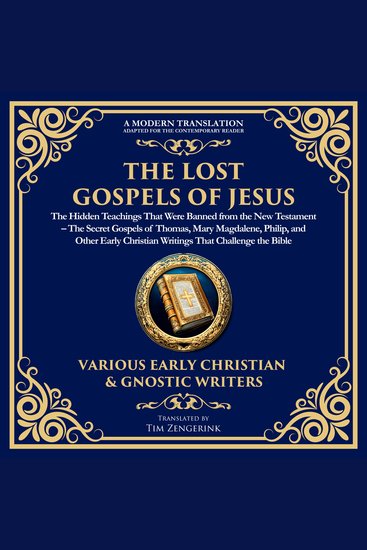
  • Lost Gospels of Jesus The: The Hidden Teachings That Were Banned from the New Testament - The Secret Gospels of Thomas Mary Magdalene Philip and Other Early Christian Writings That Challenge the Bible - cover

    Lost Gospels of Jesus The: The...

    Early Christian Scribes, Tim...

    • 0
    • 0
    • 0
    What if there was a book that revealed the hidden teachings of Jesus, the lost words of his earliest followers, and the alternative gospels that challenge our understanding of the New Testament? 
    The Lost Gospels of Jesus brings together early Christian writings that were excluded from the Bible and nearly erased from history.  
    These powerful texts offer alternative views of Jesus' life and mission, along with insights into the beliefs and struggles of the earliest Christian communities. 
    This modern translation makes these lost writings accessible to today’s listener while preserving their spiritual and historical depth. 
    Included Texts: 
    •	The Epistles of Ignatius – Letters on faith, persecution, and unity 
    •	The Epistle of Polycarp – Endurance and spiritual devotion 
    •	The Martyrdom of Polycarp – One of the earliest Christian martyr stories 
    •	The Fragments of Papias – Oral traditions about Jesus and his apostles 
    •	The Epistle of James – Practical guidance for righteous living 
    •	The Source “Q” – Sayings of Jesus used in Matthew and Luke 
    •	The Epistle to the Laodiceans – A mysterious Pauline letter 
    •	3 Corinthians – A lesser-known expansion of Paul’s message 
    •	The Gospel of the Ebionites – A Jewish-Christian gospel with a unique view of Jesus 
    •	The Infancy Gospel of Thomas – Stories of Jesus’ childhood 
    •	The Protoevangelium of James – A narrative of Mary’s early life 
    These texts shed light on lost teachings, early debates, and the rich diversity of belief in early Christianity. Discover the forgotten voices that continue to challenge and inspire. 
    Begin your journey today.
    Ver libro
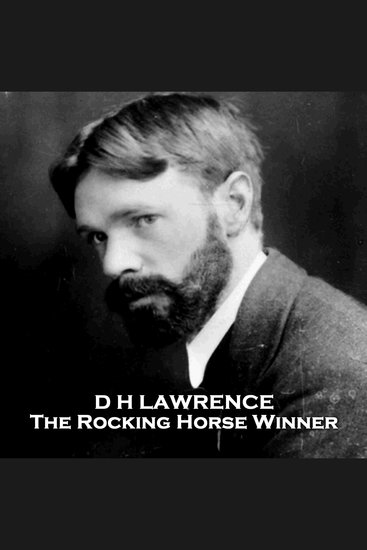
  • The Rocking Horse Winner - From their pens to your ears genius in every story - cover

    The Rocking Horse Winner - From...

    D H Lawrence

    • 0
    • 0
    • 0
    David Herbert Lawrence was born on the 11th September 1885 in Eastwood, Nottinghamshire, a coal mining town where the reality of a harsh life was only useful as experiences for future literary works. 
    He was educated at Beauvale Board School and became the first local boy to receive a scholarship to attend Nottingham High School. After 3 years he became a junior clerk in Haywood’s surgical appliances factory. He was also attempting a literary career which, in the short term, led to a teacher training position in Eastwood and later a teaching qualification from University College, Nottingham.  
    Lawrence’s first efforts were poems, short stories and a draft of ‘The White Peacock’. Moving to London and a teaching position in Croydon his writing attracted the attention of Ford Madox Ford, editor of The English Review, and he commissioned him to write ‘Odour of Chrysanthemums’.  
    Wanting to write full-time he now began work on what would become ‘Sons and Lovers.   
    In 1912 he met the older and married mother-of-three Frieda Weekley. They eloped to Germany and here Lawrence could see for himself the growing tensions with France.  So keen was his interest that he was arrested and accused of being a British spy.  
    In early 1914 Frieda obtained her divorce and they returned to Britain to be married just days before the outbreak of war. Owing to her German parentage, and his own public dislike of militarism and violence, the couple were treated with contempt and suspicion throughout the war years.  
    Despite this he continued to write but his reputation in England was so tarnished and, mirrored by his own disdain for the country, he and Frieda left England in November 1919, first for Europe and then America via Ceylon and Australia. 
    They bought a ranch in Taos, New Mexico and visited Mexico several times. The third visit in March 1925 caused a near fatal attack of malaria. To convalesce they moved to Florence. Here he continued work on ‘Lady Chatterley’s Lover’ which for many years would cause controversy. A renewed interest in oil painting resulted in an exhibition in 1929 which was raided by the police and several works were confiscated.  
    D H Lawrence died of complications arising from a bout of tuberculosis on the 2nd of March 1930 in Vence, France.  He was 44.
    Ver libro
  • Carry on Jeeves and Right Ho Jeeves - TWO PG Wodehouse Classics! - Unabridged - cover

    Carry on Jeeves and Right Ho...

    P. G. Wodehouse

    • 0
    • 0
    • 0
    P.G. Wodehouse, the master of British humor, produced dozens of books and hundreds of short stories in his long and prolific career. But none of his creations has quite captured the world's imagination as much as his bumbling, empty-headed, man-about-town Bertie Wooster and Bertie's faithful, knight-in-shining tuxedo Jeeves.  Collected here are two of Wodehouse's most beloved "Jeeves and Wooster" creations - ten short stories from the anthology "Carry On, Jeeves" and the complete novel "Right Ho, Jeeves" - each a master class in comedic writing. Along with Jeeves and Bertie, we are introduced to an entire cast of beloved Wodehouse characters: Bingo Little, James "Corky" Corcoran, Honoria Glossop, Rockmetteller Todd and the terrifying and bombastic Aunt Agatha.  These two books are presented here in their original and unabridged form.
    Ver libro
  • Was Muhammad Crazy? - cover

    Was Muhammad Crazy?

    Frédéric Joy

    • 0
    • 0
    • 0
    Through a careful psychological re-reading of the Qur'an and other biographical sources about Muhammad, the author identifies the pathological symptoms of the prophet of Islam. His diagnosis is unambiguous: the man suffered from a querulous paranoia with dissociative identity disorder. 
    The author shows that Mohammed identified himself with previous prophets (Jesus and Moses in particular), whom he plagiarized. Adapting their words and deeds to the culture of the Arab world, he imposed these new doctrines on his people primarily through direct aggression and political manipulation. Yet, Islam was phenomenally successful during his lifetime and over the centuries. 
    At this point, another question arises: How did Muhammad manage to convince the masses? The author then analyzes the personality of the submissive people and the success of this religion through the centuries. The author also deconstructs all the scientific and philosophical presuppositions behind the Muslim religion (cosmology, biology, psychology, etc.). Muhammad's moral and political discourse is confronted with its own contradictions.
    Ver libro