Unisciti a noi in un viaggio nel mondo dei libri!
Aggiungi questo libro allo scaffale
Grey
Scrivi un nuovo commento Default profile 50px
Grey
Iscriviti per leggere l'intero libro o leggi le prime pagine gratuitamente!
All characters reduced
In the Days of Chivalry: A Tale of the Times of the Black Prince - A Journey into the Realm of Knights Castles and Courtly Love - cover

In the Days of Chivalry: A Tale of the Times of the Black Prince - A Journey into the Realm of Knights Castles and Courtly Love

Evelyn Everett-Green

Casa editrice: Good Press

  • 0
  • 0
  • 0

Sinossi

Set against the tumultuous backdrop of the 14th century, "In the Days of Chivalry: A Tale of the Times of the Black Prince" by Evelyn Everett-Green masterfully intertwines historical events with the romantic ideals of chivalry and knighthood. This compelling narrative delves into the lives of knights and ladies, vividly illustrating the virtues and vices of the age, where honor, loyalty, and valor are paramount. Everett-Green employs a rich, descriptive literary style, synthesizing historical fidelity with the emotional depth of her characters, thus offering readers a window into the societal norms and conflicts of the time, particularly focusing on the legendary figure of Edward, the Black Prince, and his influence on medieval life. Evelyn Everett-Green, a prolific Victorian author, was deeply immersed in the cultural currents of her time, often drawing from her extensive knowledge of history. Her fascination with the medieval period is evident in this work, reflecting a growing interest in the romanticized past during the Victorian era, where themes of chivalry resonated strongly with contemporary audiences. Everett-Green's scholarship, along with her vivid storytelling, captures the complexities of the historical milieu while engaging with the moralistic overtones characteristic of her oeuvre. For readers yearning for a captivating journey through a pivotal era in English history, "In the Days of Chivalry" offers an enthralling exploration of valor and aspiration. This novel captivates not only history enthusiasts but also those interested in the intricate tapestry of human experience defined by love, duty, and courage. Immerse yourself in this rich portrayal of a time where the ideals of chivalry shaped destinies and resonated across generations.
Disponibile da: 12/08/2023.
Lunghezza di stampa: 363 pagine.
Altri libri che potrebbero interessarti

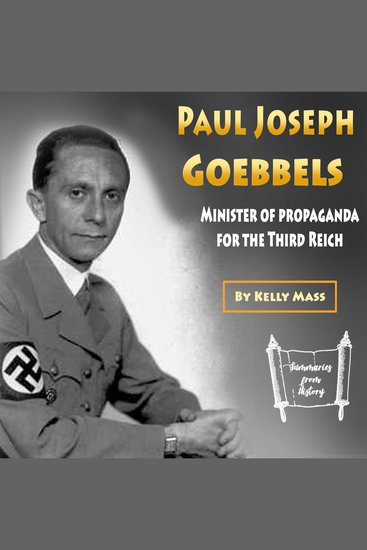
  • Paul Joseph Goebbels - Minister of Propaganda for the Third Reich - cover

    Paul Joseph Goebbels - Minister...

    Kelly Mass

    • 0
    • 0
    • 0
    There are doers and there are preachers. The people who were executing orders or abusing people in World War 2 wouldn’t have been able to commit any atrocities if the country hadn’t warmed up to an inhumane narrative. That’s where propaganda came in. Propaganda has long been part of various countries and societies to make the population believe something, and to find culprits, create feelings of animosity, and glorify local leaders or military campaigns. In World War 2, it was obviously used to promote the supposed inferiority of the Jewish race and convince a big part of the German population that they were better off dead. Goebbels was one of those brainwashers who advocated that narrative with propaganda material in the media. 
    From 1933 through 1945, Paul Joseph Goebbels functioned as the Gauleiter (district head) of Berlin, the Nazi Party's senior propagandist, and the Reich Minister of Propaganda. He was another one of Adolf Hitler's closest and most dedicated acolytes, acknowledged for his public speaking capabilities and his extreme antisemitism, which he often uttered. He promoted for gradually even worse discrimination, including but not limited to the Holocaust's killing of Jews. 
    What led to all this? How did he become so good at it? Why was he so fanatic? And what did he do that led to the terrible acts during the Holocaust others committed against the Jews in Europe? 
    Read about it or listen to an audio version of this book to find out what made Joseph Goebbels gruesomely unique in his lies.
    Mostra libro
  • Essays of Schopenhauer - cover

    Essays of Schopenhauer

    Arthur Schopenhauer

    • 0
    • 0
    • 0
    "Essays of Schopenhauer" by Arthur Schopenhauer is a captivating collection of philosophical essays that delve into the depths of human existence and offer profound insights into the complexities of life. In this thought-provoking anthology, Schopenhauer combines his keen intellect with his distinctive writing style to explore a range of philosophical ideas and themes. Throughout the essays, Schopenhauer contemplates the human condition, shedding light on the fundamental aspects of our existence. He reflects on the nature of suffering, the pursuit of happiness, and the inevitability of death, delving into the intricate relationship between desire and fulfillment. Read in English, unabridged.
    Mostra libro
  • History Biographies - Marie Curie Nostradamus and Alan Turing - cover

    History Biographies - Marie...

    Kelly Mass

    • 0
    • 0
    • 0
    This is a combo of biographies about the following well-known individuals: 
    Marie Curie - Marie Salomea Skodowska Curie was a Polish-born, naturalized-French researcher and chemist who originated radioactivity research. She was the first woman to win the Nobel Reward, the first and only woman to win it two times, and the only individual to win the Nobel Reward in 2 different clinical classifications. 
    Her first Nobel Reward was co-won by her spouse, Pierre Curie, making them the first married set to win the reward and developing the Curie family tradition of 5 Nobel Prizes. She was the first woman to be selected as a teacher at the University of Paris in 1906. 
    Nostradamus - Michel de Nostredame, referred to as Nostradamus in Latin, was a French astronomer, doctor, and presumed seer mostly known for his work Les Prophéties, a collection of 942 poetic quatrains supposedly predicting future events. In the year 1555, the book was first released. 
    Since the release of his Les Prophéties, Nostradamus has acquired a very large following of followers who, in addition to the majority of the well-known press, credit him with properly anticipating many essential historic events. 
    Alan Turing - Alan Mathison Turing was a mathematician, computer system researcher, scholar, cryptanalyst, thinker, and theoretical biologist from the U.K. With the Turing device, which can be considered a design of a general-purpose computer system, Turing had a substantial influence on the development of theoretical computer technology, offering a formalization of the ideas of algorithm and calculation. Turing is considered the creator of theoretical computer technology and AI. Turing was born in Maida Vale, London, and raised in the south of England.
    Mostra libro
  • Of Consolation - To Marcia To Helvia To Polybius - cover

    Of Consolation - To Marcia To...

    Seneca the Younger

    • 0
    • 0
    • 0
    These three ‘Consolations’, written by Seneca to his mother and two friends, have been described as ‘the crowning achievement in the canon of ‘consolation letters’. But sentimental they are not, for they emerge from the writer’s deep-seated commitment to Stoicism, where individuals are exhorted to inhabit qualities of virtue, positivity, resilience, and indifference. This recording opens with Seneca’s consolatory letter to Marcia, who, after three years, was still mourning the death of her son. He recognises her exceptional personal qualities and what benefits she has brought to her family, having rescued her father’s legacy as a historian following his death. He cites other noble Roman mothers who lost their sons, and enjoins her to adopt a more Stoic attitude of mind: we are all destined to die, he declares.  
    The second letter is to his mother sent after he had been exiled to Corsica by Emperor Caligula. He counsels Helvia not to mourn his absence – not least because he himself does not feel grief at the prospect of his own exile. He acknowledges the trials of his mother during her life, remarking ‘ill-fortune has given you no respite’. But her grief at the absence of her son may be put to one side in the knowledge that as he has ‘never trusted in Fortune,’ she can be comforted that her son is not discommoded. And history points to far harsher separations.  
    The final letter is to Polybius, Emperor Claudius’s Literary Secretary, who was mourning his brother.  Written while in exile, Seneca’s unwavering commitment to Stoic philosophy is again in evidence. One of Seneca’s principal suggestions is for Polybius to distract himself from grief by an increasing involvement in work.  
    These ‘Consolations’ have been widely admired from Classical times to the present, but are periodically questioned for their emphasis on a somewhat detached approach to grief and bereavement. Not all can manage imperturbability in such circumstances. Nevertheless, there is a steadiness and emotional calm in these missives, which Seneca himself displayed when ordered to commit suicide by Emperor Nero.
    Mostra libro
  • Echoes of Cleopatra - cover

    Echoes of Cleopatra

    Santiago Machain

    • 0
    • 0
    • 0
    Echoes of Cleopatra explores the dramatic transformation of Egypt as it became a vital province of the Roman Empire. Through the lens of politics, culture, religion, and daily life, the book traces the complex interplay between Egyptian traditions and Roman authority. From the legendary alliance of Cleopatra and Rome to the rise of new social orders, the flourishing of the arts, and the challenges of frontier diplomacy, this volume reveals how Egypt's people navigated an era of profound change. The narrative brings to life the voices of rulers, rebels, merchants, women, and the next generation, illuminating the enduring legacy of the Nile in the ancient Mediterranean world.
    Mostra libro
  • How to Focus - A Monastic Guide for an Age of Distraction - cover

    How to Focus - A Monastic Guide...

    John Cassian, Jamie Kreiner

    • 0
    • 0
    • 0
    Distraction isn't a new problem. We're also not the first to complain about how hard it is to concentrate. Early Christian monks beat us to it. They had given up everything to focus on God, yet they still struggled to keep the demons of distraction at bay. But rather than surrender to the meandering of their minds, they developed powerful strategies to improve their attention and engagement. How to Focus is an inviting collection of their strikingly relatable insights and advice—frank, funny, sympathetic, and psychologically sophisticated. 


    This wisdom is drawn from John Cassian's Collationes, one of the most influential manuals for monks from late antiquity. The Collationes follow Cassian and his friend Germanus as they travel around Egypt, asking a series of sage monks how they can make their minds stronger. In response, these monks offer a range of techniques for increasing focus, including setting goals, training the body, managing the memory, using mantras, taking breaks, consulting others—and, most of all, being honest about yourself. As Cassian and Germanus eventually realize, we can't escape distraction—but we can learn how to confront it and, eventually, to concentrate. 


    Featuring an engaging new translation by Jamie Kreiner, How to Focus can help even the least monkish of us to train our attention on what matters most.
    Mostra libro