Unisciti a noi in un viaggio nel mondo dei libri!
Aggiungi questo libro allo scaffale
Grey
Scrivi un nuovo commento Default profile 50px
Grey
Iscriviti per leggere l'intero libro o leggi le prime pagine gratuitamente!
All characters reduced
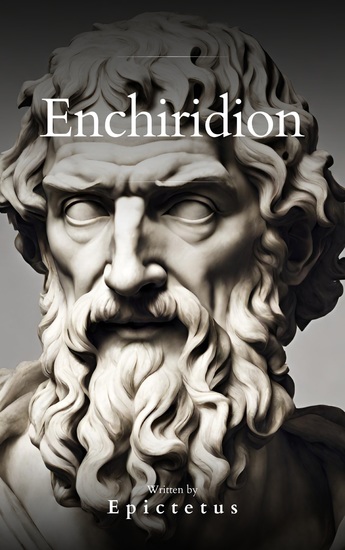
Enchiridion - A Timeless Guide to Stoic Wisdom - cover

Enchiridion - A Timeless Guide to Stoic Wisdom

Epictetus, Bookish

Casa editrice: Bookish

  • 0
  • 0
  • 0

Sinossi

Embrace the Power of Rationality and Find Eudaimonia

Embark on a transformative journey with Marcus Aurelius's Enchiridion, a timeless guide to Stoic wisdom that has captivated readers for centuries. Discover the profound teachings of Epictetus, the Roman Stoic philosopher who distilled his wisdom into this concise manual.
Enchiridion offers practical guidance on cultivating self-discipline, detachment from external events, and the pursuit of virtue. It provides a framework for navigating life's challenges with equanimity and finding inner peace, regardless of external circumstances.

"Enchiridion is a concise and powerful guide to Stoic philosophy, offering timeless wisdom for navigating life's challenges." - The Guardian
"Epictetus's teachings are as relevant today as they were centuries ago. Enchiridion is a must-read for anyone seeking to live a meaningful and fulfilling life." - Goodreads Reviewer
Embrace the power of rationality and unlock the wisdom of Enchiridion. Order your copy today and embark on a journey towards eudaimonia.
 
Disponibile da: 04/01/2024.
Lunghezza di stampa: 65 pagine.
Altri libri che potrebbero interessarti

  • 25+ The Collected Works of Vladimir Lenin - The Dreamer in the Kremlin State and Revolution What Is to Be Done? Imperialism: The Final Stage of Capitalism and others - cover

    25+ The Collected Works of...

    Vladimir Lenin, H. G. Wells

    • 0
    • 0
    • 0
    Vladimir Ilyich Ulyanov, better known as Vladimir Lenin, was a Russian revolutionary, politician, and political theorist. He served as the first and founding head of government of Soviet Russia from 1917 to 1924 and of the Soviet Union from 1922 to 1924. Under his administration, Russia, and later the Soviet Union, became a one-party socialist state governed by the Communist Party. Ideologically a Marxist, his developments to the ideology are called Leninism.
    Russia in the Shadows is a book by H. G. Wells published early in 1921, which includes a series of articles previously printed in The Sunday Express in connection with Wells's second visit to Russia (after a previous trip in January 1914 to St. Petersburg and Moscow) in September and October 1920.
    During his visit to Russia he visited his old friend Maxim Gorky, whom he had first met in 1906 on a trip to the United States, and who arranged Wells's meeting with Lenin.
    In a chapter (The Dreamer in the Kremlin) devoted to an interview with Lenin at the Kremlin Wells describes the leader and founder of Russian communism. Wells portrays Lenin as a pragmatic leader who "has recently stripped off the last pretence that the Russian revolution is anything more than the inauguration of an age of limitless experiment."
     
    Vladimir Lenin:
    State and Revolution
    What Is to Be Done?
    Imperialism: The Final Stage of Capitalism
    The State and Revolution
    The Three Sources and Three Component Parts of Marxism
    To the Citizens of Russia!
    To Workers, Soldiers, and Peasants!
    Report on Peace
    Report on Land
    Decree on Abolishment of Capital Punishment
    Decree on Transfer of Power to the Soviets
    Decree on Establishment of the Workers' and Peasants' Government
    Decree on Elections for the Constituent Assembly
    Decree on Suppression of Hostile Newspapers
    Decree on Transfer of Food Control to Municipalities
    Decree on an Eight-Hour Working Day
    Decree on the Right to Issue Laws
    Resolution on the Right of Sovnarkom to Issue Decrees
    Decree on Social Insurance
    Declaration of the Rights of the People of Russia
    Decree on Organization of Volost Land Committees
    Decree on Transfer of Power and the Means of Production to the Toilers
    Decree Proclaiming Advertising a State Monopoly
    Decree Abolishing Classes and Civil Ranks
    Decree on Workers' Control
    Resolution on Relation of the Central Executive Committee to the Sovnarkom
    Decree on the Right to Call for Re-Elections
    Decree on Establishment of the Extraordinary Commission to Fight Counter-Revolution
    V. I. Lenin Note To F. E. Dzerzhinsky with a Draft of A Decree On Fighting Counter-Revolutionaries And Saboteurs
     
    H. G. Wells:
    The Dreamer in the Kremlin
    Mostra libro
  • The Coach’s Toolkit - cover

    The Coach’s Toolkit

    Santiago Machain

    • 0
    • 0
    • 0
    The Coach's Toolkit is the second book in the transformational The Coaching Evolution Series. Designed for aspiring and practicing coaches, this guide bridges the gap between foundational knowledge and powerful application. Within its pages, readers will discover essential coaching frameworks like GROW, SMART goals, and SWOT analysis, and learn how to use them with integrity and flexibility. 
    The book dives deep into career mapping, entrepreneurial planning, personal branding, and financial mindset coaching. It equips readers to work with both job seekers and business clients—guiding them through career transitions, startup scaling, market discovery, networking, and beyond.  
    Whether you're a new coach seeking structure or an experienced coach refining your craft, this book offers actionable insights, rich context, and practical wisdom to elevate your practice and your clients' outcomes.
    Mostra libro
  • The Viking Age - Raiders and Traders - cover

    The Viking Age - Raiders and...

    Harris Ropes

    • 0
    • 0
    • 0
    The story of the Vikings begins in the rugged, coastal lands of Scandinavia, where modern-day Norway, Sweden, and Denmark now stand. These northern regions, characterized by their cold climate, deep fjords, and dense forests, shaped a resilient and resourceful people. Isolated by geography and challenged by limited arable land, the early Norse communities developed a strong connection to nature, the sea, and their close-knit societies. Life in Scandinavia during the early Middle Ages was not easy, but it fostered a culture of survival, adaptability, and innovation. 
    At the heart of Viking society was a deep belief in their mythology and gods. Norse mythology offered a complex system of deities, heroes, and mythical creatures that guided the moral and spiritual lives of the people. Central figures like Odin, the wise All-Father; Thor, the thunder god and protector; and Freyja, the goddess of love and fertility, were not just worshipped but also deeply integrated into the everyday lives of the Norse. These myths were passed down through oral storytelling, poetic sagas, and ritual practices, helping to create a shared identity among the diverse Scandinavian tribes. 
    Viking society was organized into a hierarchical structure that valued strength, honor, and loyalty. At the top were the jarls, or chieftains, who held power over clans and led warriors into battle or on raids. Below them were the karls, the free farmers, craftsmen, and traders who formed the backbone of Viking communities. At the bottom were the thralls, or slaves, who were usually captured during raids or born into servitude. Despite this stratification, Viking culture emphasized personal achievement and reputation, allowing individuals to rise in status through bravery, skill, and loyalty.
    Mostra libro
  • Paranormal Zones - cover

    Paranormal Zones

    Joslan F. Keller

    • 0
    • 0
    • 0
    The ghosts of Hollywood, the death of Edgar Allan Poe, the loving Martian, the Zone of Silence, cursed diamonds. Joslan F. Keller tells us eighteen disturbing stories that defy reason. Eighteen paranormal zones from around the world, all authentic and documented by the author, which shake our certainties—the unexplained phenomena in the sky, the incursions into the world of spirits, encounters with unusual characters, close encounters with UFOs, visits to disturbing places.
    
    Doesn't the improbable arise from our still-limited knowledge and our inability to rationally explain phenomena that go beyond our understanding? The world is neither black nor white. Are there not an infinite number of grey areas, at the frontiers of the unknown, dominated by forces whose mechanisms are little explored, or not at all?
    Mostra libro
  • Mythology across the Ancient World - The History of Mythological Stories and Rituals in Antiquity - cover

    Mythology across the Ancient...

    Editors Charles River

    • 0
    • 0
    • 0
    Although the Egyptians may not have passed their civilization directly on to later peoples, the key elements that comprised Egyptian civilization, including their religion, early ideas of state, and art and architecture, can be found among other civilizations. For instance, civilizations far separated in time and space, such as China and Mesoamerica, possessed key elements that were similar to those found in ancient Egypt. Indeed, since Egyptian civilization represented some fundamental human concepts, a study of their culture can be useful when trying to understand many other pre-modern cultures.  
    	Today the Mesopotamians and their religion are sources of curiosity, but thousands of years ago, the religion was an integral part of their lives. From their birth to their death, deities surrounded them, and whether their social interactions were on the level of a smaller city or that of a larger nation-state, deities played key roles in the social fabric of their society. Whereas the Israelites were one people who worshipped a single god, Babylon had a succession of different dynasties derived from many ethnic groups, and since Babylonian religion originated from a plethora of sources, there were very few elements that maintained primacy throughout the city’s history. For example, the Sumerian influence resulted in citizens worshipping many deities in the city, but those numbers were reduced after the Amorites came to power.  
    	One of the reasons Zeus remains one of the most recognizable gods in history is because of the spread of his influence. Due to the conquests of Alexander the Great, Zeus was brought along with other elements of Hellenization to Egypt and the Near East, and a few centuries later, Rome all but adopted him as their own chief god, Jupiter. From there, he was exported around the Roman Empire and fused with numerous other local gods in the process.
    Mostra libro
  • The Politics of Maps - Cartographic Constructions of Israel Palestine - cover

    The Politics of Maps -...

    Izhak Schnell, Christine...

    • 0
    • 0
    • 0
    Blending science and technology studies, sociology, and geography with a host of archival material, in-depth interviews, and ethnographies, The Politics of Maps explores how the geographical sciences came to be entangled with the politics, territorial claim-making, and nation-state building of Israel/Palestine. Chapters chart the cartographic history of the region, from the introduction of Western scientific and legal paradigms that seemingly legitimized and depoliticized new land regimes to the rise of new mapping technologies and software that expanded access to cartography into the public sphere. Maps produced by various sectors like the "peace camps" or the Jewish community enhanced national belonging, while others, like that of the Green Line, served largely to divide. 


    The stories of Israel's many boundaries reveal that there is no absolute, technocratic solution to boundary-making. As boundaries continue to be controversial and the Israeli-Palestinian conflict remains intractable and unresolved, The Politics of Maps uses nationally-based cartographic discourses to provide insight into the complexity, fissures, and frictions within internal political debates, illuminating the persistent power of the nation-state as a framework for forging identities, citizens, and alliances.
    Mostra libro