Unisciti a noi in un viaggio nel mondo dei libri!
Aggiungi questo libro allo scaffale
Grey
Scrivi un nuovo commento Default profile 50px
Grey
Iscriviti per leggere l'intero libro o leggi le prime pagine gratuitamente!
All characters reduced
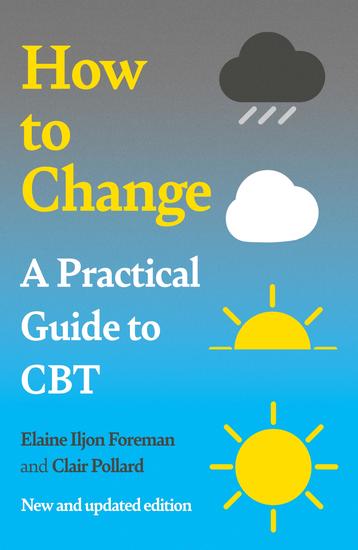
A Practical Guide to CBT - How to Change - cover

A Practical Guide to CBT - How to Change

Elaine Iljon Foreman

Casa editrice: Icon Books

  • 0
  • 0
  • 0

Sinossi

Change can often seem like an impossible task, but this practical book will help you put it into perspective. With guidance from two experts, you'll recognise the behaviours and thoughts that hold you back, and will develop skills to think more positively, act more calmly and feel better about yourself.


A new and updated edition, this book is full of activities and experiments to explore and challenge, stories and exercises to provide perspective, and a clear framework to encourage and guide you, using the same tools employed by CBT practitioners. The authors' friendly and supportive approach will help you learn to manage recurrences of negative thinking and behaviours, and to develop strong coping strategies.


CBT incorporates the latest therapies and research, including ACT and mindfulness, and explicitly addresses problem areas like insomnia and depression. This edition includes a new chapter focusing on practical advice about making changes and the principles of T.E.A.M-CBT.
Disponibile da: 02/01/2025.
Lunghezza di stampa: 256 pagine.


Altri libri che potrebbero interessarti

  • Minding the Climate - How Neuroscience Can Help Solve Our Environmental Crisis - cover

    Minding the Climate - How...

    MD Ann-Christine Duhaime

    • 0
    • 0
    • 0
    If we believe the climate crisis is real, why is it so difficult to change our behavior and our consumer tendencies? 


    Minding the Climate investigates this problem in the neuroscience of decision-making. Ann-Christine Duhaime, MD, points to the evolution of the human brain during eons of resource scarcity. The brain adapted to prioritize short-term survival over more uncertain long-term outcomes. But the resulting behavioral architecture is poorly suited to the present, when scarcity is a lesser concern and slow-moving challenges like environmental issues present the greatest danger. Duhaime details how even our acknowledged best interests are thwarted by the brain's reward system: if a behavior isn't perceived as immediately beneficial, we probably won't do it—never mind that we "know" we should. 


    Luckily, we can sway our brains, and those of others, to alter our behaviors. Duhaime describes concrete, achievable interventions that have been shown to encourage our neurological circuits to embrace new rewards. Such small, incremental steps that individuals take, whether in their roles as consumers, in the workplace, or in leadership positions, are necessary to mitigate climate change. The more we understand how our tendencies can be overridden by our brain's capacity to adapt, Duhaime argues, the more likely we are to have a future.
    Mostra libro
  • Vagus Nerve: Activation and Stimulation Therapy - PTSD Unleash Your Healing Power Break Free From Anxiety Depression Trauma Obesity sleeping disorder with Emotional Intelligence for a better life - cover

    Vagus Nerve: Activation and...

    David Bailey

    • 0
    • 0
    • 0
    Would you like to heal your nervous system and shape your body at the same time? 
    Have you ever heard about the Vagus Nerve and how important its proper function and wellness are? 
    Or maybe, you are looking for a guide that would help to perfectly balance your body and your mind? 
    If at least one of these questions got your attention, then keep reading… 
    Just think for a second. What do you usually do when you feel a little sick or tired? – You wait, have a sleep, lay down and have a rest, and after some time, you feel better. Have you ever thought about how powerful your body really is, and even when you keep redamaging it with bad food, loads of stress, lack of sleep, and inconsistent life, it keeps rehealing itself every single day. So what would happen if you start working along with your body instead of against it? That is what I am going to teach you through this audiobook… 
    We can’t live with almost any organ, but if I have to name the most important one, it is definitely our brain – our identity- an organ that manages every decision and every action inside and outside our body. Vagus Nerve is the most important wire that converts those signals into action, and inside this audiobook, I will teach techniques and strategies to keep this nerve and your whole body as healthy as possible… 
    Here is a short brief of this audiobook:How Is The Vagus Nerve Affecting your Wellbeing?Diseases associated with the vagus nerve and how to prevent them?How Does Food Affect the Gut Microbiota and digestion system?Complete guide on how to cure anxiety, stress, and depression?Mind-Body Therapies for healthy and long lifeAnd much much more… 
    Now it is your turn to take action. 
    Scroll up, click on “Buy Now” and learning!
    Mostra libro
  • Particle and Nuclear Physics - The Building Blocks of Matter (3 in 1) - cover

    Particle and Nuclear Physics -...

    Mark Hedges

    • 0
    • 0
    • 0
    At the heart of the universe lies a hidden world of fundamental particles and forces that shape all matter and energy. Particle physics seeks to understand the tiniest building blocks of nature, from quarks and leptons to the elusive Higgs boson, while nuclear physics explores the atomic nucleus, the powerful interactions that bind protons and neutrons, and the forces driving nuclear reactions, including fusion and fission. 
    This collection delves into the deep mysteries of matter, covering the essential theories, experiments, and discoveries that have revolutionized our understanding of the subatomic world. From the Standard Model to the behavior of particles in high-energy collisions, and from the structure of the atomic nucleus to the applications of nuclear science in medicine and energy production, these works provide a comprehensive foundation in the physics of the smallest scales. Whether you're fascinated by the origins of the universe, the workings of particle accelerators, or the quest for new physics beyond the Standard Model, this book serves as a gateway to the fundamental principles that govern our reality.
    Mostra libro
  • Ethology - The Science of Animal Behavior in Natural Environments - cover

    Ethology - The Science of Animal...

    Mike Crawford

    • 0
    • 0
    • 0
    Ethology is the scientific study of animal behavior, focusing on how species interact with their natural environments. Unlike psychology, which often examines behavior in controlled laboratory settings, ethology emphasizes the observation of animals in their natural habitats. This field seeks to understand the evolutionary significance of behaviors, uncovering how instincts, learning, and environmental influences shape the way animals survive and thrive.  
    The origins of ethology can be traced back to early naturalists who observed and recorded animal behaviors in the wild. However, it was not until the 20th century that ethology emerged as a distinct scientific discipline. Key figures such as Konrad Lorenz, Nikolaas Tinbergen, and Karl von Frisch laid the foundation for modern ethology. Lorenz is best known for his studies on imprinting in birds, demonstrating how young animals develop attachments to their caregivers. Tinbergen’s work established the four key questions of ethology, which explore behavior from different angles: causation, development, function, and evolution. Von Frisch, on the other hand, revolutionized our understanding of animal communication through his research on the intricate dance language of honeybees. Together, their contributions helped establish ethology as a critical field in biology.  
    Studying animal behavior is essential for understanding both the natural world and our own place within it. By examining how different species communicate, cooperate, compete, and reproduce, ethologists gain insights into the complex mechanisms driving life on Earth. This knowledge has practical applications in conservation, helping to protect endangered species by understanding their behavioral needs. It also plays a role in improving animal welfare, from designing better habitats in zoos to enhancing the treatment of domesticated animals.
    Mostra libro
  • The Buck that Buries its Poo - And 101 Other Fascinating Facts About SA's Wildlife - cover

    The Buck that Buries its Poo -...

    Quinton Coetzee

    • 0
    • 0
    • 0
    Is a zebra black with white stripes or white with black stripes? And why do flamingos stand on one leg while bats hang upside down? Did you know that a chameleon’s tongue can shoot out at five times the acceleration of a fighter jet? 
    In The Buck That Buries its Poo, naturalist Quinton Coetzee answers these and many other intriguing wildlife questions. He also dispels countless myths and elucidates some of the legends that surround 
    creatures in the South African bush we thought we knew all about. For example, bats do not get tangled in people’s hair (because they are far too adept at flying) and elephants are not afraid of mice (but they do fear bees!). 
    Other tall tales you might hear around the campfire are that lions roll in animal dung, entrails or carcasses to disguise their scent, and that rhinos have a predilection for stamping out fires. What is true, though, is that hyenas are more closely related to cats than to dogs. This handy guide is based on Coetzee’s own research and that of others, and his experience gleaned over decades living close to nature and wildlife. It seeks to unravel the mysteries of nature in Africa – from mammals and birds to arthropods and plants – with fascinating information and fun trivia. It is a book that will enlighten and entertain. 
    PS: Zebras are black with white stripes!
    Mostra libro
  • Timeline of Stars - cover

    Timeline of Stars

    Joe Adcock

    • 0
    • 0
    • 0
    Where do you place in the Timeline of Stars? Does it matter? 
    A story uncovered by a single star Bible verse led to more stars. Previously unknown within a ten-thousand-year span are planetary alignments or convergencies. What do the stars unlock? Turning points dated to authenticate history that were, until now, undetected.  
    Only in our recent history has it been possible to explore the stars. And why should it matter? Does it make a difference for you? Perhaps! 
    You can discover in much the same way as I did. Here, take my keys to the stars.
    Mostra libro