

Unisciti a noi in un viaggio nel mondo dei libri!
Aggiungi questo libro allo scaffale
Grey
Scrivi un nuovo commento Default profile 50px
Grey
Iscriviti per leggere l'intero libro o leggi le prime pagine gratuitamente!
All characters reduced
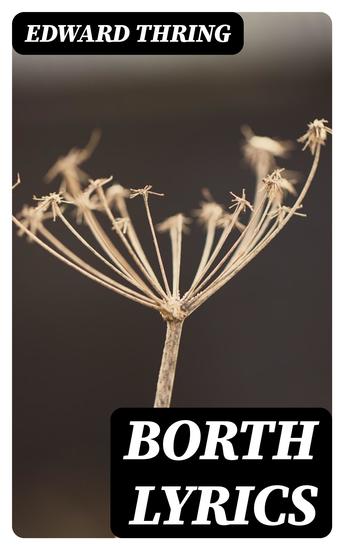
Borth Lyrics - cover

Borth Lyrics

Edward Thring

Casa editrice: DigiCat

  • 0
  • 0
  • 0

Sinossi

In "Borth Lyrics," Edward Thring embarks on a poetic exploration of the vibrant interplay between nature, human emotion, and the essence of existence. Written in the context of 19th-century Romanticism, the collection is characterized by its lyrical beauty, vivid imagery, and a profound sense of introspection. Thring's deft use of meter and rhyme, combined with a rich tapestry of metaphors, invites readers to immerse themselves in the delicate rhythms of life as experienced in the coastal village of Borth. Through his keen observations of the landscape and its inhabitants, Thring deftly intertwines personal reflection with universal themes, making the collection a remarkable contribution to the lyrical tradition of his time. Edward Thring was not only a poet but also an influential educator and headmaster of Uppingham School, where his innovative teaching methods highlighted the importance of personal development alongside academic achievement. His deep appreciation for nature and humanity's connection to it likely informed the emotional depth and ecological sensitivity present in "Borth Lyrics." Thring's dual career as a poet and educator reflects a broader Victorian pursuit of both knowledge and beauty, revealing how these elements coexist and enhance one another. I highly recommend "Borth Lyrics" to anyone seeking to engage with nature through the prism of poetry. Thring's evocative language and emotional resonance will resonate with readers who appreciate both the artistry of verse and the philosophical undercurrents of human experience. In its celebration of the natural world and the complexities of human emotion, this collection is a timeless journey worthy of exploration.
Disponibile da: 15/09/2022.
Lunghezza di stampa: 14 pagine.
Altri libri che potrebbero interessarti

  • Rhyme A Dozen A - 12 Poets 12 Poems 1 Topic ― Pain - 12 Poets 12 Poems 1 Topic - cover

    Rhyme A Dozen A - 12 Poets 12...

    Patrick Branwell Bronte, Charles...

    • 0
    • 0
    • 0
    ‘A dime a dozen’ as known in America, is perhaps equal to the English ‘cheap as chips’ but whatever the lingua franca of your choice in this series we hereby submit ‘A Rhyme a Dozen’ as 12 poems on many given subjects that are a well-rounded gathering, maybe even an essential guide, from the knowing pens of classic poets and their beautifully spoken verse to the comfort of your ears. 
     
    1 - A Rhyme A Dozen - 12 Poems, 12 Poets, 1 Topic - Pain - An Introduction 
    2 - Peaceful Death and Painful Life by Patrick Branwell Bronte 
    3 - If I Have Suffered Pain by Charles Sorley 
    4 - On Pain by Khalil Gibran 
    5 - Pain and Time Strive Not by William Morris 
    6 - Sorrow by Edna St Vincent Millay 
    7 - Pain by Ivor Gurney 
    8 - May 1917 by John Jay Thompson 
    9 - Non Dolet by Edith Wharton 
    10 - Sonnet 132 - Thine Eyes I Love, and They, As Pitying Me by William Shakespeare 
    11 - Love Arm'd by Aphra Behn 
    12 - Annabel Lee by Edgar Allan Poe 
    13 - Ode To A Nightingale by John Keats
    Mostra libro
  • Leaves of Grass (Legend Classics) - cover

    Leaves of Grass (Legend Classics)

    Walt Whitman

    • 0
    • 1
    • 0
    “I am large, I contain multitudes” 
    Walt Whitman published his first collection of poetry, Leaves of Grass, in 1855. Whitman spent most of his professional life writing and revising it multiple times until his death. 
    It was highly controversial during its time for its explicit sexual imagery, and Whitman was subject to derision by many contemporary critics. Over time, however, the collection has infiltrated popular culture and been recognised as one of the central works of American poetry. 
    The Legend Classics series:Around the World in Eighty DaysThe Adventures of Huckleberry FinnThe Importance of Being EarnestAlice's Adventures in WonderlandThe MetamorphosisThe Railway ChildrenThe Hound of the BaskervillesFrankensteinWuthering HeightsThree Men in a BoatThe Time MachineLittle WomenAnne of Green GablesThe Jungle BookThe Yellow Wallpaper and Other StoriesDraculaA Study in ScarletLeaves of GrassThe Secret GardenThe War of the WorldsA Christmas CarolStrange Case of Dr Jekyll and Mr HydeHeart of DarknessThe Scarlet LetterThis Side of ParadiseOliver TwistThe Picture of Dorian GrayTreasure IslandThe Turn of the ScrewThe Adventures of Tom SawyerEmmaThe TrialA Selection of Short Stories by Edgar Allan PoeGrimm Fairy TalesThe AwakeningMrs DallowayGulliver’s TravelsThe Castle of OtrantoSilas MarnerHard Times
    Mostra libro
  • Poesi - cover

    Poesi

    Helle Gade

    • 0
    • 0
    • 0
    A unique and beautiful collection of poems originally written for stories equally unique. First published alongside some of BDPs most amazing stories, now we bring the entire collection to you in one heart stopping collection. 
    Find yourself on a journey where your heart is touched and your soul feels connected. Discover love, sorrow, and beauty with each new poem by this award-winning author.
    Mostra libro
  • Reversing Entropy - cover

    Reversing Entropy

    Luci Shaw

    • 0
    • 0
    • 0
    From the pen of beloved poet Luci Shaw comes a new collection that celebrates inspired creativity as an antidote to chaos.
    The poet' s own words best describe the heart of this pinnacle collection of new work by beloved writer Luci Shaw:
    Entropy: A measure of the molecular disorder, or randomness, of a system, its lack of order or predictability, resulting in a gradual decline into disorder.
    Our universe, and the systems within it, constantly shift from their created states of order towards disorder, or chaos. The second law of thermodynamics asserts that entropy, or disorder, always increases with time. Creative human activities such as art, architecture, music, story or film are human efforts to halt and reverse this loss of meaning. Thus, smaller systems, like individual poems, become highly ordered as they receive energy from outside themselves, from the poet. They reverse entropy because they are moving from a state of disorder (all the random ideas, words and phrases available to the writer) into an orderly form designed by the writer to create meaningful images and concepts in the reader' s mind (which is where the word " imag-ination" comes from.) This transfer of images, concepts and ideas into the mind of a reader is the task of poetry and the calling of the poet. Just as a composer of music gathers rhythms, notes, melodies, or harmony, organizing them into fugues or sonatas or concertos, so poets work and write to discover ways of arranging their responses to the world in words that introduce meaning and beauty in the mind of the reader.
    Which is what I' ve been trying to do for most of my life.
    Mostra libro
  • The Poetry of Thomas Chatterton - Despite tragically committing suicide at only 17 Chattertons influence would stretch far beyond his years being a huge spark to poets such as Shelley Keats Wordsworth and Coleridge - cover

    The Poetry of Thomas Chatterton...

    Thomas Chatterton

    • 0
    • 0
    • 0
    Thomas Chatterton was born in Bristol on 20th November 1752 some 15 weeks after the death of his father. For a time he was admitted to Edward Colston's Bristol charity school, on a limited curriculum of reading, writing, arithmetic and the catechism. 
      
    Although fascinated by the church of St Mary Redcliffe where his uncle was sexton, he was liable to fits of abstraction, sitting for hours in a trance or crying for no reason. When Chatterton was 8 he was so eager for books that he would read and write all day long and by 11 he had become a contributor to Felix Farley's Bristol Journal. He lived in thought with his 15th-century heroes and heroines. 
      
    The first of his literary mysteries, the dialogue of "Elinoure and Juga," was written before he was 12, and he showed it to the usher at the boarding school Colston's Hospital where he was a pupil, pretending it was the work of a 15th-century poet. Chatterton remained a boarder at Colston's Hospital for more than six years. His little pocket-money was spent borrowing books from a circulating library and always attempting to ingratiate himself with book collectors. 
      
    His holidays were mostly spent at his mother's house, and much of that in the attic study living for the most part in an ideal world of his own, centered on his mid-15th century imaginary world. 
      
    Chatterton soon conceived the romance of Thomas Rowley, an imaginary monk of the 15th century, and adopted for himself the pseudonym Thomas Rowley for poetry and history. He imagined he would become a famous poet who by his talents would be able to rescue his mother from poverty. 
      
    Chatterton needed a patron. Many were not interested. Horace Walpole was but discovering that the poems were most probably fake and Chatterton himself only 16 scornfully sent him away. 


    Badly hurt by Walpole's snub, Chatterton wrote very little for a summer. Then he turned his attention to periodical literature and politics, and the London periodicals. He was frequently published but received little reward for his startling efforts. 
      
    Chatterton wrote at Easter 1770, ‘‘Last Will and Testament,’’ a satirical mix in jest and seriousness. The will was possibly prepared so that John Lambert, the attorney to whom he was apprenticed, cancelled his indentures. His friends and acquaintances, having donated money, Chatterton proceeded to London. 
      
    He continued to write and publish in various styles and was paid little for his efforts. He wrote hopefully to his mother and sister, and spent his first earnings in buying gifts for them. 
      
    In June 1770, after nine weeks in London, he moved from a shared room in Shoreditch to an attic in Brook Street, Holborn. He now enjoyed uninterrupted solitude and now could write all night. The romance of his earlier years revived, and he transcribed from an imaginary parchment of the old priest Rowley his "Excelente Balade of Charitie." This poem, disguised in archaic language, he sent to the editor of the Town and Country Magazine, where it was rejected. 
      
    A neighbouring apothecary, repeatedly invited him to come for dinner or supper; but he refused. His landlady also, suspecting his necessity, pressed him to share her dinner, but in vain. "She knew," as she afterwards said, "that he had not eaten anything for two or three days." But he assured her that he was not hungry. 
      
    In August 1770, while walking in St Pancras Churchyard, Chatterton was much absorbed in thought, and did not notice a newly dug open grave in his path, and subsequently tumbled into it. His walking companion helped Chatterton out of the grave, and told him that he was happy in assisting at the resurrection of a genius. Chatterton replied, "My dear friend, I have been at war with the grave for some time now." 
     
    On 24th August 1770, Thomas Ch
    Mostra libro
  • Oedipus at Colonus - cover

    Oedipus at Colonus

    Sophocles

    • 0
    • 0
    • 0
    Dive into the mesmerizing conclusion of Sophocles' Theban Trilogy with 'Oedipus at Colonus,' a captivating audiobook that stands as a testament to the enduring power of Greek tragedy.In the final chapter of his tumultuous life, Oedipus, once a proud king brought low by fate and his own actions, seeks solace and redemption in the town of Colonus. Blinded and exiled, he embarks on a profound journey toward tranquility, only to find himself once more at the center of earthly and divine conflicts.This audiobook brings Sophocles' timeless text to life with skillful narration, immersing you in Oedipus' poignant quest for peace. Experience the deeply human themes of repentance, forgiveness, and the desire for rest after a life filled with hardship. Observe how Oedipus, in his final hours, grapples with the repercussions of his past, the nature of his present, and the uncertainty of his legacy.'Oedipus at Colonus' is more than a tragic tale—it is a profound exploration of human endurance in the face of suffering, and the possibility of redemption even in the bleakest of circumstances. Whether you're a student of classical literature, a lover of timeless dramas, or an audiobook enthusiast seeking a thought-provoking listen, this rendition of 'Oedipus at Colonus' offers a rich, immersive experience that will resonate long after the final words have been spoken.Step into the world of ancient Greek drama and explore the depths of human resilience and the quest for peace with 'Oedipus at Colonus.' Let this immortal story touch your heart, challenge your perceptions, and leave you with timeless insights into the human condition.
    Mostra libro
