Unisciti a noi in un viaggio nel mondo dei libri!
Aggiungi questo libro allo scaffale
Grey
Scrivi un nuovo commento Default profile 50px
Grey
Iscriviti per leggere l'intero libro o leggi le prime pagine gratuitamente!
All characters reduced
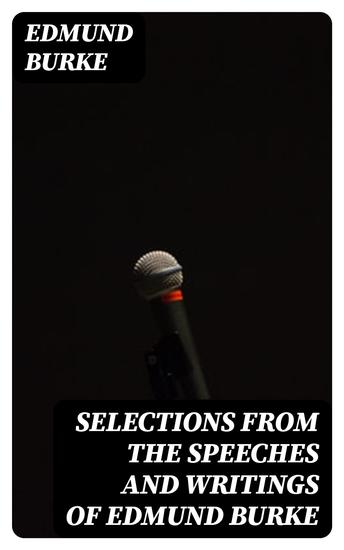
Selections from the Speeches and Writings of Edmund Burke - cover

Ci dispiace! L'editore o autore ha rimosso questo libro dal nostro catalogo. Ma per favore non ti preoccupare, hai ancora oltre 500.000 altri libri da scegliere!

Selections from the Speeches and Writings of Edmund Burke

Edmund Burke

Casa editrice: DigiCat

  • 0
  • 0
  • 0

Sinossi

In 'Selections from the Speeches and Writings of Edmund Burke,' readers are afforded a penetrating glimpse into the philosophic acuity and rhetorical prowess of one of the 18th century's most influencial thinkers. The compilation showcases Burke's eminent works, distinguished not only by their erudition but also by their persuasive eloquence, from 'Modesty of Mind' to 'Office of Sympathy' and 'Newton and Nature.' These writings are situated within the larger framework of the Enlightenment and serve as illuminating portals into the political, social, and economic discourses that shaped the intellectual landscape of Burke's time. The literary style reflects Burke's sophisticated syntax and vocabulary, appealing to those with a taste for classical eloquence and dialectical precision.
Edmund Burke, a luminary Irish-British statesman, economist, and philosopher, articulated his political theories and observations during his service in Britain's House of Commons. His insights were shaped by the profound transformations characterizing the period, including the American Revolution, and the early rumblings of change in France. The works included in this selection represent not just the fruits of his tenure as a Whig parliamentarian, but also the depth of his intellectual endeavors and his commitment to moral philosophy and the complex mechanics of governance and society.
Obsequiously recommended for students of history, political philosophy, and rhetoric, 'Selections from the Speeches and Writings of Edmund Burke' is an invaluable text for understanding the subtleties of Enlightenment thought as well as the practical considerations of political action. Burke's insights into human nature and societal dynamics remain strikingly relevant in the context of modern democratic discourse, making this collection essential for those who cherish the interplay between philosophy and practical politics, as well as for any reader seeking to grasp the historical roots of contemporary political ideation.
Disponibile da: 21/11/2022.
Lunghezza di stampa: 422 pagine.

Altri libri che potrebbero interessarti

  • The Mahabharata - cover

    The Mahabharata

    Veda Vyas

    • 0
    • 0
    • 0
    Krishna Dvaipayana, also known as and Veda Vyasa "the one who classified the Vedas"), is a rishi (sage). He is best known as the author of the Mahabharata, one of the two most important epics of Hinduism. He is also credited as the traditional compiler of the Vedas, as well as the writer of other important works including the Puranas. As per the Mahabharata, Vyasa is the son of rishi Parashara and a fisherwoman named Kali (Satyavati), who later marries king Shantanu of Kuru. Throughout the epic, Vyasa appears occasionally helping the Kuru kingdom. His spiritual career includes compiling many texts and spreading the knowledge through his disciples. The festival of Guru Purnima is dedicated to him. It is also known as Vyasa Purnima, the day believed to be both of his birth and when he divided the Vedas. Vyasa is considered one of the seven Chiranjivis (long-lived, or immortals), who are still in existence according to Hindu tradition.
    Mostra libro
  • Cherokees of the Smoky Mountains - A Little Band that has stood against the White Tide for Three Hundred Years - cover

    Cherokees of the Smoky Mountains...

    Horace Kephart, Janice Kephart

    • 0
    • 0
    • 0
    The text relates the powerful and dramatic history of Smoky Mountain Cherokees, who for 40,000 years thrived in the difficult terrain of the Great Smoky Mountains and its surrounding regions areas of what is now Kentucky, Ohio, West Virginia, North Carolina, Georgia and Alabama. With a constitution and organized government, a written language and no economic debt, the Cherokees sought to live in relative peace. However, President Jackson and the state of Georgia thought differently, forcing the Cherokees and their devoted Chief John Ross to leave their homeland and be removed to Oklahoma in the Trail of Tears (1837-1839). Much political tension was exacerbated by the fact that a key Supreme Court ruling by Chief Justice John Marshall made clear that Georgian land grabbing of Cherokee lands was illegal. This story, and how one Cherokee Chief was sacrificed to retain a small piece of Cherokee land in the southwest corner of North Carolina, known today as Qualla Boundary, is told with passion, empathy and historical accuracy. 
    Horace Kephart is also the author of Our Southern Highlanders, Camping and Woodcraft and Smoky Mountain Magic, and the creator of the Kephart knife. Mount Kephart, a 6,217 foot peak just northwest of Qualla Boundary, was chosen by Kephart and designated in his lifetime. He was instrumental in the founding of the Great Smoky National Park.  
    This version of Cherokees of the Smoky Mountains was revised by Kephart's great granddaughter, Janice Kephart, a spoken word artist, narrator, and US government subject matter expert, having served as a 9/11 Commission counsel. Janice added context for some commentary within the text but left the writing mostly as is, added historical photographs from the Hunter Library Horace Kephart Archive at Western Carolina University and other libraries, and added a new Foreword and Introduction.
    Mostra libro
  • The Tin Ring - My Memoir of Love and Survival in the Holocaust - cover

    The Tin Ring - My Memoir of Love...

    Zdenka Fantlova

    • 0
    • 0
    • 0
    The Tin Ringis a moving memoir of love, loss and hope. This new edition has been published in celebration of Zdenka's 100th birthday.
    Zdenka's peaceful life was changed forever when she was sent to Terezin concentration camp. Here, she was given a humble engraved tin ring by her first love Arno. She survived six concentration camps, endured horrors the like of which most of us can't begin to comprehend, yet never lost the will to live.
    When Arno gave her the ring he said, 'That's for our engagement. And, to keep you safe. If we are both alive when the war ends I will find you.'The ring was the symbol of his love – a tin ring – that gave her the hope to endure unimaginable suffering and survive in the belief that they would one day be re-united.
    Zdenka protected this little tin ring with her life and with astonishing determination. Never falling into destructive self-pity, her compassion for other people, her sense of humour and the ability to take remarkable risks, are just part of Zdenka's indomitable spirit.
    Zdenka survived six concentration camps including Auschwitz, Gross Rosen, Mauthausen and Belsen – the worst of all. In the last chaotic days of the war in Belsen she crawled to a Red Cross post. There she was saved by an unknown British soldier to whom the book is dedicated.
    Mostra libro
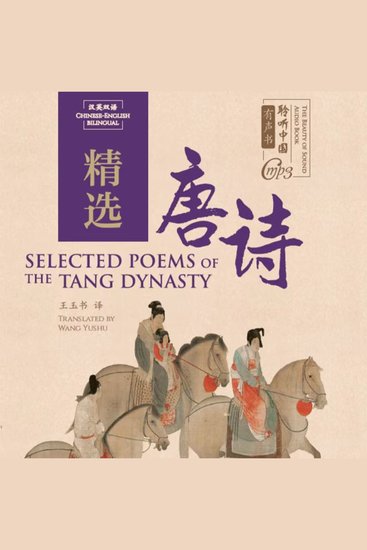
  • Selected Poems of the Tang Dynasty - 精选唐诗 - cover

    Selected Poems of the Tang...

    Wang Yushu

    • 0
    • 0
    • 0
    Tang poetry covers a wide range of subjects and has profound implications, shiny images, ornate diction and longstanding appeal. Different artistic styles and genres appeared at that time as if competing with one another for fascination. Many beautiful Tang poems are still on everyone's lips in China today and turn out to be gems in the treasure house of world literature. 
    The audiobook Selection of Tang Dynasty Poems contains the Tang Dynasty (618-907) poems from Selected Poems and Pictures of the Tang Dynasty, translated by Mr. Wang Yushu. Recited in Chinese and English by professionals, the audiobook is expected to help "readers" coming from varied language and cultural backgrounds to better enjoy the beauty of the Tang Dynasty poems.
    Mostra libro
  • Third Book of John The - The World English Bible Book 64 (Unabridged) - cover

    Third Book of John The - The...

    Various authors

    • 0
    • 0
    • 0
    The Third Book of John is the third-to-last book of the New Testament and the Christian Bible as a whole, and attributed to John the Evangelist, traditionally thought to be the author of the Gospel of John and the other two epistles of John. The Third Epistle of John is a personal letter sent by "the elder" to a man named Gaius, recommending to him a group of Christians led by Demetrius, which had come to preach the gospel in the area where Gaius lived. The purpose of the letter is to encourage and strengthen Gaius, and to warn him against Diotrephes, who refuses to cooperate with the author of the letter.
    Mostra libro
  • The Appeal to Emotion Fallacy - Manipulating Emotions Rather Than Presenting Valid Arguments - cover

    The Appeal to Emotion Fallacy -...

    William Rands

    • 0
    • 0
    • 0
    Logical fallacies are errors in reasoning that undermine the validity of an argument. They are often used unintentionally, but in many cases, they are deliberately employed to manipulate or persuade others. A logical fallacy may seem convincing on the surface, yet it lacks a sound basis when scrutinized more closely. Understanding logical fallacies is crucial because they can mislead audiences, derail thoughtful discussion, and obstruct the pursuit of truth. 
    The study of logical fallacies dates back to ancient Greece, where philosophers like Aristotle laid the foundations for reasoning and argumentation. Throughout history, these fallacies have evolved and manifested in various forms, adapting to the cultural and rhetorical needs of each era. While some fallacies are easy to identify, others are more subtle and sophisticated, making them harder to detect. 
    A logical fallacy is not necessarily about the truth or falsity of the conclusion; it pertains to the quality of the reasoning that leads to that conclusion. In other words, even if the conclusion of an argument is correct, the reasoning behind it may still be flawed. For example, an argument that relies on emotional appeals or personal attacks rather than facts and evidence is committing a fallacy, even if the conclusion is true.
    Mostra libro