Begleiten Sie uns auf eine literarische Weltreise!
Buch zum Bücherregal hinzufügen
Grey
Einen neuen Kommentar schreiben Default profile 50px
Grey
Jetzt das ganze Buch im Abo oder die ersten Seiten gratis lesen!
All characters reduced
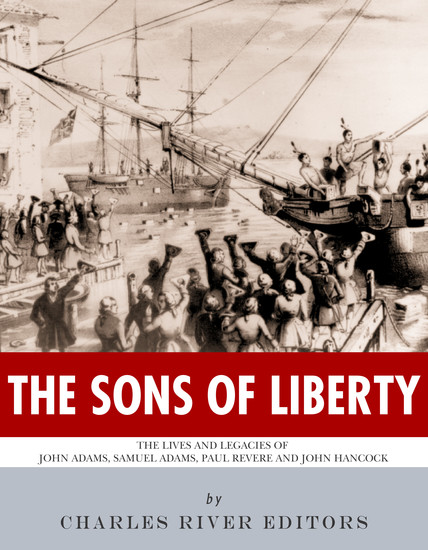
The Sons of Liberty - The Lives and Legacies of John Adams Samuel Adams Paul Revere and John Hancock - cover

The Sons of Liberty - The Lives and Legacies of John Adams Samuel Adams Paul Revere and John Hancock

Editors Charles River

Verlag: Charles River Editors

  • 0
  • 0
  • 0

Beschreibung

"The liberties of our Country, the freedom of our civil constitution are worth defending at all hazards: And it is our duty to defend them against all attacks.” – Samuel Adams
 
The American Revolution had no shortage of compelling characters with seemingly larger than life traits, including men like the multi-talented Benjamin Franklin, the wise Thomas Jefferson, the mercurial John Adams and the stoic George Washington. But no Revolutionary leader has been as controversial as Samuel Adams, who has been widely portrayed over the last two centuries as America’s most radical and fiery colonist.
 
Among his contemporaries, Adams was viewed as one of the most influential colonial leaders, a man Thomas Jefferson himself labeled “truly the Man of the Revolution” and the one who the Boston Gazette eulogized as the “Father of the American Revolution.” Adams was an outspoken opponent of British taxes in the 1760s, one of Boston’s hardest working writers and orators, a leader of the Boston Caucus, active in the Sons of Liberty, and a political leader who organized large gatherings in settings like Faneuil Hall and the Old South Meeting House. When cousin John Adams was an Ambassador to France during the Revolution, he had to explain that he was not the “famous” Adams.
 
At the same time, Adams’s zeal for his cause was unquestioned and unrivaled. During the Revolution, Adams exhorted his countrymen, "If ye love wealth greater than liberty, the tranquility of servitude greater than the animating contest for freedom, go home from us in peace. We seek not your counsel, nor your arms. Crouch down and lick the hand that feeds you; May your chains set lightly upon you, and may posterity forget that ye were our countrymen." Today historians believe that Adams’s legacy as a radical firebrand came from the British, who naturally viewed Adams as an incendiary troublemaker, and it is widely believed that important events like the Boston Massacre and Boston Tea Party were incorrectly attributed to the sway Adams held over the town. The exaggeration of Adams as the one man who could control a mob took hold, and even as modern historians try to recast Adams in a more moderate light, he continues to be remembered as the American Revolution’s most ardent patriot.
 
Over the course of 83 years, Paul Revere was one of the most prominent citizens in Boston, heralded for his silversmith work, his participation in the Sons of Liberty, and his service in the Massachusetts militia. Bearing 16 children by two wives, 11 of whom survived to adulthood, Revere supported his large family by doing everything from dentistry to casting church bells and engraving the most popular image of the Boston Massacre. His ability to roll copper into sheets made his work even more valuable to the dry docks and naval construction in Charlestown and around Boston. 
 
Given everything he did for Boston and his community, it would have no doubt greatly surprised Revere at the end of his life if he had known he would become an American legend for his midnight ride on the night of April 18, 1775. As a fervent and well-connected patriot who was part of Boston’s intelligence network, Revere was sent on the ride toward Lexington along with William Dawes, with the intention of warning the countryside that British troops were heading that way presumably to arrest patriot leaders Samuel Adams and John Hancock. After warning Adams and Hancock, Revere, Dawes, and another messenger, Samuel Prescott were stopped and detained by British soldiers on the path toward Concord, and though Dawes and Prescott managed to escape, Revere was escorted back toward Lexington by the British that morning.
Verfügbar seit: 03.06.2025.
Drucklänge: 123 Seiten.

Weitere Bücher, die Sie mögen werden

  • A Haunted Villa - From their pens to your ears genius in every story - cover

    A Haunted Villa - From their...

    Ömer Seyfettin

    • 0
    • 0
    • 0
    The bookshelves of World literature are incredible collections that have gathered together centuries of very talented authors.  From their countries and continents their fame spread and whilst among their number many are now forgotten or neglected their talents endure.  Among them is Ömer Seyfettin.
    Zum Buch
  • The Paris Girl - The Young Woman Who Outwitted the Nazis and Became a WWII Hero - cover

    The Paris Girl - The Young Woman...

    Francelle Bradford White

    • 0
    • 0
    • 0
    Andrée Griotteray was nineteen when the Germans invaded France and occupied Paris, where she worked as a clerk in the passport office. When her younger brother, Alain, created a resistance network named Orion, Andrée joined his efforts, secretly typing up and printing copies of an underground newspaper, and stealing ID cards which allowed scores of Jewish citizens to escape persecution. 


    Charming and pretty, Andrée nimbly avoided the unwanted attentions of German officers, even as she secretly began working as an undercover courier. Displaying fearlessness in the face of immense pressure, she traveled throughout the county delivering vital intelligence destined for France's allies—until the day she was betrayed and arrested. Throughout her ordeal, Andrée stayed composed, refusing to inform on her comrades. Before she was set free, she even duped her interrogators into revealing who had betrayed Orion, and continued her underground activities until France's liberation. 


    Weaving in diary entries, letters, and conversations, Andrée's daughter, Francelle, brings a uniquely personal slant to her mother's story. The Paris Girl reveals the narrow escapes and moments of terror, the daily acts of bravery and defiance, and the extraordinary courage displayed by Andrée and so many of her contemporaries, that helped turned the tide of war.
    Zum Buch
  • The Story of B24 - From their pens to your ears genius in every story - cover

    The Story of B24 - From their...

    Arthur Conan Doyle

    • 0
    • 0
    • 0
    Arthur Conan Doyle was born in Edinburgh, Scotland on 22nd May 1859.  His childhood was blighted by his father’s heavy drinking which for some years broke up the family. Fortunately, wealthy uncles were willing to support them by paying for education and clothing.  
    He was accepted at the University of Edinburgh to study medicine and also began to write short stories the first, ‘The Haunted Grange of Goresthorpe’, was published in Blackwood’s Magazine.  Despite several other stories and some articles in the British Medical Journal his medical studies took priority. 
    When these finished he was appointed as Doctor on the Greenland whaler ‘Hope of Peterhead’ in 1880 and then, after graduation, as ship’s surgeon on the SS Mayumba on its voyage to West Africa. 
    1882 saw a move to Plymouth and his own independent practice. With few patients he resumed writing and completed his first novel, ‘The Mystery of Cloomber’, although most of his output was short stories based on his experiences at sea.  
    He married Louisa Hawkins in 1885. However, two years later he met and fell in love with Jean Elizabeth Leckie, though they remained platonic out of respect for, and loyalty to, his wife. 
    His literary career suddenly burst into life in November 1886 with ‘A Study In Scarlet’, the first of the fabulously successful Sherlock Holmes stories.  
    With two children to support he now revisited his haphazard commercial arrangements and curtailed everything save for commissions from the Strand Magazine.  
    As a sportsman he was remarkably proficient. He was goalkeeper for Portsmouth Association Football Club and played ten first-class cricket matches for the Marylebone Cricket Club as well as captain of the Crowborough Beacon Golf Club in East Sussex.  
    In 1891 tired of writing Holmes stories, he began a series of historical novels and even went so far as to apparently kill off Holmes in a lethal brawl with his arch-nemesis Moriarty. 
    Despite heavy and sustained criticism he continued to write in support of the Boer War, a fact he thought contributed to his knighthood in 1902.  The following year to great relief and acclaim he brought Sherlock Holmes back from the dead in his first outing for a decade. 
    Sadly, his wife Louisa died from TB in 1906 and, a year later, he at last married Jean.  
    During the War and for several years after family deaths had left him depressed. In a search for solace and answers he alighted upon spiritualism and, such was his interest, that he wrote several books on the subject. 
    On 7th July 1930 Conan Doyle was discovered in the hall of Windlesham Manor, his house in East Sussex, clutching his chest dying of a heart attack.  He was 71.
    Zum Buch
  • Julius Caesar - The Famous Roman Emperor Who Transformed the Republic - cover

    Julius Caesar - The Famous Roman...

    Kelly Mass

    • 0
    • 0
    • 0
    Gaius Julius Caesar remains one of the most influential and recognizable figures in history. A brilliant military commander and astute statesman, Caesar played a decisive role in the events that led to the collapse of the Roman Republic and the rise of the Roman Empire. His life and career were marked by political ambition, military conquests, and transformative reforms that forever changed the Roman world.  
    Born into a patrician family, Caesar rose to prominence in Roman politics through strategic alliances and persuasive rhetoric. In 60 BC, he formed the First Triumvirate with Marcus Licinius Crassus and Gnaeus Pompeius Magnus, known as Pompey. This informal political alliance dominated Roman politics for several years, enabling Caesar to secure the consulship in 59 BC. The Triumvirate sought to advance the interests of the Populares, a political faction advocating for the rights of the common people, in opposition to the Optimates, the conservative faction of the Roman Senate. Powerful senators such as Cato the Younger and orator Cicero resisted Caesar’s growing influence, leading to increased political tensions.  
    To solidify his power, Caesar launched a series of military campaigns known as the Gallic Wars from 58 BC to 51 BC. These campaigns significantly expanded Roman territory, bringing Gaul (modern-day France and Belgium) under Roman control. Caesar's military success earned him wealth, popularity, and the unwavering loyalty of his legions. His invasion of Britain and the daring construction of a bridge over the Rhine River showcased his strategic prowess and ambition. These victories, however, unsettled Pompey, who grew increasingly aligned with the Senate following Crassus’ death in 53 BC. Fearing Caesar’s rising power, the Senate ordered him to disband his army and return to Rome as a private citizen. 
    Zum Buch
  • The Big Blue Jobbie - The Caging of a Well-Padded Scotswoman (Book 1) - cover

    The Big Blue Jobbie - The Caging...

    Yvonne Vincent

    • 0
    • 0
    • 0
    A witty, heart-warming and humorous account of family life during lockdown. 
    In March 2020 the Prime Minister told Mrs V to shield for 12 weeks. Then for a bit longer. And just a little bit longer.  No cuddles, no snogging, no tasting other people’s cocktails to see if they were nicer than hers; pick a spot and stay put. This was bad news for everyone, except possibly the ice cream industry.  Mrs V immediately laid claim to the dining room and created her little slice of self-isolation. From her perch in Covid Corner, she blogged about the daily ups and downs of family life in lockdown, keeping her readers laughing as the world got weirder. This book is a compilation of those posts, along with lots of extra bits and commentary. Like Mrs V, it’s slightly unconventional, quirky, full of warmth (both the loving and the menopausal kind) and has a filthy sense of humour.
    Zum Buch
  • Araby - From their pens to your ears genius in every story - cover

    Araby - From their pens to your...

    James Joyce

    • 0
    • 0
    • 0
    James Augustine Aloysius Joyce was born on the 2nd February 1882 in Dublin into a middle-class family, and the eldest of ten surviving siblings 
    Admired as a brilliant student he briefly attended the Christian Brothers-run O'Connell School before excelling at the Jesuit schools of Clongowes and Belvedere.  From there he went on to attend University College Dublin from 1898, studying English, French and Italian 
    In 1902, Joyce was now in his early twenties, and went to Paris to study Medicine but soon abandoned his teachings.  Back in Dublin to attend to his dying Mother he met Nora Barnacle. They bonded immediately into a life-long match. Together they decided to emigrate to Europe.  The couple lived in Trieste, Rome, Paris, and finally Zürich where Joyce pursued a variety of jobs and ventures to supplement his literary pursuits but none of these paid off.  
    After publishing a poetry volume, ‘Chamber Music’, in 1907, his short story collection ‘The Dubliners’, in 1914, helped establish his talent in the rapidly changing world.  
    Although far from home Joyce’s literary heart and works were set in his recollections of Dublin.  Characters are close resemblances of family and friends and indeed enemies.  His landmark work ‘Ulysses’, published in 1922, is set in the streets and alleyways of the city as it parallels Homer’s Odyssey in a variety of styles including its famed stream of consciousness. 
    His pen continued to produce classics of the order of ‘A Portrait of the Artist as A Young Man’ and ‘Finnegan’s Wake’ together with several volumes of poetry and a play ‘The Exiles, in 1918.   
    On the 11th January 1941, Joyce underwent surgery in Zürich for a perforated duodenal ulcer. The next day he fell into a coma. On the 13th after a brief period of lucidity in which he called for his wife and son he passed.  He was 58.
    Zum Buch