Junte-se a nós em uma viagem ao mundo dos livros!
Adicionar este livro à prateleira
Grey
Deixe um novo comentário Default profile 50px
Grey
Assine para ler o livro completo ou leia as primeiras páginas de graça!
All characters reduced
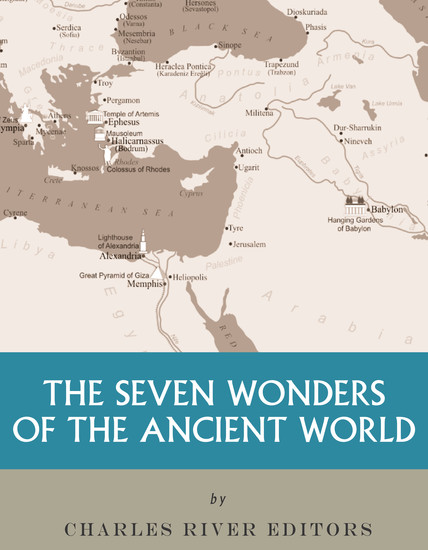
The Seven Wonders of the Ancient World - cover
LER

The Seven Wonders of the Ancient World

Editors Charles River

Editora: Charles River Editors

  • 0
  • 0
  • 0

Sinopse

“I have gazed on the walls of impregnable Babylon along which chariots may race, and on the Zeus by the banks of the Alpheus, I have seen the hanging gardens, and the Colossus of the Helios, the great man-made mountains of the lofty pyramids, and the gigantic tomb of Mausolus; but when I saw the sacred house of Artemis that towers to the clouds, the others were placed in the shade, for the sun himself has never looked upon its equal outside Olympus.” - Antipater
 
Over 2,000 years ago, two ancient writers named Antipater of Sidon and Philo of Byzantium authored antiquity’s most well known tour guides. After the two Greeks had traveled around the Mediterranean, they wrote of what they considered to be the classical world’s greatest construction projects. While there is still some question as to who actually authored the text attributed to Philo and when it was authored, their lists ended up comprising the Seven Wonders of the Ancient World, igniting interest in the ones they chose and inspiring subsequent generations to identify their era’s own Seven Wonders.
 
Naturally, the Seven Wonders of the Ancient World may be considered something of a misnomer. Only one still stands (the' Great Pyramid at Giza in Egypt), all existed in the Hellenistic culture rather than all over the world, and relatively few people saw them or visited them. They were all architectural marvels of the late Classical period and all but two were created by the Greeks. All but one were in the Mediterranean area. Even so, they represented a widespread range of works and cultures and spread out across three different continents.
 
The Seven Wonders of the Ancient World have continued to fascinate modern society, thanks in large measure to what was written about them and the fact that only one, the Great Pyramid at Giza, still survives. For that reason, speculation has revolved around the ones that didn’t. Did the Colossus of Rhodes straddle the entire harbor or was it a statue on a pedestal at the mouth of the harbor, like an ancient Statue of Liberty? How did the Babylonians successfully plant and irrigate the Hanging Gardens? How tall was the Lighthouse of Alexandria? When did Phidias construct the Statue of Zeus at Olympia?
 
The Seven Wonders of the Ancient World profiles each of the seven wonders named by Philon, discussing the history of each wonder, what was written about each wonder, what is known about each wonder, and the lingering mysteries surrounding what is not known about them. Along with historic depictions of the wonders, you will learn about the Seven Wonders of the Ancient World like you never have before, in no time at all.
 
 
Disponível desde: 28/05/2025.
Comprimento de impressão: 44 páginas.

Outros livros que poderiam interessá-lo

  • David Trimble: Peacemaker - cover

    David Trimble: Peacemaker

    Stephen Walker

    • 1
    • 0
    • 0
    Nobel laureate, party leader, peacemaker, first minister and statesman – David Trimble had many roles. But what is the real story behind the man who made headlines and changed lives?
    In this definitive biography of Trimble's life and death, award-winning journalist Stephen Walker vividly details how a shy Belfast academic changed the political landscape of Northern Ireland.
    Written with the cooperation of his widow, Lady Trimble, and their grown-up children, Peacemaker offers unparalleled insights into the life of the first person to be elected first minister of Northern Ireland and the most significant unionist leader since the creation of Northern Ireland in 1921. From the beginning of his political career in the dark days of the Troubles, to bringing unionism and nationalism together to end decades of division and violence and secure peace, Trimble's personal journey mirrors the story of Northern Ireland itself.
    Drawing on over 100 fresh interviews, this is a colourful and personal account of the life of a key figure in Irish history and an essential companion to Stephen Walker's bestselling biography of John Hume.
    Ver livro
  • Broken by the Office Boss (Gay Praise Kink Erotica) - cover

    Broken by the Office Boss (Gay...

    Archer Vale

    • 0
    • 0
    • 0
    “Step into my office. I’ll help you correct your mistakes.” 
    My boss doesn’t tolerate disobedience. 
    I’m a summer intern, but I’ve been underperforming. He says he doesn’t enjoy disciplining me, but it’s the only way to correct the issue. 
    Under his guidance, I’ve written foul things on my body. I’ve given him my phone and isolated myself. I’ve been spanked in his office. Everyone here thinks it’s hilarious. They keep laughing at me. 
    But…something inside me is changing. I’m beginning to crave his aggression… 
    --- 
    CONTAINS EXPLICIT GAY SEXUAL CONTENT. 
    For exclusive stories, visit www.ArcherVale.com.
    Ver livro
  • The Evolution of Peru's Economy - A Historical Perspective - cover

    The Evolution of Peru's Economy...

    Anya Solace

    • 0
    • 0
    • 0
    Peru’s economy has undergone a remarkable transformation over the centuries, shaped by geography, cultural heritage, and global economic forces. From the highly organized economic structures of pre-Colonial civilizations to the challenges of modern globalization, Peru’s development reflects a complex interplay of resource management, foreign influence, and domestic policies. Understanding the evolution of Peru’s economy requires a historical perspective that highlights the fundamental shifts in trade, industry, and governance that have defined the nation’s financial landscape.  
      
    The economic foundations of Peru were deeply influenced by its diverse geography and rich natural resources. The Andes, Amazon rainforest, and coastal plains provided a variety of ecosystems that supported agriculture, mining, and trade. Long before Spanish colonization, the Andean civilizations, particularly the Incas, developed sophisticated economic systems that relied on communal labor, redistribution networks, and agricultural innovations. These early economic structures created a foundation for productivity and social organization that persisted even after European intervention.  
      
    The arrival of the Spanish in the 16th century drastically altered Peru’s economic trajectory. The colonial period introduced extractive systems, such as the encomienda and mita, which forced indigenous populations into labor-intensive industries, particularly silver mining. This period established Peru as a key contributor to the Spanish Empire’s wealth but also entrenched an economic model centered on resource extraction and dependency on European markets. The restrictions imposed by Spain limited Peru’s economic autonomy, setting the stage for struggles following independence. 
    Ver livro
  • How To Stop Being A Narcissist - Break Toxic Patterns Build Real Confidence and Heal Your Relationships - cover

    How To Stop Being A Narcissist -...

    Jennifer B. Cory

    • 0
    • 0
    • 0
    Are you tired of being called selfish, manipulative, or emotionally unavailable—but deep down, you don’t know how to be any different? 
    You’re not alone. Narcissistic traits like defensiveness, control, and emotional detachment aren’t always intentional—they’re often survival habits formed long ago. But those same behaviors may be slowly destroying your relationships, your confidence, and your peace of mind. 
    How to Stop Being a Narcissist: Break Toxic Patterns, Build Real Confidence, and Heal Your Relationships from the Inside Out is not a book about labels—it’s a guide for people who are ready to stop pretending, start listening, and truly change. 
    Through honest reflection, relatable stories, and expert insight, this book will help you: 
    ✔️ Recognize the ego-driven patterns sabotaging your life 
     ✔️ Let go of the need to always be right or in control 
     ✔️ Rebuild trust with the people you’ve hurt 
     ✔️ Develop real empathy, emotional maturity, and self-worth 
     ✔️ Become someone who is safe to love—and to be loved by others 
    You don’t have to be ruled by your ego anymore. You don’t have to keep repeating the same mistakes. Change is hard, but it’s possible—and it starts the moment you’re brave enough to look in the mirror and say, “This isn’t who I want to be anymore.” 
    Ready to break the cycle and become the person you were meant to be? 
     Start reading How to Stop Being a Narcissist today—and take the first step toward true transformation.
    Ver livro
  • Sanctions - What Everyone Needs to Know - cover

    Sanctions - What Everyone Needs...

    Bruce W. Jentleson

    • 0
    • 0
    • 0
    A concise, authoritative overview of a little-understood yet extremely important phenomenon in world politics: the use of economic sanctions by one country to punish another. 


    It's hard to browse the news without seeing reports of yet another imposition of sanctions by one country on another. The United States has sanctions against more than thirty countries. Russia has repeatedly imposed sanctions against former Soviet republics. China has developed its own approach, including targeting private entities such as the NBA. And it's not just major powers: Japan and South Korea have sanctioned each other over WWII and colonial legacies; Saudi Arabia against Qatar because of differences over Iran; and France, Germany, and Norway against Brazil over the Amazon forest and climate change. In Sanctions: What Everyone Needs to Know®, Bruce Jentleson—one of America's leading scholars on the subject—answers the fundamental questions about sanctions today: Why are they used so much? What are their varieties? What are the key factors affecting their success? Why have they become the tool of first resort for states engaged in international conflict? Jentleson demonstrates that examining sanctions is key to understanding international relations and explains how and why they will likely continue to bear on global politics.
    Ver livro
  • Quiet Night Think - Poems & Essays - cover

    Quiet Night Think - Poems & Essays

    Gillian Sze

    • 0
    • 16
    • 0
    “One function of the poet at any time is to discover by his own thought and feeling what seems to him to be poetry at that time,” writes Wallace Stevens. In Quiet Night Think, award-winning poet Gillian Sze expresses her own definition.
    		 
    During the remarkable period of early parenthood, Sze’s new maternal role urges her to contemplate her own origins, both familial and artistic. Comprised of six personal essays, poems, and a concluding long poem, Quiet Night Think takes its title from a direct translation of an eighth-century Chinese poem by Li Bai, the subject of the opening essay. Sze’s memory of reading Li Bai’s poem as a child marks the beginning of an unshakable encounter with poetry. What follows is an intimate anatomization of her particular entanglement with languages and cultures.
    		 
    In her most generically diverse book yet, Sze moves between poetry and prose, mother and writer, the lyrical and the autobiographical, all the while inviting readers to meditate with her on questions of emergence and transformation: What are you trying to be? Where does a word break off? What calls to us throughout the night?
    Ver livro