Unisciti a noi in un viaggio nel mondo dei libri!
Aggiungi questo libro allo scaffale
Grey
Scrivi un nuovo commento Default profile 50px
Grey
Iscriviti per leggere l'intero libro o leggi le prime pagine gratuitamente!
All characters reduced
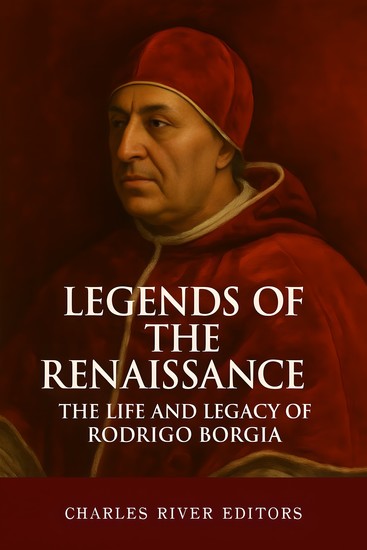
The Life and Legacy of Rodrigo Borgia - cover

The Life and Legacy of Rodrigo Borgia

Editors Charles River

Casa editrice: Charles River Editors

  • 0
  • 0
  • 0

Sinossi

“Alexander never did what he said.
 
Cesare never said what he did.” – Italian Proverb
 
A lot of ink has been spilled covering the lives of history’s most influential figures, but how much of the forest is lost for the trees? When historians are asked to pick a point in history when Western civilization was transformed and guided down the path to modernity, most of them point to the Renaissance. Indeed, the Renaissance revolutionized art, philosophy, religion, sciences and math, with individuals like Galileo, Leonardo, Michelangelo, Raphael, Dante, and Petrarch bridging the past and modern society. In Charles River Editors’ Legends of the Renaissance, readers can get caught up to speed on the lives of the most important men and women of the Renaissance in the time it takes to finish a commute, while learning interesting facts long forgotten or never known.
 
There have been no shortage of controversial Popes who were accused by Catholics and other Christians of impropriety, but the most controversial of all was the Borgia Pope, Alexander VI. Born Rodrigo Borgia, the future Pope made his way up the ranks of the Catholic Church with an assist from nepotism, breaking his vows of chastity and fathering several illegitimate children along the way.
 
The stories and legends attributed to Rodrigo and his children, particularly Cesare and Lucrezia, have made the Borgias one of the most notorious families in history. 500 years after Rodrigo’s death, he and his family have come to be associated more with incest, political intrigue, murder and state-sponsored violence. While 21st century TV series have cast the Borgias as the first organized crime family, the rumors spread by the family’s political opponents in the late 15th century have taken hold among a fascinated public. Did Rodrigo really have an incestuous relationship with daughter Lucrezia? Did he really throw lavish orgies?
 
While Rodrigo may not have been as colorful or criminal as the enduring legends, there is no question he was manipulative, ruthless and, ultimately, effective. From an administrative standpoint, Rodrigo was a success as Pope Alexander VI, with a big assist from son Cesare. To the extent that the Borgias are still associated with murder and mayhem, it was the father and son whose actions can be credited with the lion’s share of the perception. Not surprisingly, almost everything about Rodrigo’s life is still up for debate.
 
Legends of the Renaissance: The Life and Legacy of Rodrigo Borgia chronicles the Borgia Pope’s life and discusses the legends and myths surrounding him in an attempt to separate fact from fiction. Along with pictures of important people in his life, you will learn about Rodrigo Borgia like you never have before, in no time at all.
 
 
Disponibile da: 24/06/2025.
Lunghezza di stampa: 50 pagine.

Altri libri che potrebbero interessarti

  • The Great Famine of 1896-1897 - Famines in Colonial India - cover

    The Great Famine of 1896-1897 -...

    Sarah Willards

    • 0
    • 0
    • 0
    The Great Famine of 1896-1897 was one of the most devastating periods of hunger and suffering in colonial India. Spanning across large regions, particularly in the Deccan Plateau, this famine marked a tragic chapter in the history of British colonial rule. It resulted in the death of hundreds of thousands of people, although the exact number remains disputed due to the limited data available from that era. 
    This famine was not an isolated event but part of a larger pattern of food scarcity issues that India faced under British colonial governance. However, the 1896-1897 famine stood out due to the scale of its impact, the widespread malnutrition it caused, and the delayed and ineffective relief efforts by the British authorities. The failure to provide adequate assistance and the harsh economic policies implemented during this period are considered by many as contributing factors to the famine’s severity. 
    The environmental conditions in India played a significant role in the famine. A series of poor monsoons coupled with crop failures resulted in a severe food shortage. However, the effects of the famine were compounded by British policies that prioritized export of food grains from India to feed the empire’s industrial needs. This practice exacerbated food scarcity in the affected regions, leaving local populations without the resources they needed to survive.
    Mostra libro
  • Commando - A Boer Journal of the Anglo-Boer War - cover

    Commando - A Boer Journal of the...

    Deneys Reitz

    • 0
    • 0
    • 0
    The definitive account of Commando: A Boer Journal of the Anglo-Boer War, published word-for-word as Reitz first wrote it in the English translation; edited and annotated by historian and Anglo-Boer War expert, Professor Fransjohan Pretorius.
    In 1899, Deneys Reitz, then aged seventeen, enlisted in the Boer army to fight the British. He had learnt to ride, shoot and swim almost as soon as he could walk. He made full use of these skills and the endurance he had acquired in the next three years of the war, during which he fought with the Boer commandos.
    He was involved in major actions, like the battle of Spioen Kop, and he interacted with prolific political and military figures of the time, such as President Paul Kruger, Boer generals Piet Joubert, Louis Botha, Koos de la Rey, Christiaan Beyers, Jan Smuts and British commander Lord Kitchener. He even met the young Winston Churchill as a prisoner-of-war in Pretoria. Reitz forged a strong personal and political friendship with General Jan Smuts after the war, built on reciprocal respect.
    Commando is more than a historical document; it is a literary masterpiece that transcends time.
    With prose that captures both the brutality and the beauty of war, Reitz weaves a narrative that resonates with authenticity and passion.
    As relevant today as when it was first penned, Commando has become a South African classic and stands as a testament to the indomitable human spirit.
    Mostra libro
  • The Frontier Below - cover

    The Frontier Below

    Jeff Maynard

    • 0
    • 0
    • 0
    Triumphs and disasters in the deep sea 
    This is a journey through time and water, to the bottom of the ocean and the future of our planet. 
    We do not see the ocean when we look at the water that blankets more than two thirds of our planet. We only see the entrance to it. Beyond that entrance is a world hostile to humans, yet critical to our survival. The first divers to enter that world held their breath and splashed beneath the surface, often clutching rocks to pull them down. Over centuries, they invented wooden diving bells, clumsy diving suits, and unwieldy contraptions in attempts to go deeper and stay longer. But each advance was fraught with danger, as the intruders had to survive the crushing weight of water, or the deadly physiological effects of breathing compressed air. The vertical odyssey continued when explorers squeezed into heavy steel balls dangling on cables, or slung beneath floats filled with flammable gasoline. Plunging into the narrow trenches between the tectonic plates of the Earth’s crust, they eventually reached the bottom of the ocean in the same decade that men first walked on the moon. 
    Today, as nations scramble to exploit the resources of the ocean floor, The Frontier Below recalls a story of human endeavour that took 2,000 years to travel seven miles, then investigates how we will explore the ocean in the future. 
    Meticulously researched and drawing extensively on unpublished sources and personal interviews, The Frontier Below is the untold story of the pioneers who had the right stuff, but were forgotten because they went in the wrong direction. 
    The Frontier Below by Jeff Maynard is a captivating journey through the history of maritime expeditions, the science of physiology, and the economics of resource extraction. It is a testament to human endeavour and the indomitable spirit of exploration, offering a glimpse into the future of our oceans. 
    For fans of Julian Sancton (Madhouse at the End of the Earth), Buddy Levy (Empire of Ice and Stone), Rachel Lance (In the Waves), James Bradley (Ghost Species), and Helen Czerski (Blue Machine). 
    HarperCollins 2023
    Mostra libro
  • The Confessions of Saint Augustine - cover

    The Confessions of Saint Augustine

    Saint Augustine

    • 0
    • 0
    • 0
    "The Confessions of Saint Augustine" is an autobiographical work by St. Augustine of Hippo, consisting of 13 books written between AD 397 and 400. This seminal work outlines his sinful youth and his conversion to Christianity. It is widely seen as the first Western autobiography ever written, and it provides deep philosophical and theological insights into faith and morality. Augustine explores the nature of time, memory, and the inner self, and the narrative is as much a chronicle of his spiritual journey as it is a theological treatise.
    Mostra libro
  • Our Common Cause - Establishing the Political Power We Lack - cover

    Our Common Cause - Establishing...

    Étienne Chouard

    • 0
    • 0
    • 0
    I want to talk to you about democracy. The real one. The one that does not exist, and the one we really need today. My research method is that of Hippocrates, who said, look for the cause of causes. In other words, to cure a disease, to solve a problem, it is useless to attack the consequences, it is useless to attack the different causes. There is always a determining cause (the one that determines all the others)—and that is our common cause.
    The first decisive battle is to push the important words "right side up":
    First. I am not a "citizen" (a citizen is autonomous; he votes himself his laws). I am only a "voter;" that is to say, a political child—because I am subject to the law voted into existence by someone other than me.
    Second. My "parents" in politics, the elected officials, do not want me to emancipate myself from them—they do not allow me to vote for or against the laws to which I have to submit myself.
    We are "the incompetents." They treat us like children. But it is our fault, because children also believe in "Santa Claus," and so voters believe in "universal suffrage," which we accept to call "democracy" (demos kratos, power belongs to the people). The so-called modern "democracy".
    Mostra libro
  • The Bodhisattva Concept - cover

    The Bodhisattva Concept

    A.G.S. Kariyawasam

    • 0
    • 0
    • 0
    This is a Pariyatti audiobook of Bodhi Leaves No. 157, "The Bodhisattva Concept" by A.G.S. Kariyawasam found in the Pariyatti Edition of Collected Bodhi Leaves Vol. V.
     
    Excerpt from The Bodhisattva Concept:
     
    In original Pali Buddhism, the term bodhisatta is used more or less exclusively to designate Gautama Buddha prior to his enlightenment.
     
    'The concept of bodhisattva, along with that of Buddha and of the cakravartin (world-ruler), was in vogue in India even before the appearance of Gautama Buddha. When Prince Siddhārtha, who later became Gautama Buddha, took conception in the womb of Queen Māyā, a seer predicted that Suddhodana’s future son would be either a world-ruler (cakravartin) or a Buddha. Once, answering a question by a brahmin, the Buddha himself admitted that he is neither a god nor a yakkha, but a Buddha, meaning thereby one of a succession of Buddhas (A II 38).
    Mostra libro