Unisciti a noi in un viaggio nel mondo dei libri!
Aggiungi questo libro allo scaffale
Grey
Scrivi un nuovo commento Default profile 50px
Grey
Iscriviti per leggere l'intero libro o leggi le prime pagine gratuitamente!
All characters reduced
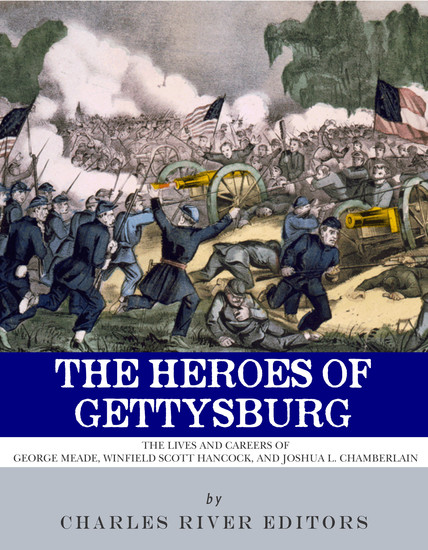
The Heroes of Gettysburg - The Lives and Careers of George Meade Winfield Scott Hancock and Joshua L Chamberlain - cover

The Heroes of Gettysburg - The Lives and Careers of George Meade Winfield Scott Hancock and Joshua L Chamberlain

Editors Charles River

Casa editrice: Charles River Editors

  • 0
  • 0
  • 0

Sinossi

Despite the fact that the Civil War began over 150 years ago, it remains one of the most widely discussed topics in America today, with Americans arguing over its causes, reenacting its famous battles, and debating which general was better than others. Americans continue to be fascinated by the Civil War icons who made the difference between victory and defeat in the war's great battles.
 
Ironically, one of the generals who often escapes the attention of Civil War fans who compile the lists of best generals is the man who won the war’s most famous battle, George G. Meade (1815-1872). In fact, Meade has become a perfect example of how the generals who did not self-promote themselves and write memoirs after the war had their reputations suffer in the ensuing decades. When people think of Appomattox Court House, they think of Ulysses S. Grant and Robert E. Lee. Few remember that the commander of the Army of the Potomac at the end of the Civil War was not Grant but Meade.
 
Meade exemplified modesty and competence, serving as a career United States Army officer and civil engineer who fought with distinction in the eastern theater of the Civil War. During the first half of the war, Meade rose from command of a brigade to command of a division and finally command of the entire Army of the Potomac just days before the Battle of Gettysburg.
 
Winfield Scott Hancock was an intimidating figure who impressed friends, foes, and fellow generals alike. Known as Hancock the Superb after McClellan described his performance as such during the Battle of Williamsburg in the Peninsula Campaign of 1862, Hancock eventually rose to become the Army of the Potomac’s greatest corps commander. Though his reputation and legacy gradually faded over time, Hancock was one of the North’s foremost war heroes by the end of the war, and he nearly became president in 1880 when he was just barely defeated by a less decorated Civil War veteran, James Garfield. 
 
After the Battle of Chancellorsville, he fortuitously became the new II Corps commander in the Army of the Potomac, just in time to deliver his greatest performance of all. At Gettysburg, Hancock was the commanding general in the field on Day 1, as Meade and the rest of the Union army arrived later that night. On Day 2, Hancock’s men assisted Sickles’ III Corps when Sickles disobeyed orders and moved it forward, creating a gap in the Union lines. And on Day 3, Hancock’s greatest day of the war, he was seriously injured and nearly bled to death while leading his men in their decisive repulse of Pickett’s Charge.
 
Chamberlain had a respectable Civil War career and life, but he had been largely forgotten in the decades after the Civil War, with the focus on more influential commanding generals and their principal subordinates. Then a remarkable thing happened with the 1974 publication of Michael Sharaa’s The Killer Angels, a Pulitzer Prize winning historical fiction that focuses on the Battle of Gettysburg and its influential generals and leaders. In one fell swoop, Michael Sharaa breathed life back into the reputations of men like John Buford and Joshua Chamberlain, cast as the Union heroes of Day 1 and Day 2 respectively that made victory at Gettysburg possible. In the novel, Chamberlain’s regiment holds the high ground against a series of desperate Confederate charges, and when they ran out of gunpowder, Chamberlain ordered a brave bayonet charge that drove the Confederates in their front from the fight. With that, the Union’s left flank was saved.
Disponibile da: 04/05/2025.
Lunghezza di stampa: 130 pagine.
Altri libri che potrebbero interessarti

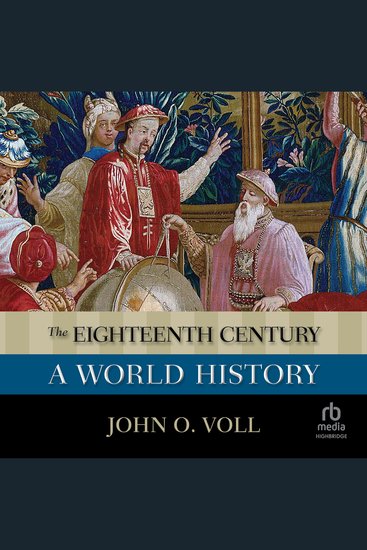
  • The Eighteenth Century - A World History - cover

    The Eighteenth Century - A World...

    John O. Voll

    • 0
    • 0
    • 0
    The eighteenth century was a time of major global transitions. Movements of religious and intellectual revival challenged established ideas, European colonies emerged in the Western hemisphere, global trade expanded, and political revolutions and revolts in America, France, Russia, and Haiti started to reshape political life. At the beginning of the century, power and wealth were roughly balanced among the major regions of the world. By its end, this balance was upset by the emergence of European imperial nation-states and Western European industrial societies whose evolution was enabled by modern processes of industrialization, globalization, and empires. 


    John O. Voll highlights key events and individuals in that transformation, from Emperor Kangxi's meeting with Jesuits and Catherine the Great's imperial expansion of Russia, Jonathan Edwards's Great Awakening and Muhammid ibn Abd al-Wahhab's Islam reform movement to Mulla Abdul Ghafur's trade in cotton, Richard Arkwright's textile factories, and Isaac Newton's and Immanuel Kant's contributions to the Enlightenment and modern science. This book shows that the eighteenth century was a time of transition to modernity, a time when the impact of the first globalization was being felt around the world. Old ways of life disappeared as new ways of organizing human activities emerged.
    Mostra libro
  • The History of the Peloponnesian War - cover

    The History of the Peloponnesian...

    Thucydides

    • 0
    • 0
    • 0
    The History of the Peloponnesian War is a historical account of the Peloponnesian War (431–404 BC), which was fought between the Peloponnesian League (led by Sparta) and the Delian League (led by Athens). It was written by Thucydides, an Athenian historian who also served as an Athenian general during the war. His account of the conflict is widely considered to be a classic and regarded as one of the earliest scholarly works of history. The History is divided into eight books. 
    Analyses of the History generally occur in one of two camps. On the one hand, some scholars such as J. B. Bury view the work as an objective and scientific piece of history. The judgment of Bury reflects this traditional interpretation of the History as "severe in its detachment, written from a purely intellectual point of view, unencumbered with platitudes and moral judgments, cold and critical." 
    On the other hand, in keeping with more recent interpretations that are associated with reader-response criticism, the History can be read as a piece of literature rather than an objective record of the historical events. This view is embodied in the words of W. R. Connor, who describes Thucydides as "an artist who responds to, selects and skillfully arranges his material, and develops its symbolic and emotional potential.
    Mostra libro
  • Transformative Horizons - Exploring the Future of Online Education - cover

    Transformative Horizons -...

    Nova Wilde

    • 0
    • 0
    • 0
    Whether you are an educator, a student, a parent, or simply a curious mind, "Transformative Horizons: Exploring the Future of Online Education" offers a compelling vision of how digital learning is reshaping our world. Embrace the possibilities, challenge the status quo, and join the conversation about the future of education.
    Mostra libro
  • The Lost Veda Sri Brama Samhita - Lord Brama's Prayers To Govindaji - cover

    The Lost Veda Sri Brama Samhita...

    Sripad Jaganantha Das

    • 0
    • 0
    • 0
    Lord Brahma saw Krsna directly and composed a prayer based on his realizations – a striking prayer by one who has seen the truth. 
      
    Krsna revealed himself to Brama, along with his spiritual planets. Overwhelmed by this transcendental revelation, Brama spoke these words glorifying Krsna. Brama’s awe and love permeate the text and reveal the workings of the cosmic creation. 
      
    The Brama Samhita teaches that transcendence, truth, and ultimate reality can be apprehended only by the mercy of the supreme transcendent entity, the Absolute Truth Himself, and that perception of ultimate reality is a function not of speculative reason but of direct spiritual cognition through divine revelation. This collection is taken from the fifth chapter of the Hymns of Brama, and includes verses 1 to 29.. There were 100 chapters in the Brama Samhita. This 5th chapter of the Brama Samhita was discovered by Lord Chaitanya. The other chapters have not yet been revealed. 
     
    The Brama-samhita clearly describes Brahman. Kṛṣṇa is the Supreme Brahman because of His unlimited knowledge, unlimited potencies, unlimited strength, unlimited influence, unlimited beauty, and unlimited renunciation. Ultimately, therefore, the word Brahman can be applied to Kṛṣṇa only.  
      
    Because the impersonal Brahman is the effulgence emanating as rays of Kṛṣṇa’s transcendental body, Kṛṣṇa is the Parabrahman. Everything rests on Brahman, but Brahman rests upon Kṛṣṇa. The material elements are accepted as the inferior energy of Kṛṣṇa. By their interaction, the cosmic manifestation takes place, rests on Kṛṣṇa, and after dissolution again enters into the body of Kṛṣṇa as His subtle energy. Kṛṣṇa is therefore the cause of both manifestation and dissolution. 
     
    Translator and commentator Bhaktisiddhanta Sarasvati was a Gaudīya Vaisnava Hindu guru, ācārya, and revivalist in early 20th century India. 
    Mostra libro
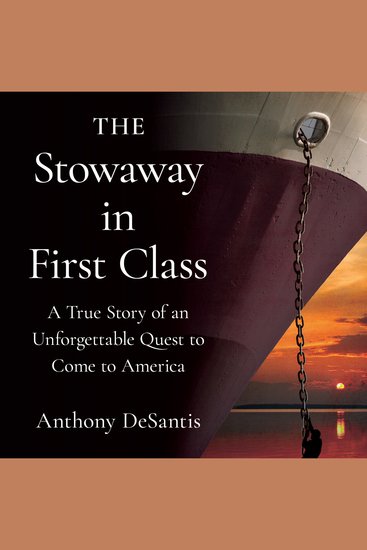
  • The Stowaway in First Class - A True Story of an Unforgettable Quest to Come to America - cover

    The Stowaway in First Class - A...

    Anthony DeSantis

    • 0
    • 0
    • 0
    A family’s legacy is forever changed in this true story of ransom notes, stowaways, and mobsters. 
    Paris, 1929. Gaetano “Guy” DeSantis is an Italian emigrant with a good life: a stable construction job, a comfortable place to live, and a blossoming relationship with a young waitress, Marie. But Guy dreams of making a future in America, alongside his cousin Frank who immigrated a few years earlier. 
    So when a mysterious stranger shows up at Guy’s door saying that Frank has paid for a boat ride across the Atlantic, how could Guy refuse? But there’s a catch—he must leave immediately, with no bags and no goodbyes.  
    With a heart of gold—and the suspense of a classic crime novel—this true story memorializes one man’s split-second decision to chart a new course for generations to come, proving that courage and honor do have the power to make a better life.
    Mostra libro
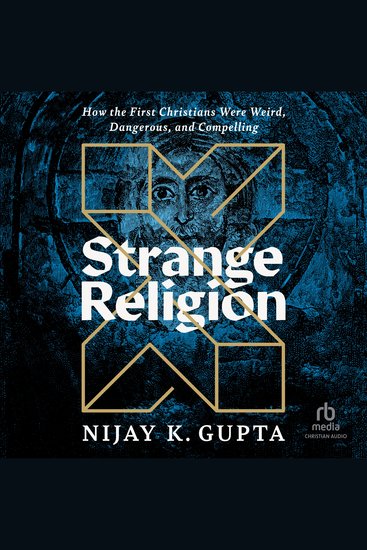
  • Strange Religion - How the First Christians Were Weird Dangerous and Compelling - cover

    Strange Religion - How the First...

    Nijay K. Gupta

    • 0
    • 0
    • 0
    The first Christians were weird. Just how weird is often lost on today's believers. 


    Within Roman society, the earliest Christians stood out for the oddness of their beliefs and practices. They believed unusual things, worshiped God in strange ways, and lived a unique lifestyle. They practiced a whole new way of thinking about and doing religion that would have been seen as bizarre and dangerous when compared to Roman religion and most other religions of the ancient world. 


    Award-winning author, blogger, speaker, and New Testament teacher Nijay Gupta traces the emerging Christian faith in its Roman context in this accessible and engaging book. Christianity would have been seen as radical in the Roman world, but some found this new religion attractive and compelling. The first Christians dared to be different, pushed the boundaries of what was acceptable, transformed how people thought about religion, and started a movement that grew like wildfire. This book shows how the example of the earliest Christians can offer today's believers encouragement and hope.
    Mostra libro