Unisciti a noi in un viaggio nel mondo dei libri!
Aggiungi questo libro allo scaffale
Grey
Scrivi un nuovo commento Default profile 50px
Grey
Iscriviti per leggere l'intero libro o leggi le prime pagine gratuitamente!
All characters reduced
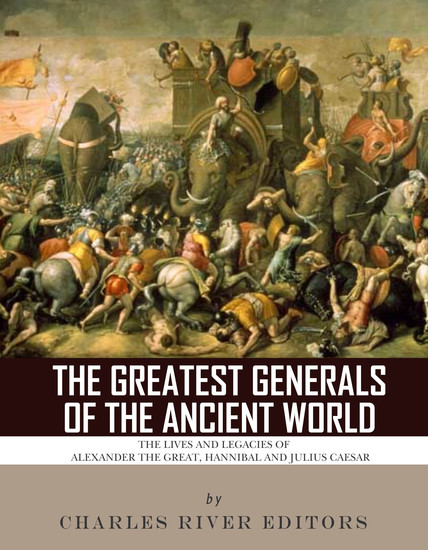
The Greatest Generals of the Ancient World - The Lives and Legacies of Alexander the Great Hannibal and Julius Caesar - cover

The Greatest Generals of the Ancient World - The Lives and Legacies of Alexander the Great Hannibal and Julius Caesar

Editors Charles River

Casa editrice: Charles River Editors

  • 0
  • 0
  • 0

Sinossi

Over the last 2,000 years, ambitious men have dreamed of forging vast empires and attaining eternal glory in battle, but of all the conquerors who took steps toward such dreams, none were ever as successful as antiquity’s first great conqueror. Leaders of the 20th century hoped to rival Napoleon’s accomplishments, while Napoleon aimed to emulate the accomplishments of Julius Caesar. But Caesar himself found inspiration in Alexander the Great (356-323 B.C.), the Macedonian King who managed to stretch an empire from Greece to the Himalayas in Asia at just 30 years old. It took less than 15 years for Alexander to conquer much of the known world.
 
As fate would have it, Alexander died of still unknown causes at the height of his conquests, when he was still in his early 30s. Although his empire was quickly divided, his legacy only grew, and Alexander became the stuff of legends even in his own time. Alexander was responsible for establishing 20 cities in his name across the world, most notably Alexandria in Egypt, and he was directly responsible for spreading Ancient Greek culture as far east as modern day India and other parts of Asia. For the ancient world, Alexander became the emblem of military greatness and accomplishment; it was reported that many of Rome’s greatest leaders, including Pompey the Great, Augustus, and Caesar himself all visited Alexander’s tomb in Alexandria, a mecca of sorts for antiquity’s other leaders.
 
In the history of war, only a select few men always make the list of greatest generals. Napoleon. Caesar. Alexander. They are always joined by Hannibal, who has the distinction of being the only man who nearly brought Rome to its knees before its decline almost 700 years later. Rome never suffered a more horrifying defeat in its history than at Cannae, and indeed, Hannibal nearly rewrote the course of Western history during the Second Punic War. Even today there remains great debate on just how he accomplished his masterful invasion of Italy across the Alps. Since his army included war elephants, historians still argue over exactly where and how he crossed over 2,000 years after he managed that incredible feat.
 
Hannibal will always be listed among history’s greatest generals, and his military campaign in Italy during the Second Punic War will always be studied, but part of the aura and mystique surrounding the Carthaginian legend is that there is still a lot of mystery. Since Carthage was destroyed by Rome a generation after Hannibal, most of what is known about Hannibal came from the very people he tormented in the late 2nd century B.C., and thus much of his background and life story is unknown. Moreover, while military historians are still amazed that he was able to maintain his army in Italy near Rome for nearly 15 years, scholars are still puzzled over some of his decisions, including why he never attempted to march on Rome in the first place.
 
Possibly the most important man of antiquity, and even all of history, was Julius Caesar. Alexander Hamilton, the famous American patriot, once remarked that “the greatest man who ever lived was Julius Caesar”. Such a tribute, coming from one of the Founding Fathers of the quintessential modern democracy in reference to a man who destroyed the Roman Republic, is testament to the enduring mark that Caesar left upon the world. The ultimate conqueror, statesman, dictator, visionary, and opportunist, during his time in power Caesar expanded the borders of Rome to almost twice their previous size, revolutionized the infrastructure of the Roman state, and destroyed the Roman Republic for good, leaving a line of emperors in its place. His legacy is so strong that his name has become, in many languages, synonymous with power: the Emperors of Austria and Germany bore the title Kaiser, and the Czars of Russia also owe the etymology of their title to Caesar.  
Disponibile da: 20/06/2025.
Lunghezza di stampa: 87 pagine.

Altri libri che potrebbero interessarti

  • Lost Boys - A Personal Journey Through the Manosphere - cover

    Lost Boys - A Personal Journey...

    James Bloodworth

    • 0
    • 0
    • 0
    Rarely has there been a more confusing time to be a man. This uncertainty has spawned an array of bizarre and harmful underground subcultures, collectively known as the manosphere, as men search for new forms of belonging. 
     
    In Lost Boys, James Bloodworth delves into these underground worlds and asks where have they come from? Why are so many men susceptible to the sinister beliefs these groups promote? What does the emergence of these communities say about Western society? And what can we do about it? In the course of his journey he meets incels, enlists on a bootcamp for so-called 'alpha males', and speaks to modern day Hugh Hefners using social media to broadcast their jet set lifestyles to millions of followers. 
     
    Combining compulsive memoir with powerful reporting, fascinating international case studies, data, cultural analysis and history, Lost Boys is an essential guide to the crisis in contemporary masculinity.
    Mostra libro
  • Taming the Octopus - The Long Battle for the Soul of the Corporation - cover

    Taming the Octopus - The Long...

    Kyle Edward Williams

    • 0
    • 0
    • 0
    The untold story of how efforts to hold big business accountable changed American capitalism. 


    In this vivid and surprising history, we meet twentieth-century activists, investors, executives, and workers who fought over a simple question: Is the role of the corporation to deliver profits to shareholders, or something more? On one side were "business statesmen" who believed corporate largess could solve social problems. On the other were libertarian intellectuals such as Milton Friedman and his oft-forgotten contemporary, Henry Manne, whose theories justified the ruthless tactics of a growing class of corporate raiders. But Kyle Edward Williams reveals that before the "activist investor" emerged as a capitalist archetype, Civil Rights groups used a similar playbook for different ends, buying shares to change a company from within. 


    As a rising tide of activists pushed corporations to account for societal harms from napalm to environmental pollution to inequitable hiring, a new idea emerged: that managers could maximize value for society while still turning a maximal profit. This elusive ideal, "stakeholder capitalism," still dominates our headlines today. Williams's necessary history equips us to reconsider democracy's tangled relationship with capitalism.
    Mostra libro
  • A Spiritual Journey of a Peaceful Warrior - cover

    A Spiritual Journey of a...

    Dan Millman

    • 0
    • 0
    • 0
    This deep dialogue uncovers many spiritual laws in everyday life. Millman gives us a taste of the four mentors who guided him on his spiritual quest. He calls these teachers The Professor, The Guru, The Warrior-Priest, and The Sage. They transmitted practical wisdom and spiritual laws for living wisely and well. These laws are as immutable as gravity.
    Mostra libro
  • Motherland - A Journey through 500000 Years of African Culture and Identity - cover

    Motherland - A Journey through...

    Luke Pepera

    • 0
    • 0
    • 0
    A groundbreaking exploration of 500,000 years of African history, cultures, and identity. 


    Historian, archaeologist, and anthropologist Luke Pepera takes us on a personal journey discovering 500,000 years of African history and cultures in order to reclaim and reconnect with this extraordinary heritage. He tackles the question many people of African descent ask—Who are we? Where do we come from? What defines us? And it explores how knowledge of this deeper history might affect current understandings of African identity. 


    Through thematically-linked chapters that explore aspects of African identity from nomadic culture and matriarchal society to beliefs about the afterlife and the tradition of oral storytelling, and interwoven with Luke's own experiences of exploring his Ghanaian family history and his personal questions of identity, this is a comprehensive, relevant, and beautifully told new history of Africa, and how it has shaped the world we know today.
    Mostra libro
  • Survival Secrets: An Unseen Chapter of Heroism and Sacrifice - Discover untold heroism and sacrifice! Dive into powerful audio lessons for an unforgettable story experience - cover

    Survival Secrets: An Unseen...

    Asher Reidman

    • 0
    • 0
    • 0
    Survival Secrets: An Unseen Chapter of Heroism and Sacrifice 
    Are you eager to advance in your career and strengthen your knowledge by understanding Discover resilience and bravery in unimaginable adversity? 
    Searching for a thorough guide that equips you with everything needed to grasp Discover resilience and bravery in unimaginable adversity? 
    Your search ends here! 
    This guide is your essential companion for deepening your understanding, applying your skills, and engaging in practical exercises. With this resource, you're prepared for success. 
    Now updated for the latest structure of Discover resilience and bravery in unimaginable adversity. 
    Key features of this enriched guide: 
    - Profound insights into Discover resilience and bravery in unimaginable adversity 
    - Detailed exploration of Discover resilience and bravery in unimaginable adversity 
    - Effective strategies for preparation and tackling challenges 
    Our guide stands out for its comprehensive coverage, crucial for overcoming adversity. Concepts are explored in depth and with precision. 
    Please note, this guide is an independent resource, not affiliated with any official entity. 
    Designed with clarity and simplicity, our guide ensures a smooth transition between topics. Experience content that is clear, precise, and technically accurate—no more complex jargon. 
    So, why delay? Click the BUY NOW button, get your guide, and start your journey towards mastering Discover resilience and bravery in unimaginable adversity!
    Mostra libro
  • The Truth About Lying - Teaching Honesty to Children at Every Age and Stage - cover

    The Truth About Lying - Teaching...

    PhD Victoria Talwar

    • 0
    • 0
    • 0
    All children lie. But when your child lies to you, it can feel like a personal betrayal. 


    Lying is a healthy and inevitable part of child development. But when do lies become a problem? In this book, psychologist Victoria Talwar, director of the Talwar Child Development Lab at McGill University, presents practical, science-based strategies to address lying and foster truthfulness in children, from early childhood to the teenage years. 


    Kids need to learn what honesty looks like in different social situations, and also how to tell the truth in ways that do not hurt others' feelings—a complicated task! Parents and caregivers will learn how to use stories and examples to have proactive conversations with children about honesty, and how to model honest behavior for children. Talwar shows listeners how to respond effectively when a child lies (as they inevitably will). Backed by years of psychological research, this common-sense, practical guide reveals which parenting strategies promote truthfulness in children—and which ones don't.
    Mostra libro