Unisciti a noi in un viaggio nel mondo dei libri!
Aggiungi questo libro allo scaffale
Grey
Scrivi un nuovo commento Default profile 50px
Grey
Iscriviti per leggere l'intero libro o leggi le prime pagine gratuitamente!
All characters reduced
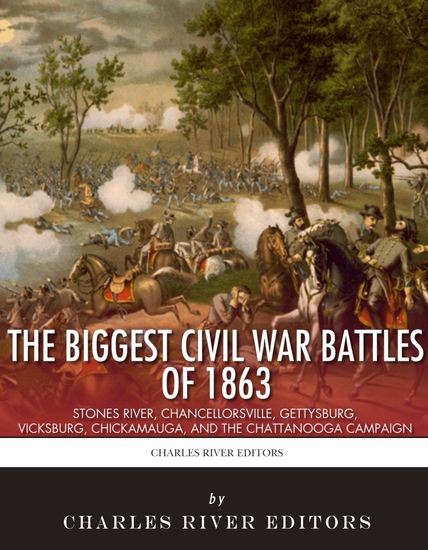
The Biggest Civil War Battles of 1863 - Stones River Chancellorsville Gettysburg Vicksburg Chickamauga and the Chattanooga Campaign - cover

The Biggest Civil War Battles of 1863 - Stones River Chancellorsville Gettysburg Vicksburg Chickamauga and the Chattanooga Campaign

Editors Charles River

Casa editrice: Charles River Editors

  • 0
  • 0
  • 0

Sinossi

Americans have long been fascinated by the Civil War and its biggest battles, particularly Gettysburg, Antietam, and Shiloh, all of which involved Robert E. Lee or Ulysses S. Grant. But one of the 6 biggest battles of the war, and the one that took the heaviest toll by % on both armies was fought at the end of 1862 in Tennessee, and it involved neither of those generals.
 
In late December 1862, William Rosecrans’s Union Army of the Cumberland was contesting Middle Tennessee against Braxton Bragg’s Army of Tennessee, and for three days the two armies savaged each other as Bragg threw his army at Rosecrans in a series of desperate assaults. Bragg’s army was unable to dislodge the Union army, and he eventually withdrew his army after learning that Rosecrans was on the verge of receiving reinforcements. Though the battle was stalemated, the fact that the Union army was left in possession of the field allowed Rosecrans to declare victory and embarrassed Bragg.
 
Though Stones River is mostly overlooked as a Civil War battle today, it had a decisive impact on the war. The two armies had both suffered nearly 33% casualties, an astounding number in 1862 that also ensured Rosecrans would not start another offensive campaign in Tennessee until the following June.
 
Lee’s heavily outnumbered army won the most stunning victory of the war at Chancellorsville, but it cost them Stonewall Jackson. Moreover, the reorganization of the armies and the battle itself played an influential role in the way the Pennsylvania Campaign and the Battle of Gettysburg unfolded later that summer.
 
After the South had lost the war, the importance of Gettysburg as one of the “high tide” marks of the Confederacy became apparent to everyone, making the battle all the more important in the years after it had been fought. While former Confederate generals cast about for scapegoats, with various officers pointing fingers at Robert E. Lee, James Longstreet, and James Stuart, historians and avid Civil War fans became obsessed with studying and analyzing all the command decisions and army movements during the entire campaign. Despite the saturation of coverage, Americans refuse to grow tired of visiting the battlefield and reliving the biggest battle fought in North America.
 
At the start of 1863, Robert E. Lee’s Army of Northern Virginia had been frustrating the Union in the Eastern theater for several months, but the situation in the West was completely different. The Confederates had lost control of several important states throughout 1862, and after New Orleans was taken by the Union, the North controlled almost all of the Mississippi River, which Confederate general James Longstreet called “the lungs of the Confederacy”. By taking control of that vital river, the North would virtually cut the Confederacy in two, putting the South in a dire situation.
 
The only domino left to fall was the stronghold of Vicksburg, and both sides knew it. The Union Army of the Tennessee, led by Ulysses S. Grant, would spend months trying to encircle the army and eventually force John Pemberton’s Confederate army to surrender. Grant eventually succeeded on July 4, 1863, but since it came a day after the climactic finish of the Battle of Gettysburg, Vicksburg was (and still is) frequently overlooked as one of the turning points of the Civil War. In fact, had the Confederate’s military leadership listened to Longstreet, who advocated detaching soldiers from Lee’s army to head west and help the Confederates deal with Grant or Rosecrans in that theater, the Battle of Gettysburg might never have happened.
Disponibile da: 02/05/2025.
Lunghezza di stampa: 289 pagine.

Altri libri che potrebbero interessarti

  • Crime and Punishment - cover

    Crime and Punishment

    Fyodor Dostoevsky

    • 0
    • 0
    • 0
    One desperate act. One guilty conscience. One mind slowly unraveling under the weight of its own secret.
    Raskolnikov, a brilliant but impoverished student, convinces himself that extraordinary people are allowed extraordinary crimes. But after he takes an axe into a pawnbroker's room, the real battle begins—not with the law, but with his own tortured soul. As suspicion closes in and compassion challenges his cold theories, Raskolnikov is forced to confront the darkness within himself.
    
    Praised as "one of the most powerful psychological novels ever written," Dostoevsky's masterpiece dives into morality, madness, justice, and the possibility of redemption. Its intensity, unforgettable characters, and philosophical depth continue to grip readers worldwide.
    
    If you crave suspense, emotional conflict, and a haunting exploration of the human mind, this classic will leave you breathless.
    
    Open the book—and step into a crime that changes everything.
    Mostra libro
  • Detroit in World War II - cover

    Detroit in World War II

    Gregory D. Sumner

    • 0
    • 0
    • 0
    When President Roosevelt called for the country to be the great "Arsenal of Democracy," Detroit helped turn the tide against fascism with its industrial might. Locals were committed to the cause, putting careers and personal ambitions on hold. Factories were retooled from the ground up. Industrialist Henry Ford, First Lady Eleanor Roosevelt, aviator Charles Lindbergh, legendary boxer Joe Louis, future baseball Hall of Famer Hank Greenberg and the real-life Rosie the Riveters all helped drive the city that was "forging thunderbolts" for the front lines. With a panoramic narrative, author Gregory D. Sumner chronicles the wartime sacrifices, contributions, and everyday life of the Motor City.
    Mostra libro
  • Africa Is Not a Country - Notes on a Bright Continent - cover

    Africa Is Not a Country - Notes...

    Dipo Faloyin

    • 0
    • 0
    • 0
    So often, Africa has been depicted simplistically as a uniform land of famines and safaris, poverty and strife, stripped of all nuance. In this bold and insightful book, Dipo Faloyin offers a much-needed corrective, weaving a vibrant tapestry of stories that bring to life Africa's rich diversity, communities, and histories. 


    Starting with an immersive description of the lively and complex urban life of Lagos, Faloyin unearths surprising truths about many African countries' colonial heritage and tells the story of the continent's struggles with democracy through seven dictatorships. With biting wit, he takes on the phenomenon of the white savior complex and brings to light the damage caused by charity campaigns of the past decades. Entering into the rivalries that energize the continent, Faloyin engages in the heated debate over which West African country makes the best jollof rice and describes the strange, incongruent beauty of the African Cup of Nations. With an eye toward the future promise of the continent, he explores the youth-led cultural and political movements that are defining and reimagining Africa on their own terms. 


    Africa Is Not a Country celebrates the energy and particularity of the continent's different cultures and communities, treating Africa with the respect it deserves.
    Mostra libro
  • Being Really Confused - A Guide to Heidegger and Other Crimes Against Clarity - cover

    Being Really Confused - A Guide...

    Sophia Blackwell

    • 0
    • 0
    • 0
    Ever opened Being and Time and wondered if your brain had a stroke? 
    Ever wanted to understand Heidegger, but all you got was a migraine and a vague sense of personal failure? 
    This is the book for you. 
    Being Really Confused is the hilariously brutal, no-holds-barred, sarcasm-soaked guide to Martin Heidegger’s philosophical fever dream. Whether you’re a burned-out philosophy major, a curious masochist, or someone who just wants to sound terrifyingly deep at brunch, this book unpacks the most infamously unreadable thinker of the 20th century—with jokes, rants, and zero patience for pretension. 
    Inside, you'll find: 
    What “Dasein” actually means (spoiler: it’s just you, but anxious) 
    How to ruin conversations with phrases like “Being-toward-death” 
    Why “the they” is probably responsible for your haircut 
    And how to survive Being and Time without filing a lawsuit against your own brain 
    Equal parts roast and revelation, this book doesn’t just explain Heidegger—it drags him, hugs him, then drags him again. 
    Read it if: 
    You want to laugh at existential dread 
    You love philosophy but hate suffering 
    You’ve been pretending to understand Heidegger and want to finally maybe mean it 
    Warning: May cause spontaneous existential crises, unbearable smugness, and the urge to buy a black turtleneck.
    Mostra libro
  • Breaking Bread - Insurgent Black Intellectual Life - cover

    Breaking Bread - Insurgent Black...

    Bell Hooks, Cornel West

    • 0
    • 0
    • 0
    In this provocative and captivating dialogue, bell hooks and Cornel West come together to discuss the dilemmas, contradictions, and joys of Black intellectual life. The two friends and comrades in struggle talk, argue, and disagree about everything from community to capitalism in a series of intimate conversations that range from playful to probing to revelatory. In evoking the act of breaking bread, the book calls upon the various traditions of sharing that take place in domestic, secular, and sacred life where people come together to give themselves, to nurture life, to renew their spirits, sustain their hopes, and to make a lived politics of revolutionary struggle an ongoing practice. 


    This twenty-fifth anniversary edition continues the dialogue with "In Solidarity," their 2016 conversation at the bell hooks Institute on racism, politics, popular culture, and the contemporary Black experience.
    Mostra libro
  • Reminiscences of My Life in Camp - cover

    Reminiscences of My Life in Camp

    Susie King Taylor

    • 0
    • 0
    • 0
    Madison & Adams Press presents the Civil War Memories Series. This meticulous selection of the firsthand accounts, memoirs and diaries is specially comprised for Civil War enthusiasts and all people curious about the personal accounts and true life stories of the unknown soldiers, the well known commanders, politicians, nurses and civilians amidst the war. 
    Reminiscences of My Life in Camp is an autobiographical work written by the first Black nurse during the American Civil War, Susie King Taylor. This exceptional reading depicts author's life as a slave, a freed woman, an educator and nurse, and a Black woman living in the postwar South.
    Mostra libro