Unisciti a noi in un viaggio nel mondo dei libri!
Aggiungi questo libro allo scaffale
Grey
Scrivi un nuovo commento Default profile 50px
Grey
Iscriviti per leggere l'intero libro o leggi le prime pagine gratuitamente!
All characters reduced
The Battle of the Ironclads - The Monitor & The Merrimac - cover

The Battle of the Ironclads - The Monitor & The Merrimac

Editors Charles River

Casa editrice: Charles River Editors

  • 0
  • 0
  • 0

Sinossi

“We of the Monitor think, and still think, that we had gained a great victory. This the Confederates have denied.” – S. Dana Greene
 
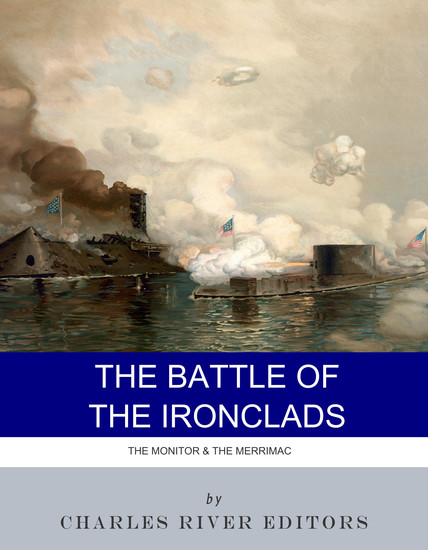
On March 8, 1862, the newest era of naval warfare began. That day, the CSS Virginia, an ironclad created out of the hull of the scuttled USS Merrimac by the Confederates, sailed down the Elizabeth River to Hampton Roads, where a Union blockade fleet was anchored. The wooden ships of the North were no match for the ironclad, which quickly rammed and sank the USS Cumberland, and as it trained its sights on the USS Congress, one Union officer noted the former Merrimac fired "shot and shell into her with terrific effect, while the shot from the Congress glanced from her iron-plated sloping sides, without doing any apparent injury."
 
The Merrimac had overwhelmingly demonstrated the superiority of the ironclad over the traditional frigates and gunships of the time, but it met its match the following day. On March 9, the North’s ironclad, the USS Monitor, arrived to challenge the Confederate ironclad. Though they were both outfitted with iron, the two ships had important differences. The Merrimac had more guns than the Monitor but was slower and more difficult to maneuver. The Monitor, however, did not have the size and power. Lieutenant S. Dana Greene described the initial shots in the battle of the ironclads: "The turrets and other parts of the ship were heavily struck, but the shots did not penetrate; the tower was intact, and it continued to revolve. A look of confidence passed over the men's faces, and we believed the Merrimac would not repeat the work she had accomplished the day before." The two ironclads would fight to a stand-still on that day, but naval warfare would never be the same.
 
The Battle of the Ironclads: The Monitor & The Merrimac looks at the history of the ships, the climactic battle, and the aftermath of their fight. Along with pictures and eyewitness accounts, you will learn about the Battle of the Ironclads like you never have before, in no time at all.
Disponibile da: 06/06/2025.
Lunghezza di stampa: 44 pagine.

Altri libri che potrebbero interessarti

  • Not Exactly Lying - Fake News and Fake Journalism in American History - cover

    Not Exactly Lying - Fake News...

    Andie Tucher

    • 0
    • 0
    • 0
    Long before the current preoccupation with "fake news," American newspapers routinely ran stories that were not quite, strictly speaking, true. Today, a firm boundary between fact and fakery is a hallmark of journalistic practice, yet for many readers and publishers across more than three centuries, this distinction has seemed slippery or even irrelevant. From fibs in America's first newspaper about royal incest to social media-driven conspiracy theories about Barack Obama's birthplace, Andie Tucher explores how American audiences have argued over what's real and what's not and why that matters for democracy. 


    Around the start of the twentieth century, journalists who were determined to improve the reputation of their craft established professional norms and the goal of objectivity. However, Tucher argues, the creation of outward forms of factuality unleashed new opportunities for falsehood: News doesn't have to be true as long as it looks true. Propaganda, disinformation, and advocacy—whether in print, on the radio, on television, or online—could be crafted to resemble the real thing. This "fake journalism" became inextricably bound up with right-wing politics, to the point where it has become an essential driver of political polarization. This book is a timely consideration of what happens to public life when news is not exactly true.
    Mostra libro
  • The Prophet - cover

    The Prophet

    Kahlil Gibran

    • 0
    • 0
    • 0
    The Prophet is a book beloved by millions for 100 years. The Prophet is a book of 26 prose poetry fables written in English by the Lebanese-American poet and writer Kahlil Gibran. It is Gibran's best-known work. 
    The prophet Al Mustafa has lived in the city of Orphalese for 12 years and is about to board a ship that will carry him home. He is stopped by a group of people with whom he discusses topics such as life and the human condition. The book is divided into chapters dealing with love, marriage, children, giving, eating and drinking, work, joy and sorrow, houses, clothes, buying and selling, crime and punishment, laws, freedom, reason and passion, pain, self-knowledge, teaching, friendship, talking, time, good and evil, prayer, pleasure, beauty, religion, and death. 
    Although published in 1923, the book contains universal wisdom that still rings true to this day and makes an excellent audiobook.
    Mostra libro
  • The Western Xia Dynasty - The Tangut Kingdom and Its Struggles for Survival - cover

    The Western Xia Dynasty - The...

    Rolf Hedger

    • 0
    • 0
    • 0
    The Western Xia Dynasty, founded by the Tangut people, emerged as a powerful and distinct kingdom in northwestern China during the 11th century. Its establishment marked the rise of a unique civilization that balanced influences from the Chinese, Tibetan, and Central Asian cultures while maintaining its own identity. The Tanguts, originally a nomadic group, gradually settled in the Ordos region and later expanded into the Hexi Corridor, an area of strategic importance due to its location along the Silk Road. 
    The dynasty was officially established in 1038 by Li Yuanhao, who declared himself emperor and adopted the title of the Great Xia. Li Yuanhao sought to solidify Tangut sovereignty by breaking free from the dominance of the Song Dynasty. To emphasize independence, he introduced significant reforms, including the creation of the Tangut script, a writing system distinct from Chinese characters, reinforcing cultural identity. Under his rule, Western Xia developed a centralized government, with administrative structures modeled in part after the Song system but adapted to suit Tangut traditions. 
    Expansion and military strength played crucial roles in the rise of the Western Xia. The Tanguts, skilled in cavalry warfare, built a formidable army that enabled them to challenge the Song Dynasty, the Liao Dynasty of the Khitans, and later, the Jin Dynasty of the Jurchens. Frequent conflicts with these neighboring states shaped Western Xia’s military strategies, leading to a highly fortified kingdom capable of defending its territory against multiple threats. While diplomacy was occasionally pursued, warfare was often the means through which the dynasty maintained its influence.
    Mostra libro
  • Any Person is the Only Self - Essays - cover

    Any Person is the Only Self -...

    Elisa Gabbert

    • 0
    • 0
    • 0
    Contagiously curious essays on reading, art, and the life of the mind, from the acclaimed author of The Unreality of Memory. 
     
    Who are we when we read? When we journal? Are we more ourselves alone or with friends? Right now or in memory? How does time transform us and the art we love? 
     
    In sixteen dazzling, expansive essays, the acclaimed essayist and poet Elisa Gabbert explores a life lived alongside books of all kinds: dog-eared and destroyed, cherished and discarded, classic and clichėd, familiar and profoundly new. She turns her witty, searching mind to the writers she admires, from Plath to Proust, and the themes that bind them―chance, freedom, envy, ambition, nostalgia, and happiness. She takes us to the strange edges of art and culture, from hair metal to surf movies to party fiction. Any Person Is the Only Self is a love letter to literature and to life, inviting us to think alongside one of our most thrilling and versatile critics.
    Mostra libro
  • Stones Still Speak - How Biblical Archaeology Illuminates the Stories You Thought You Knew - cover

    Stones Still Speak - How...

    Amanda Hope Haley

    • 0
    • 0
    • 0
    Untangling the Sunday School Stories You Learned from the Biblical History You Haven't   
     
    · Biblical archaeologist unearths the riches of the historical and cultural contexts of the Bible 
    · Unveils God's Word as one glorious, world-changing story 
     
    When we first encounter the Bible, we are taught its stories--Adam and Eve, Moses and the Red Sea, David and Goliath, Jonah and the whale, and more. When a story lacks the details we crave, we fill in the blanks--with what we've seen in movies, read in books, and been told by our Sunday school teachers. But there's a better way to encounter the whole story of Scripture: uncovering and understanding the ancient world and the people who experienced biblical events. 
     
    In Stones Still Speak, Harvard-trained archaeologist and theologian Amanda Hope Haley scrapes back 2,000 years of misguided cultural interpretations to reveal God's Word in its historical, archaeological, and literary contexts. Far from a dry academic exercise, this process explains how our misunderstandings developed and revitalizes the Scripture you thought you knew, with the greater purpose of encouraging a more intentional, rigorous study of the Bible in your daily life.
    Mostra libro
  • The Children We Left Behind - How Western Culture Rationalizes Family Separation & Ignores The Pain Of Child Neglect - cover

    The Children We Left Behind -...

    Adam B. Coleman

    • 0
    • 0
    • 0
    Nearly every major social problem in the West can be traced back to our declining appreciation for the nuclear family structure and our failure to plan for families properly. Our culture has shifted from prioritizing sacrifice for the benefit of innocent children to catering to the fleeting desires of the adults who bring them into the world. 
    As a result, family separation has become commonplace, and what we consider normal is often rationalized, even when it harms our children. The culture of radical individualism among adults has left children to bear the consequences of their parents' choices. 
    I was once that child who was left behind, neglected by his father, and witnessed his mother shoulder the load for our survival. My father's choice to abandon me physically and emotionally contributed to my decades of struggle with depression, low self-esteem, and suicidal ideation. 
    Unfortunately, my experience of homelessness, mental hospital incarceration, and perpetual internal strife is no longer rare. However, our stories are often ignored, and we avoid holding accountable the parents who have failed us. 
    If we are to change our culture's trajectory, we must sacrifice our pride and prioritize the needs of our children over our own selfish desires. Our children must come first, or they will come last-there is no middle ground.
    Mostra libro