Unisciti a noi in un viaggio nel mondo dei libri!
Aggiungi questo libro allo scaffale
Grey
Scrivi un nuovo commento Default profile 50px
Grey
Iscriviti per leggere l'intero libro o leggi le prime pagine gratuitamente!
All characters reduced
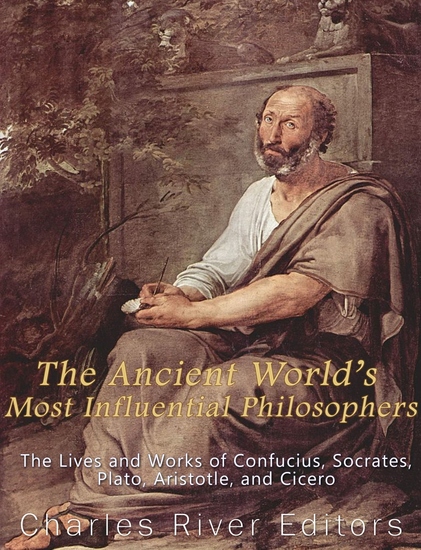
The Ancient World’s Most Influential Philosophers - The Lives and Works of Confucius Socrates Plato Aristotle and Cicero - cover

The Ancient World’s Most Influential Philosophers - The Lives and Works of Confucius Socrates Plato Aristotle and Cicero

Editors Charles River

Casa editrice: Charles River Editors

  • 0
  • 0
  • 0

Sinossi

Many people argue that Confucius is the most influential person of all time, and if having a significant effect on the greatest number of people is the criterion, he may very well be. China is one of the largest and oldest civilizations on earth, and Confucius has been influential there from almost the beginning: the first Chinese dynasty was founded around 1600 BCE and Confucius lived from 551-479 BCE.
 
Although he is still one of history’s most famous philosophers, Confucius was in many respects an unremarkable man, and even his physical features were said to be unattractive. There is little evidence that he thought of himself as a harbinger of any kind, but shortly after his death, writings, sayings, and theories based on his life and ideas spread throughout China and even took hold of the imperial court of one of the most powerful and important dynasties, the Han (206 BCE-220 CE). It was during the Han Dynasty that Confucianism became closely tied to state affairs, and it would remain so until the fall of the last dynasty in 1912. Confucianism was closely tied to state religious and ritual practice, and naturally, it benefited greatly from this relationship and was able to subsequently exert influence on all aspects of society.[1] As a "state religion", it provided "religious sanction for policy-making, official sacrifices, court ceremonies, royal marriage, funeral and mourning rights" as well as several major sacrifices to gods and ancestors.[2] Confucianism continues to reverberate to the present day; the Chinese Communist Party still discusses Confucius in their official newspapers and references his thought when they think it will help promote a political or social stance.
 
In 427 B.C., the Ancient Greek city-state of Athens was flourishing.  Approximately 80 years earlier, the Athenians had formed the first self-representative democracy in history, the Peloponnesian War against Sparta had only just started, and Socrates was only beginning to lay the foundation of what would become Western philosophy. 
 
None of Socrates’ works survived antiquity, so most of what is known about him came from the writings of his followers, most notably Plato.  What is known about Socrates is that he seemed to make a career out of philosophy, and Plato was intent on following in his footsteps. Yet for all of the influence of Socrates’ life on his followers, it was Socrates’ death around 399 B.C. that truly shaped them.  Plato was so embittered by Socrates’ trial in Athens that he completely soured on Athenian democracy, and Aristotle would later criticize politicians who relied on rhetoric; when Aristotle’s own life was threatened, he fled Greece and allegedly remarked, “I will not allow the Athenians to sin twice against philosophy."
 
Since Socrates wrote nothing down, or at least nothing that survived antiquity, there has been a wealth of scholarship ever since attempting to determine the person to whom the philosophical positions of the various (and genuine) Socratic dialogues of Plato’s should be attributed. Even though Aristotle insisted that Socrates only cared about ethics and held no metaphysical theory of the kind that Plato propounded, the attempt to read the ugly but wise Socrates via the Platonic dialogues continued up to the 20th century. The change of tone, style and philosophical topics seemed to be a big argument that Socratic views are to be found in the early Platonic works, whereas later works bear the stamp of Plato’s personal views. The Platonic scholar Gregory Vlastos introduced a developmentalist position which has almost become an orthodoxy in Platonic studies, by moving the discussion from the historical Socrates to Plato as a philosopher. According to developmentalism, if the views in the dialogue are not spelled out only to be refuted afterward, then the person they should be attributed to is Plato and not Socrates. These philosophical views developed over time.
Disponibile da: 01/05/2025.
Lunghezza di stampa: 154 pagine.
Altri libri che potrebbero interessarti

  • She is But a Woman - Queenship in Scotland 1424–1463 - cover

    She is But a Woman - Queenship...

    Fiona Anne Downie

    • 0
    • 0
    • 0
    She is but a Woman, the first in-depth study of medieval Scottish queens, investigates the relationship between gender and power in the medieval Scottish court by exploring the art of queenship as practised by Joan Beaufort and Mary of Guelders, queens of James I and James II. These women were excluded from authority but clearly possessed power as wives and mothers of kings. They established and cultivated relationships with members of the court, learned about Scottish political life and supported their husbands in the business of government. The book examines for the first time the arrivals of Joan and Mary in Scotland, their social and political status, their relationships with their husbands and families, and their roles in international diplomacy.
    This modern re-evaluation of the role and power of the medieval queen is a thematic exploration rather than a biographical study. It situates the experiences of Joan and Mary within a broader European context and provides a new perspective on Scotland's political, social and cultural links with Europe in the fifteenth century.
    Mostra libro
  • Narrative of the Captivity and Restoration of Mrs Mary Rowlandson - cover

    Narrative of the Captivity and...

    Mary Rowlandson

    • 0
    • 0
    • 0
    Dive into the pioneering American bestseller, The Narrative of the Captivity and Restoration of Mrs. Mary Rowlandson. This enthralling memoir presents an unflinching account of survival and spiritual endurance during King Philip's War in 1676. Captured by Native Americans, Mary Rowlandson endured an extraordinary eleven weeks in captivity, offering us a window into the early frontier life and the complex intercultural dynamics of the time. 
    Rowlandson's narrative transcends a mere survival tale. Deeply embedded in her Puritan faith, her story intertwines her harrowing experiences with reflections on divine providence, making it a profound exploration of faith under pressure. This aspect not only enriches the historical texture of her account but also provides invaluable insights into the Puritan worldview, appealing to those interested in religious history and early American culture. 
    Whether you are a lover of historical memoirs, a scholar of early American literature, or simply captivated by stories of human resilience, Mary Rowlandson's vivid recount of her captivity and restoration offers something for everyone. This narrative stands as a testament to the endurance of the human spirit and a valuable cultural artifact from a turbulent time in America’s past. 
    This audiobook was narrated and produced by RAM Studios, where humans and artificial intelligence collaborate to create an excellent listening experience. (The reading is done primarily by AI)
    Mostra libro
  • The Big Lie About Race in America's Schools - cover

    The Big Lie About Race in...

    Shaun R. Harper, Royel M. Johnson

    • 0
    • 0
    • 0
    Royel M. Johnson and Shaun R. Harper's book, The Big Lie About Race in America's Schools, delivers a collective response to the challenge of racially charged misinformation, disinformation, and censorship that increasingly permeates and weakens not only US education but also our democracy. Royel Johnson and Shaun Harper bring together leading education scholars and educators to confront the weaponized distortions that are undermining both public education and racial justice. The experts gathered in this work offer strategies to counter these dangerous trends.The contributors examine efforts both broad and specific, from restrictive education legislation, to book bans, to twisting terminology like Critical Race Theory (CRT) and diversity, equity, and inclusion (DEI), that are obscuring truth in public education. They demonstrate how this narrowing of ideas does a disservice to all students and especially to those who are underrepresented in curricula.Ultimately, the book offers clear, actionable insights for educators, policymakers, and advocates who seek solutions that will counter recent trends and transform educational contexts within K–12 and higher education. This volume advocates strengthening educational alliances through shared leadership, organized collaboration, and parental involvement. It also presents innovative countermeasures to help defend public education.
    Mostra libro
  • The Battle of Kings Mountain - Eyewitness Accounts: The Battle That Turned The Tide of the American Revolution - cover

    The Battle of Kings Mountain -...

    Robert M. Dunkerly

    • 0
    • 0
    • 0
    A pivotal moment in American history, as told by our forefathers 


    On October 7, 1780, American Patriot and Loyalist soldiers battled each other at Kings Mountain, near the border of North and South Carolina. With over one hundred eyewitness accounts, this collection of participant statements from men of both sides includes letters and statements in their original form—the soldiers' own words—unedited and unabridged. Rife with previously unpublished details of this historic turning point in the American Revolution, described as the war's "largest all-American fight," these accounts expose the dramatic happenings of the battle, including new perspectives on the debate over Patriot Colonel William Campbell's bravery during the fight. Robert M. Dunkerley's work is an invaluable resource to historians studying the flow of combat, genealogists tracing their ancestors, and anyone interested in Kings Mountain and the Southern Campaign.
    Mostra libro
  • 5 Reasons Why You Feel Empty Inside - Understanding Emotional Numbness and How to Overcome It - cover

    5 Reasons Why You Feel Empty...

    John Harpoon

    • 0
    • 0
    • 0
    Emotional numbness is a silent struggle that many people experience but rarely talk about. It’s that feeling of emptiness, the sense that something is missing even when life seems fine on the surface. You go through the motions of daily life, yet deep inside, there’s a void you can’t quite explain. Some people describe it as feeling detached, as if they’re watching their life from the outside without truly participating in it. Others might feel nothing at all, unable to connect with joy, sadness, or even excitement. If this sounds familiar, you are not alone.  
      
    In a world that constantly demands productivity and success, emotional well-being often takes a back seat. Many people dismiss their feelings, assuming that if they push through, things will eventually get better. But ignoring emotional numbness doesn’t make it go away. Instead, it lingers, slowly affecting relationships, motivation, and overall quality of life. This book was written to help you understand why you feel this way and, more importantly, how to regain the sense of connection and fulfillment that may seem lost.  
      
    Understanding emotional numbness requires looking beyond the surface. It’s not just about feeling “off” or disconnected—it often stems from deeper issues like unresolved trauma, chronic stress, or a lack of purpose. Some people experience it after prolonged emotional suppression, while others might feel empty due to unfulfilled needs or a sense of isolation. The reasons can vary, but the result is the same: a life that feels dull, unfulfilling, and distant. The good news is that emotional numbness is not permanent. With the right awareness and strategies, you can break free from this state and start experiencing life more fully. 
    Mostra libro
  • Evocation - Evoke The Power of Inter-Dimensional Beings and Summon Spirits - Yes You Can Series - cover

    Evocation - Evoke The Power of...

    Maria D'Andrea

    • 0
    • 0
    • 0
    TOP RATED PSYCHIC REVEALS HOW TO EVOKE THE MOST POWERFUL OF POSITIVE SPIRITS AND COMPEL THEM TO DO YOUR BIDDING! 
    HUNGARIAN BORN MARIA D'ANDREA SAYS YOU CAN GAIN RICHES, HONOR AND TRANQUILITY WITH THE USE OF VARIOUS PENTACLES, ALL OF WHICH ARE FULLY ILLUSTRATED IN THIS UNIQUE STUDY GUIDE. 
    If you are considering an occult approach to life's difficulties, this easy to read, step-by-step tutorial will teach you how to summon deities, angels, archangels, or any sort of inter-dimensional being, as well as the protocols for conversing with whatever entity arrives at your command. Maria's methods give you 100 percent control of the situation as you delve into what the sages of old have termed "ceremonial magick." 
    However, not only does Maria teach how to bring spirits into your presence, she also teaches proper cleansing and banishing techniques to help the student in the aftermath of the spirits' visit. You cannot be taken over or "possessed" if you follow Maria's instructions to the letter. 
    Indeed! If you approach contacting the various benevolent spirits who await your summoning with the proper caution and respect for ritual, you may get the kind of personal help you've needed for years but could never find elsewhere in the "real" world. What mortals cannot do for themselves, spirits will do for them. Maria's "Evocation" is here to aid in your contact and dealings with the "Other Side." 
    Spells you will find in this book include: 
    •Summon the Archangel Metetron to connect to the divine for information or healing. 
    •Gain riches, honor and tranquility by the skillful use of various pentacles, all of which are fully illustrated in the book. 
    •Use the pentacles of Venus to draw romance into your life or to safeguard and jump-start love relationships you’re in already.
    Mostra libro