Unisciti a noi in un viaggio nel mondo dei libri!
Aggiungi questo libro allo scaffale
Grey
Scrivi un nuovo commento Default profile 50px
Grey
Iscriviti per leggere l'intero libro o leggi le prime pagine gratuitamente!
All characters reduced
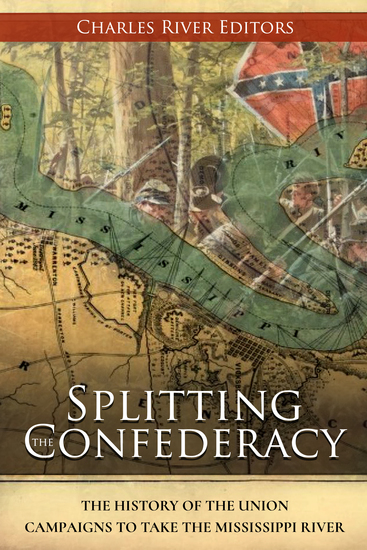
Splitting the Confederacy - The History of the Union Campaigns to Take the Mississippi River - cover

Splitting the Confederacy - The History of the Union Campaigns to Take the Mississippi River

Editors Charles River

Casa editrice: Charles River Editors

  • 0
  • 0
  • 0

Sinossi

Given its importance, it’s somewhat surprising in retrospect that the Union managed to capture New Orleans in an easier manner than places like Vicksburg and Atlanta. Admiral David Farragut’s naval forces battered their shaky Confederate counterparts and were able to get over a dozen ships upriver past a couple of crucial Confederate forts along the Mississippi. By May 1862, Union forces occupied the city and General Benjamin Butler became its military governor, leaving the last true bastion of Confederate defenses on the Mississippi at Vicksburg. When Grant captured that in July 1863, the Union controlled the entire river and essentially cut the Confederacy in two.
 
In many ways, the occupation of New Orleans for the rest of the war is as intriguing a story as the campaign to capture it. Butler was a political general, and while he would go on to be a politician in the North after the war, he became the most reviled man in the South as a result of his reign in New Orleans. During a governorship that helped earn him the moniker “Beast,” Butler became notorious for several acts, including seizing a massive amount of money that had been deposited in the Dutch consul’s office. But it was General Order No. 28, which said any woman in town who insulted a member of the Army would be treated like “a "woman of the town plying her avocation" (in other words, she’d be treated as a prostitute) that earned widespread condemnation across the nation, and even abroad in England. Butler was considered so brutal in the South that Confederate president Jefferson Davis personally ordered that he should be executed if he was captured. As it turned out, he never was, and when he was recalled east, he served in commands for the duration of the war before going on to a distinguished political career.
 
The only domino left to fall was the stronghold of Vicksburg, and both sides knew it. The Union Army of the Tennessee, led by Ulysses S. Grant, would spend months trying to encircle the city and eventually force John Pemberton’s Confederate army to surrender. Grant eventually succeeded on July 4, 1863, but since it came a day after the climactic finish of the Battle of Gettysburg, Vicksburg was (and still is) frequently overlooked as one of the turning points of the Civil War. In fact, had the Confederate’s military leadership listened to Longstreet, who advocated detaching soldiers from Lee’s army to head west and help the Confederates deal with Grant or Rosecrans in that theater, the Battle of Gettysburg might never have happened.
 
While many read about the siege of Vicksburg in the summer of 1863, as well as the desperate straits the Confederate soldiers and Vicksburg residents found themselves in, Grant’s initial attempts to advance towards Vicksburg met with several miserable failures, and it took several months just to get to the point where the Union forces could start a siege. First, Grant’s supply base at Holly Springs was captured, and then an assault launched by Union General Sherman at Chickasaw Bayou was easily repulsed by Confederate forces, with serious Union casualties resulting.  Grant then attempted to have his men build canals north and west of the city to facilitate transportation, which included grueling work and disease in the bayous.
 
On April 30, 1863, Grant finally launched the successful campaign against Vicksburg, marching down the western side of the Mississippi River while the navy covered his movements. He then crossed the river south of Vicksburg and quickly took Port Gibson on May 1, Grand Gulf on May 3, and Raymond on May 12.  Realizing Vicksburg was the objective, the Confederate forces under the command of Pemberton gathered in that vicinity, but instead of going directly for Vicksburg, Grant took the state capital of Jackson instead, effectively isolating Vicksburg. Pemberton’s garrison now had broken communication and supply lines.
Disponibile da: 01/05/2025.
Lunghezza di stampa: 84 pagine.


Altri libri che potrebbero interessarti

  • The Last Empire - Essays 1992-2000 - cover

    The Last Empire - Essays 1992-2000

    Gore Vidal

    • 0
    • 0
    • 0
    The Last Empire is a collection of provocative, witty, and eloquent essays by Gore Vidal about all things USA. In more than two dozen essays, Vidal brings his keen intellect, experience, and razor-edged wit to bear on an astonishing range of subjects, offering incisive observations about terrorism, civil liberties, the CIA, Al Gore, and the Clintons—interwoven with a rich tapestry of personal anecdote, critical insight, and historical detail. Erudite, forever curious, argumentative, irascible, and often very funny, Gore writes that the United States is, "a unique society in which we have free enterprise for the poor and socialism for the rich." The Last Empire is a sweeping coda to the still-existing conflicted vision of the American dream—leaving no need to imagine what trenchant barbs Vidal would have uttered concerning the state and level of discourse of American society right now.
    Mostra libro
  • The Glorious Revolution - England's Bloodless Overthrow - cover

    The Glorious Revolution -...

    Nova Ashford

    • 0
    • 0
    • 0
    The Glorious Revolution of 1688 was not an event that occurred overnight; it was the culmination of years of political, religious, and social tensions in England. By the late 17th century, England was experiencing a period of instability and growing unrest, especially regarding the power of the monarchy versus the authority of Parliament. King James II, who ascended the throne in 1685, was a deeply polarizing figure. His reign would ignite the political crisis that eventually led to what would become known as the Glorious Revolution—a bloodless overthrow of the monarchy that profoundly reshaped English government and society. 
    James II, a devout Catholic, introduced policies that alarmed the predominantly Protestant English population. He sought to expand royal power at the expense of Parliament, leading to widespread fear of a return to Catholicism and absolute monarchy, similar to the reigns of his predecessors. His attempts to grant religious tolerance to Catholics and appoint them to high government and military positions created a rift between him and Parliament, which was largely controlled by Protestants. Moreover, his apparent disregard for the Protestant majority's concerns about his intentions deepened the divide between the monarchy and the English people. 
    At the same time, the political landscape of England was undergoing significant changes. The Whigs and Tories, the two major political factions of the time, were increasingly at odds over issues of religion and royal power. The Whigs, with their preference for constitutional monarchy and limited royal power, were particularly opposed to James II’s policies. They sought to preserve the Protestant faith and limit the king’s ability to impose his will without Parliament’s consent. On the other hand, the Tories, while still supportive of the monarchy, became increasingly wary of James's actions and the possibility of his dynastic line establishing a Catholic monarchy in England.
    Mostra libro
  • Rewrite Your Life - Discover Your Truth Through the Healing Power of Fiction - cover

    Rewrite Your Life - Discover...

    Jessica Lourey

    • 0
    • 0
    • 0
    Learn the Art of Storytelling“A step-by-step guide for writers struggling to create fiction from their life . . . delivers on its promise with such honesty, simplicity, and beauty.”—William Kent Krueger, New York Times bestselling author
     
    #1 Bestseller in Self-Help, CreativityShortlisted for an Agatha Award for Best Nonfiction!
     
    Tender, raw, and laugh-out-loud funny, Rewrite Your Life offers both a map and a compass for those seeking to harvest their life experiences to heal, lead a more authentic life, and craft a rich, powerful work of fiction.
     
    According to common wisdom, we all have a book inside of us. But how do we select and then write our most significant story—the one that helps us to evolve and invites pure creativity into our lives? In Rewrite Your Life, creative writing professor, sociologist, and popular fiction author Jess Lourey guides you through the redemptive process of writing a healing novel that recycles and transforms your most precious resources—your own emotions and experiences.
     
    There’s more to writing that meets the eye. This fact-to-fiction process provides not only the essential building blocks of bestselling novels but is also personally transformative. Based on the process the author developed and field-tested in the wake of her husband’s suicide, Rewrite Your Life is devoted to the practice of discovering, healing, and evolving through fiction writing. It combines research, practical and engaging guidance, and personal experience to meet readers where they are and take their creativity and personal growth to the next level.
     
    Rewrite your life teaches you to:
     
    Navigate the inner process to telling a storyUse tools and tactics to master fiction writingUncover the stories through your experiencesIf you have read books such as Save the Cat! Writes a Novel, How to Be Heard, or Story Power, you will love Rewrite Your Life.
    Mostra libro
  • The Law - cover

    The Law

    Bastiat Frederic

    • 0
    • 0
    • 0
    An analysis that grounds the law in the personality, liberty, and property of the individual from “the most brilliant economic journalist who ever lived” (Joseph Schumpeter, twentieth-century political economist).  The law is the organization of the natural right of lawful defense; it is the substitution of collective for individual forces, for the purpose of acting in the sphere in which they have a right to act, of doing what they have a right to do, to secure persons, liberties, and properties, and to maintain each in its right, so as to cause justice to reign over all.   It is with these words that the nineteenth-century French economist and statesman Frédéric Bastiat describes his theory of the individual rights of man in a classic refutation of the communist ideas that were sweeping across France at the time. In these pages, Bastiat affirms that the non-intervention of the State in private affairs gives rise to our wants and their satisfactions developing in their natural order. Problems arise when the law leaves its proper sphere and is employed in annihilating that justice which it should have established. He describes the threat of socialism as “philanthropic tyranny,” the enemy to his revered principles of justice, peace, order, stability, harmony, and logic. In clear, concise prose, Bastiat reveals the dangers of government overreach, a philosophy that still inspires libertarian ideology today.
    Mostra libro
  • The Age of Elizabeth - cover

    The Age of Elizabeth

    MA Andrew Browning

    • 0
    • 0
    • 0
    From her accession through her impressive reign, this thorough biography of Elizabeth I details the life and rule of one of Britain/s most influential rulers. From diplomatic relations to military choices to the Wars of Religion, this book is extensive, detailed, and fascinating.
    Mostra libro
  • Reclaim - understanding complex trauma and those who abuse - cover

    Reclaim - understanding complex...

    Dr. Ahona Guha

    • 0
    • 0
    • 0
    The relationship between trauma and mental health is becoming better recognized, but survivors and professionals alike remain confused about how best to understand and treat it. In Reclaim, through a series of case studies and expert analysis, Dr. Ahona Guha explores complex traumas, how survivors can recover and heal, and the nature of those who abuse. She shines a light on the "difficult" trauma victims that society often ignores, and tackles vital questions such as, "Why are psychological abuse and coercive control so difficult to spot?" and "Why do some people harm others, and how do we protect ourselves from them?" 


    As a clinical and forensic psychologist, Dr. Guha has had extensive experience in working with those who perpetrate harm—including stalkers, sex offenders, violent offenders, and those who threaten, bully, and harass—and she has a deep understanding of the psychological and social factors that cause people to abuse others. In turn, her clinical work in the trauma treatment field has led her to recognize the enormous impacts of complex trauma, and the failures of systems when working with those who have been victimized. 


    By emphasizing compassion above all, Dr. Guha calls for us to become better informed about perpetrators and the needs of victims, so we might reclaim a safer, healthier society for everyone.
    Mostra libro