Unisciti a noi in un viaggio nel mondo dei libri!
Aggiungi questo libro allo scaffale
Grey
Scrivi un nuovo commento Default profile 50px
Grey
Iscriviti per leggere l'intero libro o leggi le prime pagine gratuitamente!
All characters reduced
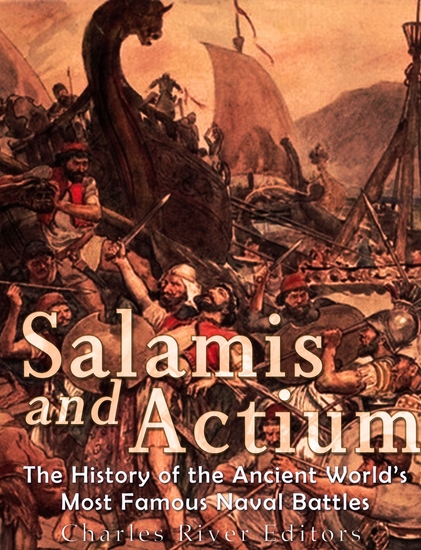
Salamis and Actium - The History of the Ancient World’s Most Famous Naval Battles - cover

Salamis and Actium - The History of the Ancient World’s Most Famous Naval Battles

Editors Charles River

Casa editrice: Charles River Editors

  • 0
  • 0
  • 0

Sinossi

When the Spartans’ famous and sacrificial stand at the Battle of Thermopylae ended during the Second Persian War, the Athenian fleet was forced to fall back, and Xerxes’ massive Persian army marched unopposed into Greece before advancing on Athens. The Greek armies were scattered and unable to face the might of Persia, so Athens was forced to do the unthinkable: evacuate the entire population of the city to Salamis, from where the Athenians watched in horror as Xerxes’ troops plundered the defenseless city, set it aflame, and razed the Acropolis.
 
However, the Athenians remained belligerent, in part because according to the oracle at Delphi, “only the wooden wall shall save you.” Indeed, this would prove true when Themistocles managed to lure the Persian fleet into the straits of Salamis. There, on a warm day in September 480 BCE, hundreds of Greek and Persian ships faced each other in a narrow strait between the Attic peninsula of Greece and the island of Salamis. The battle that ensued would prove to be epic on a number of different levels, as it set a precedent for how later naval battles were fought in the ancient Mediterranean, turned the tide in the Greeks’ favor against the Persians in the Persian Wars, and ultimately played a role in Athens’ rise to a preeminent role in the Hellenic world.
 
Bereft of much of his fleet after Salamis, Xerxes feared being stranded on the wrong side of the Hellespont, as there was a chance Themistocles might take the allied navy north to destroy his bridge across the straits. Accordingly, he retreated with the greater part of his army, back through Thermopylae and then from there to Persia, and many of his men perished from lack of adequate supplies and disease. Thus, it can safely be said that while Thermopylae continues to be more celebrated and better remembered, Salamis was the decisive battle of the Second Persian War.
 
Every era has watershed moments that shape the arc of history, and for Ancient Rome, few were as decisive or monumental as the Battle of Actium in 31 B.C. The battle’s importance is understandable given the stakes and people involved; Actium pitted the joint navies of Cleopatra and Mark Antony against the battle fleet of Octavian. In many ways, this climactic battle was the culmination of a years-long power struggle between the heirs of the assassinated Julius Caesar, with Octavian being his legally appointed heir and Antony being his longtime lieutenant and trusted advisor. Antony had even taken Caesar’s Egyptian mistress as his own.
 
Actium is also remarkable because Roman conflicts were almost always decided on land. The generals of the Roman Republic were far more comfortable fighting on land than at sea, and while Pompey Magnus had made a reputation fighting on the Mediterranean, it was his victories during Sulla’s war that earned him his distinguished nickname. Likewise, Caesar had largely shunned naval combat throughout his distinguished career, and he had even been captured by pirates while sailing in the Aegean. Philippi, Mutina, Utica and Pharsalus had all been land battles, and with good reason. Unlike the British Empire of the 19th century or Athens and her “Wooden Wall”, the Roman military machine was almost entirely geared towards land combat, which received the greater part of funding from the state and was considered by far the more honorable profession. While the annals of Roman history are replete with great generals, they are considerably lighter on the side of the admirals, and there were many examples of generals finding the transition to sea difficult. Roman antipathy for sea fighting may explain why the piracy problem was such an endemic one for the Mediterranean during their rule. 
Disponibile da: 01/05/2025.
Lunghezza di stampa: 86 pagine.

Altri libri che potrebbero interessarti

  • The Ten Legal Cases That Made Modern Britain - cover

    The Ten Legal Cases That Made...

    Inigo Bing

    • 0
    • 0
    • 0
    LIFE. SEX. RACE. POWER. FREE SPEECH. PROTEST. PRIVACY. DEMOCRACY. SOVEREIGNTY. DEATH.
    Society shapes law… and law shapes society.
    We like to imagine that progress comes about when Parliament spots a looming groundswell in public opinion and responds by changing the laws that govern our daily lives. This is not always true.
    In this fascinating book, Inigo Bing unravels ten legal cases in which the decisions of judges or a jury either heralded a shift in outlook or forced Parliament to respond to simmering social change.
    Some of these cases demonstrate the role judges have in defending our civil liberties against overweening executive power, articulating inherent unwritten rights Parliament would prefer to keep quiet about. Others explore what happens when rapid technological or social change outpaces government, placing urgent ethical dilemmas in the lap of the court. All of them have had a lasting impact on the society we inhabit.
    Taken together, these stories provide a powerful insight into eighty years of British social, political and cultural history, illustrating why legal cases are just as important to making our world as laws written by Parliament or grassroots changes within society.
    Mostra libro
  • The Oak Papers - cover

    The Oak Papers

    James Canton

    • 0
    • 0
    • 0
    ""A profound meditation on the human need for connection with nature, as one man seeks solace beneath the bows of an ancient oak tree.""—Peter Wohlleben, author of The Hidden Life of Trees 
    ""James Canton knows so much, writes so well and understands so deeply about the true forest magic and the important place these trees have in it. Knowledge and joy.""— Sara Maitland, author of How to Be Alone 
    Joining the ranks of The Hidden Life of Trees and H is for Hawk, an evocative memoir and ode to one of the most majestic living things on earth—the oak tree—probing the mysteries of nature and the healing role it plays in our lives. 
    Thrown into turmoil by the end of his long-term relationship, Professor James Canton spent two years meditating beneath the welcoming shelter of the massive 800-year-old Honywood Oak tree in North Essex, England. While considering the direction of his own life, he began to contemplate the existence of this colossus tree. Standing in England for centuries, the oak would have been a sapling when the Magna Carta was signed in 1215. 
    In this beautiful, transportive book, Canton tells the story of this tree in its ecological, spiritual, literary, and historical contexts, using it as a prism to see his own life and human history. The Oak Papers is a reflection on change and transformation, and the role nature has played in sustaining and redeeming us.  
    Canton examines our long-standing dependency on the oak, and how that has developed and morphed into myth and legend. We no longer need these sturdy trees to build our houses and boats, to fuel our fires, or to grind their acorns into flour in times of famine. What purpose, then, do they serve in our world today? Are these miracles of nature no longer necessary to our lives? What can they offer us?  
    Taking inspiration from the literary world—Henry David Thoreau, Leo Tolstoy, Katherine Basford’s Green Man, Thomas Hardy, William Shakespeare, and others—Canton ponders the wondrous magic of nature and the threats its faces, from human development to climate change, implores us to act as responsible stewards to conserve what is precious, and reminds us of the lessons we can learn from the world around us, if only we slow down enough to listen.
    Mostra libro
  • Free to Obey - How the Nazis Invented Modern Management - cover

    Free to Obey - How the Nazis...

    Johann Chapoutot

    • 0
    • 0
    • 0
    What if the rules of modern capitalism were written during the Third Reich?  Reinhard Höhn (1904-2000) was a commander of the SS, one of Nazi Germany’s most brilliant legal minds, and an archetype of the fervid technocrats and intellectuals that built the Third Reich. Following Germany’s defeat, after a few years in hiding, he emerged in the early 1950s as the founder and director of a renowned management school in Lower Saxony.  Höhn’s story wouldn’t be very different from that of many other prominent Nazis if not for the fact that a vast number of Germany’s postwar business leaders—more than 600,000 executives—were educated at his management school.  In this fascinating book, Johann Chapoutot, one of France’s most brilliant historians, traces the profound links between Nazism and the principles of modern corporate management, our definitions of success, and a concept of personal freedom that masks rigid hierarchical structures of power and control.  “One of the most gifted European historians of his generation.”—Timothy Snyder, New York Times best-selling author of On Tyranny
    Mostra libro
  • Space Crone - cover

    Space Crone

    Ursula K. Le Guin

    • 0
    • 0
    • 0
    Winner of the Locus Award 2024 for Non-Fiction  
     
    Ursula K. Le Guin witnessed and contributed to many of the twentieth century’s rebellions and upheavals, including women’s liberation, the Civil Rights movement and US anti-war and environmental activism. Spanning fifty years of her life and work, Space Crone brings together Le Guin’s writings on feminism and gender for the first time, offering new insights into her imaginative, multispecies feminist consciousness: from its roots in deep ecology and philosophies of non-violence to her self-education about racism and her writing on motherhood and ageing.
    Mostra libro
  • Unloved - cover

    Unloved

    Toni Maguire, Marc Clegg

    • 0
    • 0
    • 0
    How does an abusive childhood lead you into the world of drug dealers and addiction? 


    When Marc was a small child, his father committed suicide. When his mother remarried, Marc thought his life was going to be OK but he could never have imagined just what was going to happen . . . 


    Unloved is Marc's powerful story of sinking into the depths of addiction and despair and then finding the inner strength to rise above it. Marc is now at peace with his past and leads a happy and productive life. 


    Contains mature themes.
    Mostra libro
  • Reflections on Happiness - cover

    Reflections on Happiness

    Emilie du Châtelet

    • 0
    • 0
    • 0
    Reflections on Happiness by Gabrielle Émilie Le Tonnelier de Breteuil, Marquise du Châtelet, is a philosophical essay exploring the nature of happiness and its relationship to human life. Written in the 18th century, the work reflects the marquise's deep engagement with the intellectual currents of her time, particularly the Enlightenment. In this piece, she examines the concept of happiness, questioning what it truly means to live a fulfilled and meaningful life. 
    Du Châtelet argues that happiness is not simply a passive state of contentment but is closely linked to the pursuit of reason, virtue, and intellectual growth. She critiques the idea that material wealth or external circumstances alone can bring lasting happiness, suggesting instead that a person’s inner life—shaped by rational thought, self-control, and personal development—plays a crucial role in achieving fulfillment. Moreover, she posits that happiness is a complex and individual experience, shaped by both reason and emotions, and that it is more sustainable when it is aligned with one’s own nature and values. 
    Throughout the work, du Châtelet blends insights from philosophy, science, and personal reflection, offering a nuanced understanding of happiness as both a goal and a process. The essay reflects her belief in the power of human agency and the importance of intellectual and emotional balance in the pursuit of a meaningful life.
    Mostra libro