Unisciti a noi in un viaggio nel mondo dei libri!
Aggiungi questo libro allo scaffale
Grey
Scrivi un nuovo commento Default profile 50px
Grey
Iscriviti per leggere l'intero libro o leggi le prime pagine gratuitamente!
All characters reduced
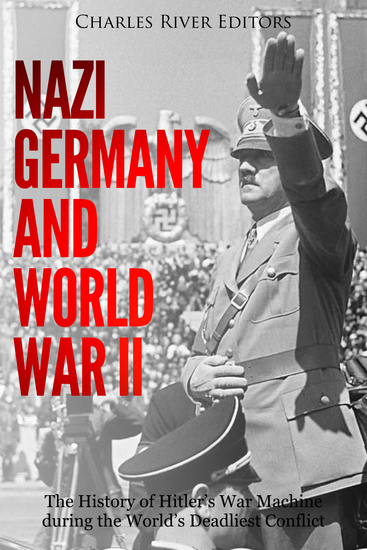
Nazi Germany and World War II - The History of Hitler’s War Machine during the World’s Deadliest Conflict - cover

Nazi Germany and World War II - The History of Hitler’s War Machine during the World’s Deadliest Conflict

Editors Charles River

Casa editrice: Charles River Editors

  • 0
  • 0
  • 0

Sinossi

Munich is widely reviled today and is held up as the epitome of appeasement, but historians still debate its effects on the Second World War, as well as Neville Chamberlain's character and motivations. Some believe the attempted appeasement of Nazi Germany hastened, or even caused, the mayhem occupying the next seven years. Others believe that the pact merely failed to alter war's inevitable arrival in either direction. Historians and authors alternately interpret Chamberlain as a bumbling, arrogant fool, a strong-willed statesman who simply miscalculated the nature of Hitler and Nazi Germany, or even a man with dictatorial ambitions surreptitiously inserting himself into the Fuhrer's orbit and prevented from further damaging democracy only by his fall and death from bowel cancer. Another possible interpretation, with considerable documentary support, asserts Chamberlain wished to enlist Germany's aid against the state most Europeans perceived as the true threat of the era, the Soviet Union.
 
Europe’s attempts to appease him, most notably at Munich in 1938, failed, as Nazi Germany swallowed up Austria and Czechoslovakia by 1939. Italy was on the march as well, invading Albania in April of 1939. The straw that broke the camel's back, however, was Germany's invasion of Poland on September 1 of that year.  Two days later, France and Great Britain declared war on Germany, and World War II had begun in earnest.
 
Of course, as most people now know, the invasion of Poland was merely the preface to the Nazi blitzkrieg of most of Western Europe, which would include Denmark, Belgium, and France by the summer of 1940. The resistance put up by these countries is often portrayed as weak, and the narrative is that the British stood alone in 1940 against the Nazi onslaught, defending the British Isles during the Battle of Britain and preventing a potential German invasion.
 
At the beginning of 1941, it was unclear whether the Allies would be able to remain in the war for much longer. British Prime Minister Winston Churchill had already immortalized the men of the Royal Air Force with one of the West’s most famous war-time quotes, but the potential of a German invasion of Britain still loomed. With the comfort of hindsight, historians now suggest that the picture was actually more complex than that, but the Battle of Britain, fought throughout the summer and early autumn of 1940, was unquestionably epic in scope. The largest air campaign in history at the time, the vaunted Nazi Luftwaffe sought to smash the Royal Air Force, but thankfully, the RAF stood toe to toe with the Luftwaffe and ensured Hitler’s planned invasion was permanently put on hold. The Allied victory in the Battle of Britain inflicted a psychological and physical defeat on the Luftwaffe and Nazi regime at large, and as the last standing bastion of democracy in Europe, Britain would provide the toehold for the June 1944 invasion of Europe that liberated the continent. For those reasons alone, the Battle of Britain was one of the decisive turning points of history’s deadliest conflict.
Disponibile da: 01/05/2025.
Lunghezza di stampa: 666 pagine.

Altri libri che potrebbero interessarti

  • Wording Around With Editing - Getting Your First Draft Ready to Publish - cover

    Wording Around With Editing -...

    Kathy Mac

    • 0
    • 0
    • 0
    Wording Around with Editing gives readers everything they need to get their first draft of any writing project ready to publish. 
    The first three chapters detail steps of the editing process and introduce the types of editing: Substantive, Stylistic and Copy. The next four chapters get into the nitty gritty of each of those, with an additional chapter on Proofreading. The final three chapters explain the importance of writing communities in helping writers bring their book to its very best form. Every chapter of Wording Around with Editing ends with a resource to help readers dive more deeply into that chapters' topic, as well as prompts that help authors take their first steps on each stage of the editing process. 
    "Kathy Mac is a 'writer's writer.' In this tight and mighty work, she cuts to the heart of what she's learned about process, craft, and loving yourself through the hard parts of writing." 
    – AJ Ripley 
    During the COVID-19 lockdown in the spring of 2020, poet and creative writing professor Kathy Mac (St. Thomas University, Fredericton, Canada) taught a free online course, the notes for which became Wording Around with Prose, the first in the Wording Around series. Wording Around with Editing: Getting your First Draft Ready to Publish is the second one in the series.
    Mostra libro
  • History of China - Specific Events Causes and Consequences - cover

    History of China - Specific...

    Kelly Mass

    • 0
    • 0
    • 0
    This is a combo of 5 titles with different topics related to Chinese history. The topics are the following: 
    Ancient China: It’s hard to cover all of China’s vast history in a short book, but for the sake of leaving out details, we will still give it a try. In this guide, you will be able to learn more about the most important turning events, eras, dynasties, leaders, wars, and cultural aspects of ancient China. 
    Chinese Mythology: Chinese folklore is mythology from the geographical area now called China that has been given orally or documented. Several myths from different local and cultural customs are included in Chinese folklore. Much of folklore includes thrilling stories including impressive characters and beings, the use of magic powers, and normally occurs in a mythologically unique area or time. 
    Confucius: Confucius was a Chinese thinker and political leader who was considered as the apotheosis of Chinese sages. Confucius' theories and philosophy, commonly seen as one of the most essential and prominent individuals in human history, created the structure of East Asian civilization and civilization, and stay appropriate across China and East Asia today. Confucianism, his philosophical theories, highlighted personal and governmental morality, social connection precision, justice, generosity, and genuineness. 
    Mao Zedong: Mao Zedong has had a tremendous impact on the Chinese nation. During his Great Leap Forward, he was responsible for more deaths than both Hitler and Stalin, making him the biggest mass murderer in history. What happened during the Great Leap Forward? Why did so many farmers starve to death? And what else did Mao Zedong do during his reign? 
    Portuguese Macau: Macau is known as the Las Vegas of China. It attracts many tourists every year, and it has a unique set of laws and history behind it. How did it become this way? Well, one of the reasons is that it used to be part of the Portuguese Empire.
    Mostra libro
  • A Rare Recording of Frank Lloyd Wright - cover

    A Rare Recording of Frank Lloyd...

    Frank Lloyd Wright

    • 0
    • 0
    • 0
    Frank Lloyd Wright (June 8, 1867 to April 9, 1959), born in Richland Center, Wisconsin, was an American architect, designer, writer, and educator. He designed more than 1,000 structures over a creative period of 70 years. Wright played a key role in the architectural movements of the twentieth century, influencing architects worldwide through his works and mentoring hundreds of apprentices in his Taliesin Fellowship. Wright believed in designing in harmony with humanity and the environment, a philosophy he called organic architecture. This philosophy was exemplified in Fallingwater (1935), which has been called "the best all-time work of American architecture." The following audio clips are from the late 1950s.
    Mostra libro
  • Women in American History - cover

    Women in American History

    Grace Humphrey

    • 0
    • 0
    • 0
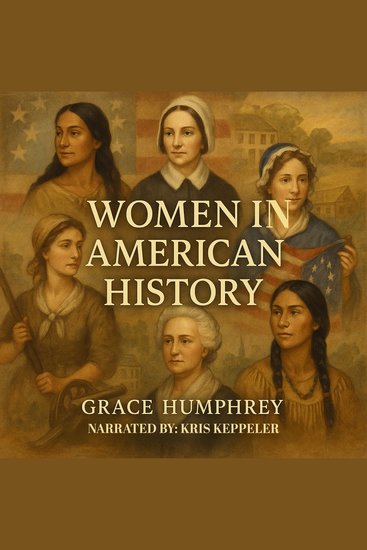
    Discover the untold stories of the women who helped shape a nation. Women in American History by Grace Humphrey offers an inspiring look into the lives of extraordinary women from America’s earliest days through the 19th century. From Pocahontas, who forged an unlikely bond between Native Americans and English settlers, to Sacajawea, whose guidance proved pivotal to the Lewis and Clark Expedition, these accounts highlight courage, vision, and perseverance. 
    You’ll meet Anne Hutchinson, who fought for religious freedom, Betsy Ross, whose needle stitched the first American flag, Molly Pitcher, who took up arms on the battlefield, and Martha Washington, whose strength supported a revolutionary leader. Each chapter celebrates these remarkable women as more than historical footnotes—they are icons of determination who left an enduring impact on the American story. 
    Narrated by Kris Keppeler, this audiobook is a tribute to the often-overlooked women who played vital roles in shaping America’s legacy.
    Mostra libro
  • How to Read People and Decode Human Behavior - Improve Communication Detect Lies Read Body Language Predict Behavior Build Charisma Analyze Minds Influence Others & Master Emotional Intelligence - cover

    How to Read People and Decode...

    Nathan Soren

    • 0
    • 0
    • 0
    Want to Know What People Are Really Thinking—Without Them Saying a Word? 
    Imagine walking into any room and instantly picking up on the true feelings, intentions, and motivations of the people around you. 
    If you’ve ever struggled to read social cues, decode mixed messages, or sense when someone’s being dishonest, you're not alone. But what if you could understand people deeply, connect effortlessly, and navigate any situation with clarity and confidence? 
    This audiobook is your practical, step-by-step guide to mastering the hidden language of human behavior—so you can stop second-guessing and start reading people like a book. 
    You’ll discover how to:Boost your charisma and become more naturally likableDetect lies using a proven 3-step formulaDecode micro-expressions and subtle body language cuesUse active listening techniques to build real trustNavigate awkward moments and disarm manipulative behaviorUnderstand emotional triggers and influence outcomesSharpen your people-reading skills with real-life examplesBuild emotional intelligence and connect on a deeper level 
    Whether you’re leading a team, selling a product, improving your relationships, or just want to stop overthinking social situations—this audiobook gives you the tools you need to understand others quickly and communicate with impact. 
    Packed with insights, exercises, and real-world scenarios, How to Read People and Decode Human Behavior will help you unlock one of the most powerful skills in life. 
    Start listening today—and learn how to turn every interaction into an opportunity for connection.
    Mostra libro
  • How to Steal a City - The Battle for Nelson Mandela Bay: An Inside Account - cover

    How to Steal a City - The Battle...

    Crispian Olver

    • 0
    • 0
    • 0
    How to Steal a City is the gripping insider account of this intervention, which lays bare how Nelson Mandela Bay metro was bled dry by criminal syndicates, and how factional politics within the ruling party abetted that corruption.  
    As a former senior state official and local government ‘fixer’, Crispian Olver was no stranger to dodgy politicians and broken organisations. Yet what he found in Nelson Mandela Bay went far beyond rigged contracts, blatant conflicts of interest and garden-variety kickbacks. The city’s administration had evolved into a sophisticated web of front companies, criminal syndicates and compromised local politicians and officials. The metro was effectively controlled by a criminal network closely allied to a dominant local ANC faction. What Olver found was complete state capture – a microcosm of what has taken place in national government. 
    Olver and his team initiated a clean-up of the administration, clearing out corrupt officials and rebuilding public trust. Then came the ANC’s doomed campaign for the August 2016 local government elections. Having lost its way in factional battles and corruption, the divided party went down to a humiliating defeat in its traditional heartland.  
    Olver paid a high price for his work in Nelson Mandela Bay. Intense political pressure and even threats to his personal safety took a toll on his mental and physical health. When his political support was withdrawn, he had to flee the city as the forces stacked against him took their revenge. This is his story.
    Mostra libro