Unisciti a noi in un viaggio nel mondo dei libri!
Aggiungi questo libro allo scaffale
Grey
Scrivi un nuovo commento Default profile 50px
Grey
Iscriviti per leggere l'intero libro o leggi le prime pagine gratuitamente!
All characters reduced
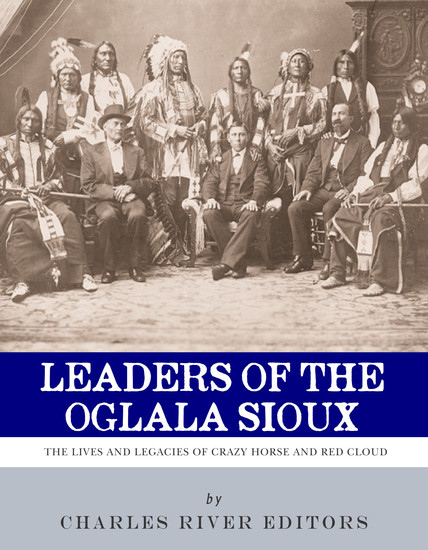
Leaders of the Oglala Sioux - The Lives and Legacies of Crazy Horse and Red Cloud - cover

Leaders of the Oglala Sioux - The Lives and Legacies of Crazy Horse and Red Cloud

Editors Charles River

Casa editrice: Charles River Editors

  • 0
  • 0
  • 0

Sinossi

As he lay dying, Tashunke Witco, whose name is literally translated as “His Horse is Spirited” or “His Horse is Crazy,” refused to be placed on an army cot, and he insisted upon being placed on the floor. He had spent his life avoiding white people whenever possible, and after he died, his cousin Touch the Clouds pointed to the blanket covering the dead Chief’s body and said, “This is the lodge of Crazy Horse.”
 
Throughout his life, Tashunke Witco tried to live the life his people had enjoyed for centuries. He never signed a treaty with the U.S. government and was never photographed, largely because he wanted to avoid contact with the settlers encroaching further west upon Native American lands. By staying away from white settlements and military forts, he thus avoided the places where a photographer might be lurking. As the great Lakota leaders surrendered to the U.S. military or were killed, they became symbols of the qualities and character of their people. Red Cloud is often referred to as a symbol of Lakota concession. Sitting Bull is considered symbolic of Lakota spirituality. Crazy Horse, because he delayed surrender and never entered into treaty agreements with the U.S. military, became a symbol of Lakota resistance.
 
Crazy Horse may have fervently wished to avoid white settlers, but he’s a Native American icon today because of the inability to do so. Like Geronimo in the Southwest and Sitting Bull on the Plains, Crazy Horse was a chief who fought in several skirmishes against settlers and U.S. forces during the 1860s, and he became one of the most famous Native Americans in American history because of one fateful confrontation with whites: the legendary Battle of the Little Bighorn, during which an estimated 2,000 Lakota and Cheyenne warriors routed and then annihilated the 7th U.S. Cavalry led by George Custer. That disaster led the American government to double down on its efforts to “pacify” the Plains, and by the end of the decade many of them had surrendered and been moved onto a reservation. Like Sitting Bull, Crazy Horse tried to avoid surrendering for as long as he could, and both suffered a controversial death.  
 
Among the Oglala Lakota, one of the most famous bands of the Native American Tribe known as the Sioux, the longest and most effective leader was Makhpiyaluta, better known as Red Cloud. Though he has not been remembered as vividly as another member of the Oglala Lakota, Crazy Horse, Red Cloud led the group for 40 years, in war, in peace, and on a reservation, becoming so esteemed and influential that Americans began to mistakenly take him for the leader of the entire Sioux tribe.
 
 In the 1860s, Red Cloud was at the forefront of skirmishing among whites and Native Americans along the frontier in Wyoming and Montana, which came to be known as Red Cloud’s War. After that, however, Red Cloud continued to lead his people to reservations first near the Black Hills and later westward after the Battle of the Little Bighorn. Though he was respected as a war chief, it was his political functions as a spokesman of the Oglala that truly allowed Red Cloud to leave his mark over the last several decades of his life. Whereas Sitting Bull and Crazy Horse suffered premature deaths, Red Cloud outlived the other important leaders of the Sioux until dying in 1909 at 87 years old. Near the end of his life, he reportedly said, “They made us many promises, more than I can remember. But they kept but one -- they promised to take our land...and they took it.”
 
 Though Red Cloud was forever embittered by what he and his people had lost, his long leadership and his help in transitioning his people onto reservations has ironically turned him into somewhat of a symbol of conciliation and reconciliation between Native Americans and whites, as opposed to Native American symbols of defiance like Tecumseh, Sitting Bull and Crazy Horse.
Disponibile da: 21/06/2025.
Lunghezza di stampa: 65 pagine.

Altri libri che potrebbero interessarti

  • Empire of Purity - The History of Americans' Global War on Prostitution - cover

    Empire of Purity - The History...

    Eva Payne

    • 0
    • 0
    • 0
    Between the 1870s and 1930s, American social reformers, working closely with the US government, transformed sexual vice into an international political and humanitarian concern. As these activists worked to eradicate prostitution and trafficking, they promoted sexual self-control for both men and women as a cornerstone of civilization and a basis of American exceptionalism. Empire of Purity traces the history of these efforts, showing how the policing and penalization of sexuality was used to justify American interventions around the world. 


    Eva Payne describes how American reformers successfully pushed for international anti-trafficking agreements that mirrored US laws, calling for states to criminalize prostitution and restrict migration, and harming the very women they claimed to protect. She argues that Americans' ambitions to reshape global sexual morality and law advanced an ideology of racial hierarchy that viewed women of color, immigrants, and sexual minorities as dangerous vectors of disease. 


    Drawing on archives in Europe, the United States, and Latin America, Empire of Purity ties the war on sexual vice to American imperial ambitions and a politicization of sexuality that continues to govern both domestic and international policy today.
    Mostra libro
  • The Get to the Point! Guide to Using Microsoft Word 2021 and Word for Microsoft Office 365 on Windows and Mac - cover

    The Get to the Point! Guide to...

    Marc Allan Moore

    • 0
    • 0
    • 0
    Get to the point, get what you need, & get it done! 
    Don’t waste a minute of your precious time memorizing pointless keyboard shortcuts! Most people don’t need to know how to use every obscure feature of Microsoft Word 2021 and Word for Office 365—so when you want to get up and running without having to study dozens of commands you’ll never use, the Get to the Point! Guide to Using Microsoft Word 2021 and Word for Microsoft Office 365 on Windows and Mac will show you how to do what you need to quickly, easily, and intuitively. 
    Like sitting down beside an experienced friend who'll show you the ropes with infinite patience, the Get to the Point! Guide to Using Microsoft Word 2021 and Word for Microsoft Office 365 on Windows and Mac features a plethora of expert tips and tricks designed to save you time and frustration, boiled down to the bare minimum of required information to get even the most inexperienced of readers up to speed and working like a professional in no time. 
    Drawing on decades of experience as a technical instructor and daily Microsoft Word user, author Marc Allan Moore has condensed a lifetime’s worth of insider tips, tricks, and secrets of making Microsoft Word 2021 and Word for Office 365 work for you into this slim volume. 
    Whether you’re on Windows or OSX, PC or Mac, or Word 2021 or Word for Office 365, don’t waste time learning irrelevant formatting, confusing macros, or impenetrable jargon—get up to speed, get your work done and get on with your life using the Get to the Point! Guide to Using Microsoft Word 2021 and Word for Microsoft Office 365 on Windows and Mac!
    Mostra libro
  • The saga of Indian Food - cover

    The saga of Indian Food

    Amit Schandillia

    • 0
    • 0
    • 0
    More than 2,400 years ago, Indian merchants traveling along the Silk Road introduced the world to an aromatic rice dish that would later become the Persian staple, pilaf. A couple of millennia down the line, the Mughals brought the dish back to the subcontinent and turned it into biryani. Meanwhile in the East, the Portuguese were busy inventing the evergreen Bengali icon, the rosogulla. Between biryani and rosogulla, is a fascinating story of how foreign foods came to conquer India.
    Mostra libro
  • Ancient Celtic Legends: The History of Celtic Folk Tales and Myths that Influenced European Mythology - cover

    Ancient Celtic Legends: The...

    Editors Charles River

    • 0
    • 0
    • 0
    The Celts are one of the most well-known groups in Europe and one of the least understood. Depending on which classifications are used, the Celts are also one of the oldest civilizations in Europe. In the centuries before Christ, the Celts were spread out across much of continental Europe, and though they are mostly identified with Gaul, evidence suggests they also spread as far as Portugal. Though they were spread out across Europe before the height of the Roman Empire, most people associate the Celts with the British Isles today, particularly Ireland and Scotland. After they had been relegated to those smaller regions as a result of the Romans and other migrations, the culture of the Celts as it is currently understood began to congeal during the Early Middle Ages, and Celtic culture, folklore, and legend have all become inextricably intertwined with Irish history and British history as a whole. 
    Historically, Celtic cultures differ from their English and French neighbors in a number of ways, including social organization, language, values and economic systems, but one of the most captivating of these has always been their myths. Celtic Myths, which can be read in translation without needing special training in grammar, are more accessible than the Celtic languages, and unlike the other distinctive features that have faded over the centuries, myths still have their immediacy and power when read today. While much has undoubtedly been lost from the ancient Celts over time, medieval manuscripts help scholars understand how Celtic myths have reached the form they have today. Like many ancient belief systems, Celtic mythology shares Indo-European roots, meaning Celtic beliefs have cousins in related societies like the Norse, Greeks, Romans and Slavs, with a foundation of shared mythmaking that goes back several millennia.
    Mostra libro
  • Refusenik - cover

    Refusenik

    Lynn Melnick

    • 0
    • 0
    • 0
    In this searing new volume, Lynn Melnick dives head-first through concentric waves of personal and generational trauma with her trademark fearlessness. Evincing a complex mind shaped by the late 20th century’s misplaced priorities, Refusenik interrogates misogyny and anti-Semitism across time and a shifting global landscape—from a football field in Los Angeles to a Russian shtetl to a beloved daughter’s Brooklyn bedroom. Variously unraveling and allowing for intricate tangles of anger, nostalgia and love, these agile poems furrow deeper into the terrain of Melnick’s much-celebrated earlier titles, arriving at a profound and pressured understanding of what it means to be a contemporary American. Audiobook recorded by JBI Library for inclusion in the Yetzirah Audio Poetry Series (YAPS!).
    Mostra libro
  • TikTok Dopamine Balls - Mirth Gongs & Singalongs - cover

    TikTok Dopamine Balls - Mirth...

    Mike Blake

    • 0
    • 0
    • 0
    TikTok Dopamine Balls:   Mirth, Gongs & SingalongsThis poem is about the many varied experiences on TikTok. The high's, the lows, the fun, the throws.For a lot of Tiktokers, its a Dopamine fix, cavorting on cam, enjoying their 5 minutes ofTiktok fame. Lots go viral, and get enormous amounts of followers.Its all fun after all, its just one big Dopamine ball.Full of mirth, and singalongs, and the gongs of others.There's many things to say about Tiktok, but at the end of the day. It passes the time,in a positive rhymn like a Ticking tocking clock.
    Mostra libro