Junte-se a nós em uma viagem ao mundo dos livros!
Adicionar este livro à prateleira
Grey
Deixe um novo comentário Default profile 50px
Grey
Assine para ler o livro completo ou leia as primeiras páginas de graça!
All characters reduced
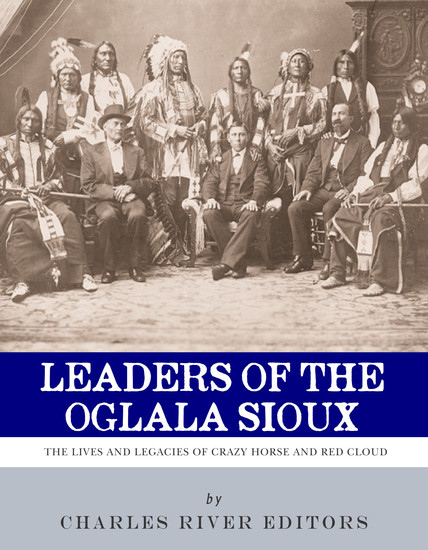
Leaders of the Oglala Sioux - The Lives and Legacies of Crazy Horse and Red Cloud - cover
LER

Leaders of the Oglala Sioux - The Lives and Legacies of Crazy Horse and Red Cloud

Editors Charles River

Editora: Charles River Editors

  • 0
  • 0
  • 0

Sinopse

As he lay dying, Tashunke Witco, whose name is literally translated as “His Horse is Spirited” or “His Horse is Crazy,” refused to be placed on an army cot, and he insisted upon being placed on the floor. He had spent his life avoiding white people whenever possible, and after he died, his cousin Touch the Clouds pointed to the blanket covering the dead Chief’s body and said, “This is the lodge of Crazy Horse.”
 
Throughout his life, Tashunke Witco tried to live the life his people had enjoyed for centuries. He never signed a treaty with the U.S. government and was never photographed, largely because he wanted to avoid contact with the settlers encroaching further west upon Native American lands. By staying away from white settlements and military forts, he thus avoided the places where a photographer might be lurking. As the great Lakota leaders surrendered to the U.S. military or were killed, they became symbols of the qualities and character of their people. Red Cloud is often referred to as a symbol of Lakota concession. Sitting Bull is considered symbolic of Lakota spirituality. Crazy Horse, because he delayed surrender and never entered into treaty agreements with the U.S. military, became a symbol of Lakota resistance.
 
Crazy Horse may have fervently wished to avoid white settlers, but he’s a Native American icon today because of the inability to do so. Like Geronimo in the Southwest and Sitting Bull on the Plains, Crazy Horse was a chief who fought in several skirmishes against settlers and U.S. forces during the 1860s, and he became one of the most famous Native Americans in American history because of one fateful confrontation with whites: the legendary Battle of the Little Bighorn, during which an estimated 2,000 Lakota and Cheyenne warriors routed and then annihilated the 7th U.S. Cavalry led by George Custer. That disaster led the American government to double down on its efforts to “pacify” the Plains, and by the end of the decade many of them had surrendered and been moved onto a reservation. Like Sitting Bull, Crazy Horse tried to avoid surrendering for as long as he could, and both suffered a controversial death.  
 
Among the Oglala Lakota, one of the most famous bands of the Native American Tribe known as the Sioux, the longest and most effective leader was Makhpiyaluta, better known as Red Cloud. Though he has not been remembered as vividly as another member of the Oglala Lakota, Crazy Horse, Red Cloud led the group for 40 years, in war, in peace, and on a reservation, becoming so esteemed and influential that Americans began to mistakenly take him for the leader of the entire Sioux tribe.
 
 In the 1860s, Red Cloud was at the forefront of skirmishing among whites and Native Americans along the frontier in Wyoming and Montana, which came to be known as Red Cloud’s War. After that, however, Red Cloud continued to lead his people to reservations first near the Black Hills and later westward after the Battle of the Little Bighorn. Though he was respected as a war chief, it was his political functions as a spokesman of the Oglala that truly allowed Red Cloud to leave his mark over the last several decades of his life. Whereas Sitting Bull and Crazy Horse suffered premature deaths, Red Cloud outlived the other important leaders of the Sioux until dying in 1909 at 87 years old. Near the end of his life, he reportedly said, “They made us many promises, more than I can remember. But they kept but one -- they promised to take our land...and they took it.”
 
 Though Red Cloud was forever embittered by what he and his people had lost, his long leadership and his help in transitioning his people onto reservations has ironically turned him into somewhat of a symbol of conciliation and reconciliation between Native Americans and whites, as opposed to Native American symbols of defiance like Tecumseh, Sitting Bull and Crazy Horse.
Disponível desde: 21/06/2025.
Comprimento de impressão: 65 páginas.

Outros livros que poderiam interessá-lo

  • Behind the Scenes - The Dramatic Lives of Philip Burton - cover

    Behind the Scenes - The Dramatic...

    Angela John

    • 0
    • 0
    • 0
    Philip Burton (1904-95) is best remembered as the schoolmaster responsible for training and transforming his pupil Richard Jenkins into Richard Burton, world-famous star of stage and screen. Together they produced a remarkable symbiosis. The stage-struck Philip Burton was present behind the scenes for the rest of the actor's life, intervening at crucial moments to ensure consummate stage performances in, for example, Coriolanus, Hamlet and Camelot. This biography, drawing upon a number of previously unseen sources, provides a fresh angle on this compelling story. And by placing Philip Burton's story centre stage, a remarkable figure also emerges in his own right. In a life that virtually spanned the twentieth century, he demonstrated resilience and transatlantic triumph against the odds.
    
    Like his best-known protégé, he was born into an impoverished south Wales mining family. Alongside teaching, he acted, wrote and produced plays and in 1945, with wireless at its height, he became a BBC radio producer. He worked on almost 200 radio programmes, encouraging newcomers and producing work by Dylan Thomas. He wrote scripts for the fledgling television and penned its first 'soap.' Reinventing himself in the mid-1950s, Philip Burton moved to the United States where, after dabbling in the film industry and working as a theatre director, he became the inspirational first director of the American Musical and Dramatic Academy in New York. He took American citizenship and travelled across the States, delivering sparkling Shakespearean lecture-recitals. He published five books, living in Key West, Florida from the 1970s. Philip Burton died in 1995 aged ninety, his expertise and encouragement having enabled numerous aspiring actors and writers to flourish on both sides of the Atlantic.
    Ver livro
  • A Preface to Paradise Lost - cover

    A Preface to Paradise Lost

    C. S. Lewis

    • 0
    • 0
    • 0
    A Preface to Paradise Lost is one of C. S. Lewis's most famous scholarly works. The book had its genesis in Lewis's Ballard Matthews Lectures, which he delivered at the University College of North Wales in 1941. It discusses the epic poem Paradise Lost, by John Milton.
    Ver livro
  • Balkan Bombshells - Contemporary Women's Writing from Serbia and Montenegro - cover

    Balkan Bombshells - Contemporary...

    Will Firth

    • 0
    • 0
    • 0
    A collection to whet the appetite of anyone wishing to learn more about a region rich in history, folklore and (her)stories. Telling it like a woman does not mean literature for women only: it provides an insight into half of humanity, a window onto the lives of citizens who work, love and develop their inner lives. This collection brings together the voices of a wide selection of prize-winning and established authors:
    Balkan Bombshells brings together established Serbian and Montenegrin writers like Svetlana Slapšak, Jelena Lengold (winner of the EU Prize for Literature 2013), Dana Todorović and Olja Kneżević (author of Catherine the Great and the Small, Istros 2020), together with a select group of up-coming writers: Marijana Čanak (1982, Serbia): "Awakened" (Probuđena) follows the early years of a girl from a very simple background, who discovers she has extrasensory powers. A gruesome fascination with biology allows her to attend high school, where she ends up sewing a voodoo doll to take revenge on a molesting teacher. Marijana Dolić (1990, Bosnia-Herzegovina & Serbia): "Notes from the attic" (Zapisi iz potkrovlja), originally diary entries, are intense mediatations on faith, love and hope – poignant testimony to a struggle to cope in difficult times. Ana Miloš (1992, Serbia): "Peace" (Mir) portrays a woman struggling with disparate feelings after her only child dies. She has long since broken up with the child's father. She enjoys finally having time for herself, but she has to confront accusations of people around her that she is heartless. Once a mother, always a mother? Katarina Mitrović (1991, Serbia):"Small death" (Mala smrt). We are introduced to a fearful young woman who is far from happy with life, and we follow her on a summer holiday by the Adriatic, where a halfhearted romantic adventure takes a scary turn. Andrea Popov Miletić (1985, Serbia):|: excerpt from the novel Young pioneers, we are seaweed (Pioniri maleni, mi smo morska trava; 2019). This stand-alone excerpt is a poetic flashback to her childhood in the province of Vojvodina in the Yugoslav era, to holidays by the Mediterranean, and to feelings of belonging and home. Lena Ruth Stefanović (1970, Sebria/ Montenegro): "Zhenya" is a fragment from her 2016 novel Daughter of the Childless Man (Šćer onoga bez đece), is an entertaining meta-story about an ordinary woman in the late Soviet Union, whom the author decides to grant a new lease of life, so Zhenya studies languages, becomes a mondain writer and moves with her new husband to Montenegro, where the author loses track of her.
    Ver livro
  • Stalkers - Original Tales by Masters of Terror - cover

    Stalkers - Original Tales by...

    Ed Gorman

    • 0
    • 0
    • 0
    There are two types of entities: the Hunter and the Hunted— and revenge, guilt, lust, and desperation drive all of them. Darkness falls quickly when you're being stalked— but it is always dark when you' re the stalker. From shadowy city streets and Amazon jungles to deep-South swamps, this collection of eight stories involving elements of mystery, science fiction, and horror is sure to entertain. Unabridged selections include:
    • " The Stalker of Souls" by Edward D. Hoch, read by Joseph Campanella
    
    • " Pilots" by Joe R. Lansdale and Dan Lowry, read by Joseph Campanella
    
    • " Lizardman" by Charles de Lint, read by David Dukes
    
    • " The Sacred Fire" by Robert R. McCammon, read by Arte Johnson
    
    • " The Hunt" by Richard Laymon, read by Arte Johnson
    
    • " Trapped" by Dean Koontz, read by Bess Armstrong
    
    • " Rivereñ os" by Trish Janeshutz, read by Bess Armstrong
    
    • " Stalker" by Ed Gorman, read by Arte Johnson
    Ver livro
  • Dionea - Violet Paget wrote under a male pseudonym to help her career a huge pioneer of supernatural fiction - cover

    Dionea - Violet Paget wrote...

    Vernon Lee

    • 0
    • 0
    • 0
    Vernon Lee was born Violet Paget on 4th October 1856 in Boulogne, France to intellectual expatriate British parents.   
     
    In common with several other very talented literary women of the day she felt it necessary to publish under a masculine pseudonym in order for her writing to be taken seriously.  Indeed she seems to have adopted that persona across her whole lifestyle becoming personally known and acknowledged by all as Vernon Lee and accordingly dressed as a man.    
     
    Her first published work, in 1880, was taken from her collection of essays that had originally appeared in Fraser’s Magazine with the scholarly title of; ‘Studies of the Eighteenth Century in Italy.’ It reflected her passion for music and centered on the rich creative lives of poet-librettist Pietro Metastasio and dramatists Carlo Goldoni and Carlo Gozzi.   
     
    She wrote over a dozen volumes of essays on art, music, and travel with her scholarly appreciation animated by wit and imagination.  Lee was well-regarded as an expert on the Italian Renaissance and was a proponent of the Aesthetic movement. 
     
    Her literary talents were extensive and she wrote a number of novels and plays.  Perhaps her best remembered works are her haunting and powerful short stories exploring the supernatural.  Lee has often received accolades for these and glowingly compared to other authors such as M R James. 
      
    A committed pacifist she was resolved to protest against World War I. Her social activism in other areas was perhaps fueled by her feminist beliefs.  In her private life she was a lesbian and had long-term passionate relationships with three women including the doomed author and poet, Amy Levy.   
     
    Vernon Lee died on 13th February 1935 in San Gervasio Bresciano, Italy.  
     
    In Dionea we discover that a young girl has been washed ashore near Genoa.  Her life could be one of misery or success depending on the fates.  But despite her ravishing beauty Dionea grows up to be not the woman all had hoped she might become.
    Ver livro
  • A Thing That Glistened - From their pens to your ears genius in every story - cover

    A Thing That Glistened - From...

    Frank R Stockton

    • 0
    • 0
    • 0
    Frank Richard Stockton was born in Philadelphia on 5th April 1834.  
    His father, a Methodist minister, discouraged Stockton’s literary career from an early age.  Feeling unable to go against those wishes it was for many years that Stockton’s income was maintained as a wood engraver.   
    His first work was published in 1867 and his first collection only appeared in 1870.  Despite this late arrival Stockton’s innovative and often far-fetched stories, with a gentle ‘poking fun’ humour were very popular.  Like his contemporary Mark Twain he avoided the scolding, hectoring and moral tones of many other authors and instead gently teased and cajoled his reader to open their eyes to the ills, the greed and the ambitions of the world around them.  His sci-fi stories in particular were far-seeing and inventive including a tale of negative gravity and a bloodless Anglo-US war won by technological feats.  
    Perhaps his most enduring tale though is ‘The Lady, or the Tiger?’ from 1882.  A condemned man is given a choice of being eaten alive or marrying his princess lover.  But he has to choose which door each is behind. 
    Frank R Stockton died in Washington, DC, on 20th April 1902, of a cerebral haemorrhage.  He is buried at The Woodlands in Philadelphia.
    Ver livro