Unisciti a noi in un viaggio nel mondo dei libri!
Aggiungi questo libro allo scaffale
Grey
Scrivi un nuovo commento Default profile 50px
Grey
Iscriviti per leggere l'intero libro o leggi le prime pagine gratuitamente!
All characters reduced
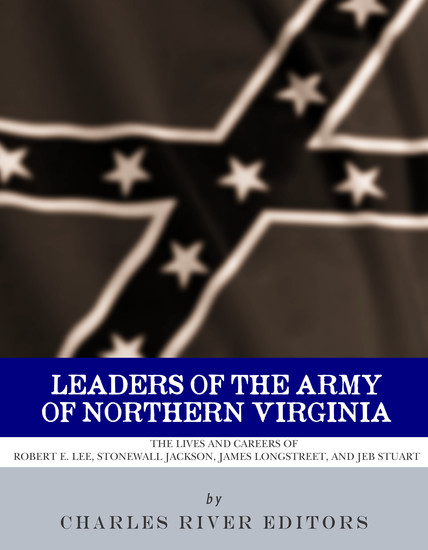
Leaders of the Army of Northern Virginia - The Lives and Careers of Robert E Lee Stonewall Jackson James Longstreet and JEB Stuart - cover

Leaders of the Army of Northern Virginia - The Lives and Careers of Robert E Lee Stonewall Jackson James Longstreet and JEB Stuart

Editors Charles River

Casa editrice: Charles River Editors

  • 0
  • 0
  • 0

Sinossi

With the exception of George Washington, perhaps the most famous general in American history is Robert E. Lee (January 19, 1807 – October 12, 1870), despite the fact he led the Confederate Army of Northern Virginia against the Union in the Civil War. As the son of U.S. Revolutionary War hero Henry "Light Horse Harry" Lee III, and a relative of Martha Custis Washington, Lee was imbued with a strong sense of honor and duty from the beginning. And as a top graduate of West Point, Lee had distinguished himself so well before the Civil War that President Lincoln asked him to command the entire Union Army. Lee famously declined, serving his home state of Virginia instead after it seceded.
 
Lee is remembered today for constantly defeating the Union’s Army of the Potomac in the Eastern theater from 1862-1865, considerably frustrating Lincoln and his generals. His leadership of his army led to him being deified after the war by some of his former subordinates, especially Virginians, and he came to personify the Lost Cause’s ideal Southern soldier. His reputation was secured in the decades after the war as a general who brilliantly led his men to amazing victories against all odds.
 
Thomas Jonathan Jackson is one of the most famous generals of the Civil War, but many of the people he continues to fascinate probably don’t remember his whole name. That’s because Jackson earned his famous “Stonewall” moniker at the First Battle of Manassas or Bull Run, when Brigadier-General Bee told his brigade to rally behind Jackson, whose men were standing like a stone wall. Ironically, it’s still unclear whether that was a compliment for standing strong or an insult for not moving his brigade, but the nickname stuck for the brigade and the general itself.
 
Jackson would only enhance his legend over the next two years, first leading his army on one of the most incredible campaigns of the war in the Shenandoah Valley in 1862.. Known as the Valley Campaign, Jackson kept 3 Union armies occupied north of Richmond with less than 1/3 of the men, marching his army up and down the Valley 650 miles in three months. The impressive feat helped his men earn the nickname “foot cavalry.”
 
One of the most important, and controversial, Confederate generals during the Civil War was Lieutenant General James Longstreet, the man Robert E. Lee called his “old war horse.” Longstreet was Lee’s principal subordinate for most of the war, ably managing a corps in the Army of Northern Virginia and being instrumental in Confederate victories at Second Bull Run, Fredericksburg, and Chickamauga. Longstreet was also effective at Antietam and the Battle of the Wilderness, where he was nearly killed by a shot through the neck.
 
Had Longstreet died on the field in early May 1864, he would almost certainly be considered one of the South’s biggest heroes. However, it was his performance at Gettysburg and arguments with other Southern generals after the Civil War that tarnished his image. After the South lost the war and Gettysburg came to be viewed as one of its biggest turning points, former Confederate generals looked to that battle to find scapegoats to blame for losing the war. Longstreet was charged with being slow to attack on the second day of the Battle of Gettysburg, allowing the Union to man Little Round Top. He also resisted Lee’s order for Pickett’s Charge the next day, making his criticisms clear both that day and after the war through his rightings. The fact that he served in Republican administrations after the Civil War rubbed his former comrades the wrong way, and the Georgian Longstreet’s criticism of Lee infuriated the Virginian Lost Cause advocates who idolized Lee.
Disponibile da: 05/05/2025.
Lunghezza di stampa: 139 pagine.

Altri libri che potrebbero interessarti

  • Blackinese - Reflections on Race and Ethnicity from a Biracial Millennial - cover

    Blackinese - Reflections on Race...

    Patricia Bradby Moore

    • 0
    • 0
    • 0
    In this candid and thought-provoking memoir, a millennial woman of Black and Chinese heritage reflects on the complexities of growing up with a mixed identity in the American South and beyond. From childhood memories to college experiences and a burgeoning career, Blackinese explores the nuances of race, culture, and belonging, tackling everything from food and music to dating, politics, and religion. 
    With vulnerable honesty, author Patricia Bradby Moore takes readers on a journey through her ever-evolving sense of self, which has been shaped by her diverse upbringing and global travels. From navigating the challenges of being multiracial in the U.S. to exploring how race is understood and experienced in other parts of the world, her story speaks to the growing population of mixed-race individuals who don’t fit into simple boxes. 
    Blackinese is an invitation to reflect on identity, empathy, and the shared human experience. With every page, it encourages readers to embrace their complexity and find strength in their uniqueness. This is a memoir for anyone who has ever felt they don’t quite fit the mold and for those who want to better understand what it means to live in a world where the lines of race and identity are anything but clear.
    Mostra libro
  • Don't Cry Dance - A Memoir of war love and forgiveness - cover

    Don't Cry Dance - A Memoir of...

    Nina Angelo

    • 0
    • 0
    • 0
    Don’t Cry, Dance is a memoir spanning four generations - through war, horror and loss, to peace, calm and love - from Auschwitz-Birkenow to Paris, London, Athens and ultimately to Sydney, Australia.Janka was a Polish Jewish girl, and Alberto, a Spanish Greek Jewish man. This tale reveals how love and hearts of kindness came out of the horrors of the concentration camps.In 1949, they came to Australia, bringing two cultures, 13 languages and their toddler Nina, to forge a new beginning. These two people would never have met and fallen in love, if they hadn’t survived the attempted extermination of a race in the death chambers of Europe. They knew and taught their children, that we cannot move on without forgiveness.Nina always knew she came from their legacy of resilience, generosity, hospitality, love and their acceptance of all people. As a storyteller and community artist, it was time for her to add her story to theirs and weave a lasting memory and tale of forgiveness for future generations.
    Mostra libro
  • British Empire - Details of the Largest Empire in Human History - cover

    British Empire - Details of the...

    Kelly Mass

    • 0
    • 0
    • 0
    The British Empire was an extensive network of dominions, colonies, protectorates, mandates, and territories ruled or administered by the United Kingdom and its predecessor governments. This sprawling empire evolved from England's early ventures into overseas territories and trading ports, beginning in the late 16th century and continuing through the early 18th century. The empire grew to become the largest in recorded history, dominating global affairs for more than a century. 
    The roots of the British Empire can be traced back to England’s desire to expand its economic and political influence, driven by competition with other European powers like Spain and Portugal, who were leading the Age of Exploration. These countries had established lucrative colonial empires in the Americas, Africa, and Asia, amassing great wealth and resources. Inspired by their success, England, along with France and the Netherlands, began establishing its own colonies and trading posts, particularly in North America, the Caribbean, and Asia. 
    During the 17th and 18th centuries, the British Empire grew in strength through a combination of military conquests, naval power, and strategic alliances. Following its unification with Scotland through the 1707 Act of Union, Britain emerged as a major colonial power, extending its control across vast regions. The empire's reach expanded dramatically after the series of conflicts with its rivals, including the Anglo-Dutch Wars and the long-standing hostilities with France, culminating in Britain's dominance over North America and its influence over global trade routes.
    Mostra libro
  • 50 Masterpieces you have to read before you die vol: 2 - cover

    50 Masterpieces you have to read...

    George Eliot, Charles Dickens,...

    • 0
    • 0
    • 0
    This book contains now several HTML tables of contents that will make reading a real pleasure!
    Novels
    Jerome, Jerome K.: "Three Men in a Boat"
    Joyce, James: "A Portrait of the Artist as a Young Man"
    Joyce, James: "Ulysses"
    Kingsley, Charles: "The Water-Babies"
    Kipling, Rudyard: "Kim"
    La Fayette, Madame de: "The Princess of Clèves"
    Laclos, Pierre Choderlos de: "Dangerous Liaisons"
    Lawrence, D. H.: "Sons and Lovers"
    Lawrence, D. H.: "The Rainbow"
    Le Fanu, Joseph Sheridan: "In a Glass Darkly"
    Lewis, Matthew Gregory: "The Monk"
    Lewis, Sinclair: "Main Street"
    London, Jack: "The Call of the Wild"
    Lovecraft, H. P.: "At the Mountains of Madness"
    Mann, Thomas: "Royal Highness"
    Maugham, W. Somerset: "Of Human Bondage"
    Maupassant, Guy de: "Bel-Ami"
    Melville, Herman: "Moby-Dick"
    Poe, Edgar Allan: "The Fall of the House of Usher"
    Proust, Marcel: "Swann's Way"
    Radcliffe, Ann: "The Mysteries of Udolpho"
    Richardson, Samuel: "Clarissa"
    Sand, George: "The Devil's Pool"
    Scott, Walter: "Ivanhoe"
    Shelley, Mary: "Frankenstein"
    Sienkiewicz, Henryk: "Quo Vadis"
    Sinclair, May: "Life and Death of Harriett Frean"
    Sinclair, Upton: "The Jungle"
    Stendhal: "The Red and the Black"
    Stendhal: "The Chartreuse of Parma"
    Sterne, Laurence: "Tristram Shandy"
    Stevenson, Robert Louis: "Treasure Island"
    Stoker, Bram: "Dracula"
    Stowe, Harriet Beecher: "Uncle Tom's Cabin"
    Swift, Jonathan: "Gulliver's Travels"
    Tagore, Rabindranath: "The Home and the World"
    Thackeray, William Makepeace: "Vanity Fair"
    Tolstoy, Leo: "War and Peace"
    Tolstoy, Leo: "Anna Karenina"
    Troloppe, Anthony: "The Way We Live Now"
    Turgenev, Ivan: "Fathers and Sons"
    Twain, Mark: "The Adventures of Huckleberry Finn"
    Verne, Jules: "Journey to the Interior of the Earth"
    Wallace, Lew: "Ben-Hur"
    Wells, H. G.: "The Time Machine"
    West, Rebecca: "The Return of the Soldier"
    Wharton, Edith: "The Age of Innocence"
    Wilde, Oscar: "The Picture of Dorian Gray"
    Xueqin, Cao: "The Dream of the Red Chamber"
    Zola, Émile: "Germinal"
    Mostra libro
  • Otto Hahn: A short biography - 5 Minutes: Short on time – long on info! - cover

    Otto Hahn: A short biography - 5...

    5 Minutes, 5 Minute Biographies,...

    • 0
    • 0
    • 0
    Otto Hahn, German physicist and discoverer of atomic fission: Life and work in a short biography! Everything you need to know, brief and concise. Infotainment, education and entertainment at its best!
    Mostra libro
  • The Mahabharata - cover

    The Mahabharata

    Veda Vyas

    • 0
    • 0
    • 0
    Krishna Dvaipayana, also known as and Veda Vyasa "the one who classified the Vedas"), is a rishi (sage). He is best known as the author of the Mahabharata, one of the two most important epics of Hinduism. He is also credited as the traditional compiler of the Vedas, as well as the writer of other important works including the Puranas. As per the Mahabharata, Vyasa is the son of rishi Parashara and a fisherwoman named Kali (Satyavati), who later marries king Shantanu of Kuru. Throughout the epic, Vyasa appears occasionally helping the Kuru kingdom. His spiritual career includes compiling many texts and spreading the knowledge through his disciples. The festival of Guru Purnima is dedicated to him. It is also known as Vyasa Purnima, the day believed to be both of his birth and when he divided the Vedas. Vyasa is considered one of the seven Chiranjivis (long-lived, or immortals), who are still in existence according to Hindu tradition.
    Mostra libro