Begleiten Sie uns auf eine literarische Weltreise!
Buch zum Bücherregal hinzufügen
Grey
Einen neuen Kommentar schreiben Default profile 50px
Grey
Jetzt das ganze Buch im Abo oder die ersten Seiten gratis lesen!
All characters reduced
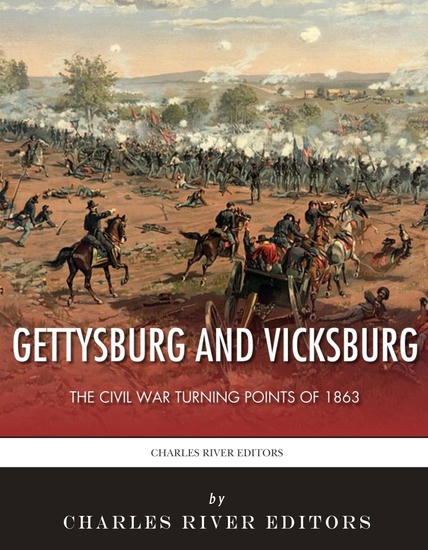
Gettysburg and Vicksburg - The Civil War Turning Points of 1863 - cover

Gettysburg and Vicksburg - The Civil War Turning Points of 1863

Editors Charles River

Verlag: Charles River Editors

  • 0
  • 0
  • 0

Beschreibung

Without question, the most famous battle of the American Civil War took place outside of the small town of Gettysburg, Pennsylvania, which happened to be a transportation hub, serving as the center of a wheel with several roads leading out to other Pennsylvanian towns. From July 1-3, Robert E. Lee’s Confederate Army of Northern Virginia tried everything in its power to decisively defeat George Meade’s Union Army of the Potomac, unleashing ferocious assaults that inflicted nearly 50,000 casualties in all.
 
Day 1 of the battle would have been one of the 25 biggest battles of the Civil War itself, and it ended with a tactical Confederate victory. But over the next two days, Lee would try and fail to dislodge the Union army with attacks on both of its flanks during the second day and Pickett’s Charge on the third and final day. Meade’s stout defense held, barely, repulsing each attempted assault, handing the Union a desperately needed victory that ended up being one of the Civil War’s turning points.
 
After the South had lost the war, the importance of Gettysburg as one of the “high tide” marks of the Confederacy became apparent to everyone, making the battle all the more important in the years after it had been fought. While former Confederate generals cast about for scapegoats, with various officers pointing fingers at Robert E. Lee, James Longstreet, and James Stuart, historians and avid Civil War fans became obsessed with studying and analyzing all the command decisions and army movements during the entire campaign. Despite the saturation of coverage, Americans refuse to grow tired of visiting the battlefield and reliving the biggest battle fought in North America.
 
At the start of 1863, Robert E. Lee’s Army of Northern Virginia had been frustrating the Union in the Eastern theater for several months, but the situation in the West was completely different. The Confederates had lost control of several important states throughout 1862, and after New Orleans was taken by the Union, the North controlled almost all of the Mississippi River, which Confederate general James Longstreet called “the lungs of the Confederacy”. By taking control of that vital river, the North would virtually cut the Confederacy in two, putting the South in a dire situation.
 
The only domino left to fall was the stronghold of Vicksburg, and both sides knew it. The Union Army of the Tennessee, led by Ulysses S. Grant, would spend months trying to encircle the army and eventually force John Pemberton’s Confederate army to surrender. Grant eventually succeeded on July 4, 1863, but since it came a day after the climactic finish of the Battle of Gettysburg, Vicksburg was (and still is) frequently overlooked as one of the turning points of the Civil War. In fact, had the Confederate’s military leadership listened to Longstreet, who advocated detaching soldiers from Lee’s army to head west and help the Confederates deal with Grant or Rosecrans in that theater, the Battle of Gettysburg might never have happened.
 
On April 30, 1863, Grant finally launched the successful campaign against Vicksburg, marching down the western side of the Mississippi River while the navy covered his movements. He then crossed the river south of Vicksburg and quickly took Port Gibson on May 1, Grand Gulf on May 3, and Raymond on May 12.  Realizing Vicksburg was the objective, the Confederate forces under the command of Pemberton gathered in that vicinity, but instead of going directly for Vicksburg, Grant took the state capital of Jackson instead, effectively isolating Vicksburg. Pemberton’s garrison now had broken communication and supply lines. With Grant in command, his forces won a couple of battles outside Vicksburg at Champion Hill and Big Black River on May 16 and 17, forcing Pemberton’s men into Vicksburg and completely enveloping it. Soonafter, Grant and his men settled into a nearly two month long siege.
Verfügbar seit: 02.05.2025.
Drucklänge: 124 Seiten.

Weitere Bücher, die Sie mögen werden

  • The Unabomber Manifesto and Other Essays by Theodore Kaczynski - cover

    The Unabomber Manifesto and...

    Theodore J. Kaczynski

    • 0
    • 0
    • 0
    Theodore Kaczynski, also known as the Unabomber, is a United States murderer, mathematician, and neo-Luddite social critic who carried out a campaign of mail bombings. He was born in Chicago, Illinois, where, as an intellectual child prodigy, he excelled academically from an early age. 
    A considerable amount of credible circumstantial evidence suggests that Kaczynski was the unwitting victim of top secret CIA-sponsored 'MK-ULTRA' mind-control experiments conducted at Harvard University from the fall of 1959 through the spring of 1962. Some experts suggest that these experiments may have been the cause of his emotional problems. 
    Kaczynski eventually received an undergraduate degree from Harvard University and earned a PhD in mathematics from the University of Michigan. He became an assistant professor at the University of California, Berkeley at age 25 but resigned two years later. 
    In 1971, he moved to a remote cabin without electricity or running water, in Lincoln, Montana, where he began to learn survival skills in an attempt to become self-sufficient. 
    He decided to start his bombing campaign after watching the wilderness around his home get destroyed by development. 
    From 1978 to 1995, Kaczynski sent 16 bombs to targets including universities and airlines, killing three people and injuring 23. Kaczynski sent a letter to The New York Times on April 24, 1995 and promised "to desist from terrorism" if the Times or The Washington Post published his manifesto. In his Industrial Society and Its Future (also called the "Unabomber Manifesto"), he argued that his bombings were extreme but necessary to attract attention to the erosion of human freedom necessitated by modern technologies requiring large-scale organization. 
    included in this volume: 
    -Unnamed Essay 
    -When Non-Violence is Suicide 
    -Hit Where It Hurts 
    -Industrial Society and Its Future (aka The Unabomber Manifesto)
    Zum Buch
  • Where Soldiers Lie - cover

    Where Soldiers Lie

    Anonym

    • 0
    • 0
    • 0
    What drives veterans, military experts and forensic investigators to dedicate years to search for and identify the remains of fallen warriors? What does it mean to the families of the dead to be able to lay them to rest? 
      
    Over thirty five thousand Australian soldiers and airmen are still listed as Missing In Action from the wars of the 20th Century.  
    Telling the moving story of the determination and skill of the searchers who apply old-fashioned detective work and cutting-edge science to solve the mysteries of the missing and bring peace of mind and solace to their families and to all those who serve, Where Soldiers Lie follows these investigators and scientists on their mission to locate and identify unrecovered war casualties and to unlock their secrets. From the jungles of Vietnam, where one man led a decade-long battle to recover and bring home the final six, to Korea, Papua New Guinea and the fields of the Somme, Flanders and Fromelles,  
    Where Soldiers Lie is a deeply human story of perseverance, luck and resolution, a story of incredible determination against difficult odds, of exacting forensic analysis and painstaking detective work, to uncover and identify the remains of Australian soldiers, in battlefield over the decades, and to bring their remains home. 
    Powerful, moving and compelling reading. 
    'At times it is a heartbreaking story. At other times, it's a detective story. On a deeper level, a book such as Where Soldiers Lie, which honours and commemorates these lost heroes, offers a form of grief and acceptance in its own right.' Herald Sun
    Zum Buch
  • Big Words for Young Readers: Teaching Kids in Grades K to 5 to Decode-and Understand-Words With Multiple Syllables and Morphemes - cover

    Big Words for Young Readers:...

    Heidi Anne Mesmer

    • 0
    • 0
    • 0
    Phonics instruction shouldn't end when students can decode short words. From an early age, they also need to be able to decode "big words"-words with multiple syllables (sound units) and morphemes (meaning units)-to read proficiently. The key is to teach them systematically and explicitly, in developmentally appropriate ways. That's where this audiobook comes in. Dr. Heidi Anne Mesmer shares essential background on how language "works," provides a K-5 scope and sequence to guide practice, and offers abundant research-backed strategies that teachers can put into action immediately.
    Zum Buch
  • safe-to-fight - The Step by Step Protocol for Couples to Navigate Conflict Improve Communication and Strengthen Their Bond - cover

    safe-to-fight - The Step by Step...

    Claire Donnelly

    • 0
    • 0
    • 0
    Do arguments with your partner leave you feeling misunderstood and disconnected? You long for closeness, yet every tough conversation turns into a painful loop of blame, defensiveness, and silence. What if conflict itself isn’t the enemy—but the key to deeper intimacy, if you know how to navigate it safely? 
    In Safe to Fight, Dr. Elias Vance introduces the Conflict Resolution Protocol (CRP)—a proven, science-backed system that transforms conflict from a battleground into a bridge for understanding. Drawing from decades of research in relationship science, attachment theory, and neuroscience, Dr. Vance offers couples a practical roadmap for communicating effectively, repairing emotional wounds, and growing stronger together. 
    Inside, you’ll discover:The 4 stages of every argument—and how to interrupt destructive patterns before they spiral.The “Cooling-Off Window” that prevents emotional flooding and resets your nervous system.The “Soft Start-Up” that lets you raise tough issues without triggering defensiveness.The Speaker–Listener framework that ensures both partners feel heard and validated.How to decode your unique conflict styles and attachment needs.The step-by-step CRP system to transform fights into opportunities for connection. 
    Packed with scripts, action prompts, and practical tools, Safe to Fight is more than a book—it’s a relationship blueprint for building trust, empathy, and lasting resilience. Whether you’re newly together or decades into your marriage, this guide will help you communicate with compassion, repair effectively after conflict, and rediscover the love that brought you together in the first place. 
    Stop fearing conflict—and learn how to make it safe to fight.
    Zum Buch
  • Author Paul Levinson Discusses Marshall McLuhan and The Evolution of Media - cover

    Author Paul Levinson Discusses...

    Paul Levinson

    • 0
    • 0
    • 0
    In the following keynote seminar, author Paul Levinson discusses Canadian philosopher and academic Marshall McLuhan—whose concept of "The Medium Is The Message" from his seminal book, Understanding Media: The Extensions of Man, which proposed that the media, not the content that they carry, affects the society in which it plays a role—as well as, the evolution of media over the past half-century.
    Zum Buch
  • Relationship Has Significance Only When It is a Process of Self-Revelation - cover

    Relationship Has Significance...

    Jiddu Krishnamurti

    • 0
    • 0
    • 0
    Relationship has significance only when it is a process of self-revelation - 17 July 1949 
    • Where there is authority there can be no discovery of something new. 
    • Relationship based on an idea cannot be a self-revealing process. 
    • Self-knowledge is understood, uncovered and its process revealed through 
    relationship. 
    • Is it possible to love without the interference of the mind? 
    • When the mind becomes supreme, all-important, then there can be no 
    affection. 
    • Q: What is that thinking that must come to an end? What do you mean by 
    thinking and thought?
    Zum Buch