Unisciti a noi in un viaggio nel mondo dei libri!
Aggiungi questo libro allo scaffale
Grey
Scrivi un nuovo commento Default profile 50px
Grey
Iscriviti per leggere l'intero libro o leggi le prime pagine gratuitamente!
All characters reduced
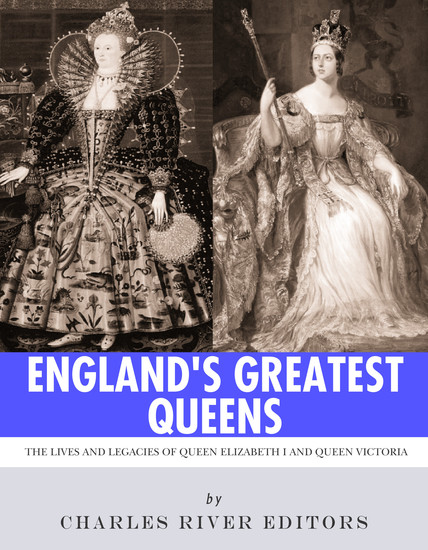
England’s Greatest Queens - The Lives and Legacies of Queen Elizabeth I and Queen Victoria - cover

England’s Greatest Queens - The Lives and Legacies of Queen Elizabeth I and Queen Victoria

Editors Charles River

Casa editrice: Charles River Editors

  • 0
  • 0
  • 0

Sinossi

When Queen Elizabeth II came to the throne in 1952, many commentators heralded the beginning of her reign as the second Elizabethan age. The first one, of course, concerned the reign of Henry VIII’s second surviving daughter and middle surviving child, Queen Elizabeth I, one of England’s most famous and influential rulers. It was an age when the arts, commerce and trade flourished. It was the epoch of gallantry and great, enduring literature. It was also an age of wars and military conflicts in which men were the primary drivers and women often were pawns.


Elizabeth I changed the rules of the game and indeed she herself was changed by the game. She was a female monarch of England, a kingdom that had unceremoniously broken with the Catholic Church, and the Vatican and the rest of Christendom was baying for her blood. She had had commercial and militaristic enemies galore. In the end, she helped change the entire structure of female leadership.


Elizabeth was the last Tudor sovereign, the daughter of the cruel and magnificent King Henry VIII and a granddaughter of the Tudor House’s founder, the shrewd Henry VII. Elizabeth, hailed as “Good Queen Bess,” “Gloriana” and “The Virgin Queen” to this day in the public firmament, would improve upon Henry VIII’s successes and mitigate his failures, and despite her own failings would turn out to “have the heart and stomach of a king, and a king of England too”. Indeed, that was the phrase she would utter in describing herself while exhorting her troops to fight for England against the Spanish Armada).


Elizabeth often has been featured in biographies that were more like hagiographies, glossing over her fits of temper, impatience and other frailties. It is fair to say, however, that she had also inherited her grandfather’s political acumen and her father’s magnificence, thus creating not just one of the most colourful courts in Europe but also one of the most effective governments in English history. It was an age of Christopher Marlowe’s and William Shakespeare’s flourishing creativity that still enhances English as well as comparative literature. Elizabeth was also patroness of Sir Francis Drake, the pirate, thereby promoting English settlement of foreign colonies. The Jamestown Settlement in Virginia would come in 1607, four years after Elizabeth’s passing, and the Plymouth colony in Massachusetts would come in 1620.
 
England has had no shortage of influential monarchs, but only Queen Elizabeth I and Queen Victoria had their nation’s age literally named after them. Both the Elizabethan era and Victorian era have come to symbolize a golden age of peace and progress in every aspect of British life, with the long reigns of both queens also providing stability.
 
Of course, there was a critical difference between those two queens: Elizabeth I still wielded great power in the 16th century, whereas Victoria was a constitutional monarch with limited power over the workings of the British government. But in a way, that made Victoria even more unique, as she still proved able to mold the cultural identity of a nearly 65 year long epoch. Furthermore, Victoria established some of the ceremonial customs of the British monarch and became both the forerunner and role model of subsequent queens, a legacy that continues to endure with her great-great granddaughter, Queen Elizabeth II.
 
Though Britain’s longest reigning monarch is now mostly associated with conservative values (particularly strict morality and traditional social and gender roles), Victoria and her era oversaw the cultural and technological progress of Britain and the West in general, architectural revivals, and the expansion of imperialism.  
Disponibile da: 20/06/2025.
Lunghezza di stampa: 63 pagine.
Altri libri che potrebbero interessarti

  • Without Exception - Reclaiming Abortion Personhood and Freedom - cover

    Without Exception - Reclaiming...

    Pam Houston

    • 0
    • 0
    • 0
    Without Exception is an unflinching call for freedom by way of abortion rights. 


    "A story told with honesty. I thank Pam Houston for this timely and timeless book" —CAMILLE T. DUNGY, Soil: The Story of a Black Mother's Garden 


    Written with equal parts candor and lyricism, Pam Houston illuminates the interconnected histories of abortion in the United States and in her own life during the decades when Roe v. Wade was the law of the land. Houston guides us through the shifting landscapes of politics, the law, and self-determination in a country where access to medical care and the power to determine your own destiny are increasingly—and once again—dependent on geography and circumstance.
    Mostra libro
  • Kargil - From Surprise To Victory - cover

    Kargil - From Surprise To Victory

    V.P. Malik

    • 0
    • 0
    • 0
    In February 1999, Pakistani Army personnel, disguised as jihadi militants, infiltrated into mountainous Kargil and occupied key vantage points. Their intrusion triggered a limited war between the world's newest nuclear states. It was a bitter battle, and one that threw up important lessons for India's defence preparedness, as also its responses to conflicts such as this. This incisive book by General V.P. Malik, former Chief of the Army Staff, analyses the reasoning behind the Pakistani Army's moves and tactics and reviews crucial issues such as the extent of intelligence and surveillance failure on the Indian side and the measures necessary to redress these failings. Away from questions of strategy and tactics, however, Kargil is also a reminder of the unalloyed heroism that was on display during those grim weeks, heroism that become a benchmark for valour.
    Mostra libro
  • Rugby World Cup - 50 Geopolitical Questions - cover

    Rugby World Cup - 50...

    Kévin Veyssière

    • 0
    • 0
    • 0
    How was rugby born in 1823? Why didn’t the first Rugby World Cup take place until 1987?  Why are there so few «new nations» emerging in the world of rugby? How did the sport establish itself in New Zealand, South Africa, France, Ireland, Fiji, Georgia and Hong Kong? Are women’s rugby and the Olympic discipline of 7-a-side rugby opening up new frontiers? Why are the United Arab Emirates, Qatar and Saudi Arabia interested in the sport?
    Through 50 geopolitical and international questions, Kévin Veyssière invites rugby fans, the curious and budding geographers alike, to discover the genesis and evolution of this sport, so attached to its traditions and long kept out of the spotlight. The book’s concise, entertaining approach helps readers to better understand how rugby has become part of the global sports industry over time and across continents, and how it has become a formidable tool for understanding the political, economic and social changes taking place in the world today.
    Mostra libro
  • Enchiridirion Discourses Golden Sayings Fragments & Selected Writings The - A New English Translation - Adapted for the Contemporary Reader - cover

    Enchiridirion Discourses Golden...

    Epictetus

    • 0
    • 0
    • 0
    Unlock the Timeless Wisdom of a Stoic Master! 
    Dive into The Enchiridion, Discourses, Golden Sayings, Fragments & Selected Writings by Epictetus, presented in a new English translation adapted for the contemporary reader. This comprehensive collection offers profound insights into self-mastery, resilience, and living a life of virtue. 
    Epictetus's teachings provide practical guidance on navigating life's challenges with grace and inner strength. Covering themes like personal freedom, the power of perception, and focusing on what we can control, his wisdom remains profoundly relevant today. 
    Experience the Wisdom That Has Inspired Generations 
    Accessible Modern Translation – Clarity and simplicity bring Epictetus's thoughts to life. 
    Timeless Teachings – Cultivate inner peace, embrace adversity, and practice mindful living. 
    Practical Guidance – Actionable advice for personal growth and achieving tranquility. 
    Imagine gaining the perspective of a philosopher who transformed adversity into strength. Immerse yourself in lessons on self-discipline, acceptance, and the art of living well. 
    Whether you're a student of philosophy, seeking personal development, or exploring Stoicism, this book enriches your mind and spirit. 
    Don’t Miss Out! 
    Join countless readers inspired by Epictetus's teachings. More than historical texts, these writings are a guide to balanced and purposeful living in today's world. 
    Get your audiobook now to embark on a journey through Epictetus's wisdom and unlock the secrets to inner freedom and tranquility!
    Mostra libro
  • Nicomachean Ethics - The Blueprint for Virtue Happiness and the Good Life - A Modern Translation - Adapted for the Contemporary Reader - cover

    Nicomachean Ethics - The...

    Aristotle

    • 0
    • 0
    • 0
    What if you could discover the keys to true happiness, cultivate virtue, and live a life of purpose and fulfillment? 
    Nicomachean Ethics: The Blueprint for Virtue, Happiness, and the Good Life presents Aristotle’s timeless teachings, carefully translated and adapted for today’s readers. Written over two thousand years ago, Nicomachean Ethics explores what it means to live virtuously and achieve eudaimonia—a life of true fulfillment.What You’ll Discover:The Pursuit of Happiness – Aristotle’s principles for living a meaningful, flourishing life.The Role of Virtue – Develop moral character, make wise choices, and align with your values.Practical Wisdom for Daily Life – Learn balance, moderation, and ethical decision-making.Accessible and Modernized Language – Experience Aristotle’s insights in clear, practical terms. 
    Aristotle’s philosophy offers a timeless guide to building character, making ethical choices, and achieving lasting happiness. His wisdom helps us live with intention and harmony between our actions, desires, and goals. 
    Take charge of your happiness, cultivate virtue, and unlock the good life. 
    Get your copy today and transform your life with Aristotle’s timeless teachings.
    Mostra libro
  • 20th Century’s Most Influential Artists The: The Lives and Art of Pablo Picasso Salvador Dali Andy Warhol and Jackson Pollock - cover

    20th Century’s Most Influential...

    Editors Charles River

    • 0
    • 0
    • 0
    In their biography of Pablo Picasso, Hans Ludwig and Chris Jaffe note that “for him, art was always adventure: ‘To find is the thing.’” Indeed, there is perhaps no artist who produced more art than Picasso, whose enormous oeuvre (which spanned most of his 91-year life) contained a countless number of paintings and drawings. Picasso also worked in other mediums as well, notably sculpture and lithography, and his constant experimentation with form makes him a useful case study through which to chart the growth of Modernism as an artistic movement and many of the artistic trends that would dominate the 20th century. At the same time, one of the challenges involved in examining Picasso’s body of work is the sheer breadth of it all.  
    	In his review of Salvador Dali’s first autobiography, George Orwell declared that “One ought to be able to hold in one’s head simultaneously the two facts that Dali is a good draughtsman and a disgusting human being.” Whether or not one agrees with the famous author’s assessment, Orwell captures the polarizing nature of Salvador Dali, and the extent to which his undeniable technical virtuosity often brushed against his penchant for provoking his audiences (not to mention provoking long-entrenched standards of “proper” taste).  
    	To truly grasp the significance of Jackson Pollock in 20th century art, it’s necessary to understand the dramatic departure he initiated away from the straightforward compositions associated with the social realist art of the 1930s, a Depression-era period in which political art offered readily comprehensible narratives that were grasped by viewers with little artistic training.  
    Few artists of the 20th century were as enigmatic as Andy Warhol, who once remarked, “If you want to know all about Andy Warhol, just look at the surface of my paintings and films and me, there I am. There’s nothing behind it.” This statement is hardly out of character for the famous artist.
    Mostra libro