¡Acompáñanos a viajar por el mundo de los libros!
Añadir este libro a la estantería
Grey
Escribe un nuevo comentario Default profile 50px
Grey
Suscríbete para leer el libro completo o lee las primeras páginas gratis.
All characters reduced
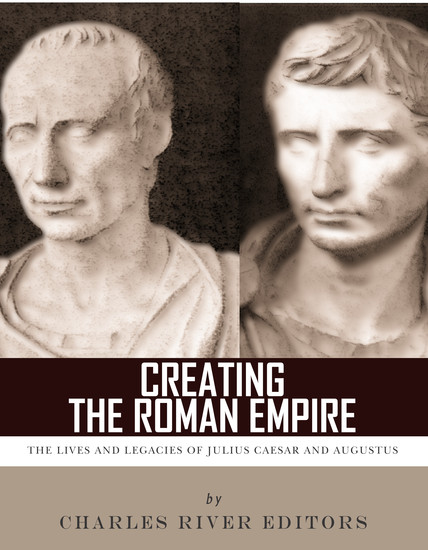
Creating the Roman Empire - The Lives and Legacies of Julius Caesar and Augustus - cover

Creating the Roman Empire - The Lives and Legacies of Julius Caesar and Augustus

Editors Charles River

Editorial: Charles River Editors

  • 0
  • 0
  • 0

Sinopsis

Possibly the most important man of antiquity, and even all of history, was Julius Caesar. Alexander Hamilton, the famous American patriot, once remarked that “the greatest man who ever lived was Julius Caesar”. Such a tribute, coming from one of the Founding Fathers of the quintessential modern democracy in reference to a man who destroyed the Roman Republic, is testament to the enduring mark that Caesar left upon the world. The ultimate conqueror, statesman, dictator, visionary, and opportunist, during his time in power Caesar expanded the borders of Rome to almost twice their previous size, revolutionized the infrastructure of the Roman state, and destroyed the Roman Republic for good, leaving a line of emperors in its place. His legacy is so strong that his name has become, in many languages, synonymous with power: the Emperors of Austria and Germany bore the title Kaiser, and the Czars of Russia also owe the etymology of their title to Caesar. His name also crept further eastward out of Europe, even cropping up in Hindi and Urdu, where the term for “Emperor” is Kaisar.
 
Even in his time, Caesar was in many ways larger than life, and because of his legacy as virtual founder of the Roman Empire, much of what was written about – and by – him during his life and immediately after his assassination was politically motivated. His successor, Octavian Augustus, had a strong interest in ensuring that Caesar’s life be painted in a favorable light, while Caesar’s political enemies attempted to paint him as a corrupt, undemocratic dictator who was destroying the old order of the Republic. This makes it exceedingly difficult to separate historical fact from apocryphal interjection, as the writings of Cicero (a rival of Caesar’s) and the later biographies of Suetonius and Plutarch can be misleading. Nonetheless, along with Caesar’s De Bello Gallico, his famous notes on his campaign against the Gauls, they remain our chief sources for Caesar’s life – a life everyone agreed was nothing short of remarkable and changed the course of history forever.
 
The importance of Gaius Julius Caesar Augustus (or as he was known from birth, Gaius Octavius “Octavian” Thurinus) to the course of Western history is hard to overstate. His life, his rise to power, his political, social and military achievements, all laid the foundations for the creation of an Empire which would endure for almost five centuries, and whose traditions, laws, architecture and art continue to influence much of Europe and the world today. Octavian was the first true Roman Emperor, and the first man since the Etruscan Tarquins, five centuries earlier, to establish a successful hereditary ruling dynasty in what had been a proud Republic for over half a millennium. He was a canny strategist, an excellent orator, a fine writer, a generous patron of the arts and enthusiastic promoter of public works, but above all he was a master politician. Octavian’s great-uncle (and adoptive father) Julius Caesar was a great general, his rival Mark Antony was a great soldier, but as a politician Octavian outmatched them all.
 
Certainly, like all men, Octavian had his defects. Like many of the most successful politicians, he could connive, plot and prevaricate with the best of them, and he made full use of the emotional pull that his late beloved great-uncle had over the legions during the course of his rise to power. His justice was also famously heavy-handed, and he was not known for his mercy towards those he defeated in battle or marginalised political opponents. Yet despite all this, he still stands in bronze on Rome’s Via dei Fori Imperiali to this day, along with the likes of Caesar, Hadrian, Trajan and Marcus Aurelius, and he is forever immortalised in all western calendars as the patron of the month of August, which was dedicated to him when he was deified, following his death, as Divus Augustus.
Disponible desde: 15/05/2025.
Longitud de impresión: 66 páginas.

Otros libros que te pueden interesar

  • Byways of Blessedness - Exploring Hidden Paths to Inner Harmony - cover

    Byways of Blessedness -...

    James Allen

    • 0
    • 0
    • 0
    What if you could discover serene, overlooked pathways to a richer and more harmonious life—simply by shifting your perspective? 
    James Allen’s contemplative work unravels the small but profound ways we can cultivate blessedness every day. Adapted for modern readers, this text highlights virtues like patience, kindness, and selflessness, revealing how they open the door to enduring happiness and spiritual fulfillment. 
    What You’ll Discover in This Modern Translation:Practical exercises for nurturing compassion and understandingThe transformative impact of small acts of goodwillHow to maintain serenity amid life’s daily pressuresUplifting wisdom to guide your personal and spiritual evolution 
    Imagine feeling a warm sense of contentment that no setback can dim, grounded in gentle virtues that sustain both you and those around you. Let James Allen show you the overlooked but ever-present routes to a blessed existence. 
    Embark on a journey of gentle transformation. Get your copy now and uncover the hidden pathways leading to inner harmony.
    Ver libro
  • The Life of Kings - The Baltimore Sun and the Golden Age of the American Newspaper - cover

    The Life of Kings - The...

    Frederic B Hill, Stephens Broening

    • 0
    • 0
    • 0
    In an age when local daily papers with formerly robust reporting are cutting sections and even closing their doors, the contributors to The Life of Kings celebrate the heyday of one such paper, the Baltimore Sun, when it set the agenda for Baltimore, was a force in Washington, and extended its reach around the globe. Contributors like David Simon, creator of HBO’s The Wire, and renowned political cartoonist Kevin Kallaugher (better known as KAL), tell what it was like to work in what may have been the last golden age of American newspapers -- when journalism still seemed like “the life of kings” that H.L. Mencken so cheerfully remembered. The writers in this volume recall the standards that made the Sun and other fine independent newspapers a bulwark of civic life for so long. Their contributions affirm that the core principles they followed are no less imperative for the new forms of journalism: a strong sense of the public interest in whose name they were acting, a reverence for accuracy, and an obligation
    Ver libro
  • Crowded House - Threesome and Group Sex Erotica - cover

    Crowded House - Threesome and...

    Rachel Kramer Bussel

    • 0
    • 0
    • 0
    The more, the merrier! In Crowded House: Threesome and Group Sex Erotica you'll discover the excitement and thrills of multiple lovers connecting in the most intimate and naked of ways. From group encounters and throuples to sex games, swingers retreats, sex parties, alien sex and more, these triad and group sex stories are sure to turn you on with their heat and creativity. Learn "How to Seduce a Mermaid," discover the hottest way to use "PTO," and go behind the scenes of a very steamy cooking reality show. In these stories, sexual fantasies are fulfilled, exes are reunited, with a twist, and sexual fetishes are explored to the max. 


    Edited by the award-winning Rachel Kramer Bussel, with stories by Lucy Eden, Katrina Jackson, Angora Shade, and more, these sizzling erotic adult stories show that three (or four or more) is the perfect bedroom crowd. 


    Contains mature themes.
    Ver libro
  • Platanides - Through The Eye of The Storm - cover

    Platanides - Through The Eye of...

    William Planes

    • 0
    • 0
    • 0
    Many Christians lived in Asia Minor (later Turkey) before the Armenian and Greek genocide by the Muslims at the outset of the twentieth century. The author; Planes, cronicals his father’s true life experience in an effort to make clear the precious freedoms that we have in the United States. 
    This book presents the true story of a Christian boy and his escape from the genocide of Greek and Armenian Christians. This is a true story of the life of this boy who was born in Asia Minor in 1908; howhe, with his family managed to escape the genocide of Greek and Armenian Christians at the hands of Kamel Ataturk on September 13, 1922; how the boy’s family lived as refugees of genocide on the Island of Crete Greece where they survied World War II; how the boy left his family and immigrated to America; and the boy’s life in America. The book draws a contraxt of the family’s experiences as genocide refugees living in Crete and the boy’s life in America; how these events and those of World War II on the Greek island of Crete influenced them and their children; and his relationship as adults with the boy’s son, the author. The author emphasizes the Christian Orthodox Faith which was tousht to him by his parents. In response to a question about his Faith, the book and why he has written this book, the author stated “It was a lesson by my father to his kids that no matter what you’re confronted with in life if you trust in Christ and you believe without a doubt that Christ is with you, you can get through anything. That was what we learned at a very early age and that’s what stuck with me throughout my life.".....
    Ver libro
  • Essay: A Beauty Worth Admiring By Joshua Dixon - (Featured in Tamela Gordon's Hood Wellness) - cover

    Essay: A Beauty Worth Admiring...

    Joshua Dixon

    • 0
    • 0
    • 0
    What does self-care look like when struggling to make ends meet, living with a disability, or navigating intersectional marginalization? How can you prioritize well-being while divesting from systems built to destroy you? The answer: Hood Wellness, a groundbreaking exploration that challenges the oppressive systems deeply rooted in health and wellness industries in the United States. 
    In a world where self-care is critical to survival, Gordon offers a revolutionary perspective that celebrates individuals' unique privileges, challenges, and desires. By defying the norms of multi-billion-dollar industries, Hood Wellness illuminates the possibilities... 
    Joshua Dixon's essay, "A Beauty Worth Admiring," is a deeply personal narrative recounting his journey of survival, resilience, and self-discovery following a traumatic pit bull attack that left him with severe injuries at the age of eight. He describes the intense physical and emotional pain he endured during his recovery, including multiple surgeries and the challenges of navigating a world that often treated him with cruelty due to his appearance. 
    Despite these hardships, Joshua finds solace and strength in his family, especially his mother, who supported him unwaveringly. He shares how his passion for art and photography became a therapeutic outlet, allowing him to express the pain he couldn’t articulate with words and ultimately helping him reclaim his identity and confidence. 
    Joshua also reflects on the racism and ableism he encountered throughout his life, particularly during his time in school. He describes how these experiences, along with the ongoing struggle with body dysmorphia and mental health challenges, have shaped his commitment to promoting wellness and kindness through his platform, Admire Wear. The essay highlights his growth from a victim to a survivor who uses his story and art to inspire and uplift others.
    Ver libro
  • Lives of Eminent Philosophers (Socrates) - Biographer of the Wise – Diogenes Laertius’ Account of Socrates’ Life Teachings and Legacy - cover

    Lives of Eminent Philosophers...

    Diogenes Laertius, Tim Zengerink

    • 0
    • 0
    • 0
    What if a man who wrote nothing became the most quoted thinker in history? 
    In Lives of Eminent Philosophers, Book II, Diogenes Laertius shares a rare and revealing account of Socrates’ life, teachings, and influence. This modern translation offers timeless insights into the character of the man who reshaped Western thought not by pen, but by example. 
    What you’ll discover inside: 
    •	A biographical portrait of Socrates from one of antiquity’s most influential chroniclers 
    •	Stories, sayings, and habits that shaped a life of virtue and wisdom 
    •	A look at Socrates through the lens of Diogenes Laertius’ sharp observation and moral admiration 
    •	A faithful, modern translation designed to bring Socrates’ character and ideas to life 
    Whether you seek inspiration, moral clarity, or philosophical reflection, this account invites you to meet Socrates not as myth—but as a man.
    Ver libro