Unisciti a noi in un viaggio nel mondo dei libri!
Aggiungi questo libro allo scaffale
Grey
Scrivi un nuovo commento Default profile 50px
Grey
Iscriviti per leggere l'intero libro o leggi le prime pagine gratuitamente!
All characters reduced
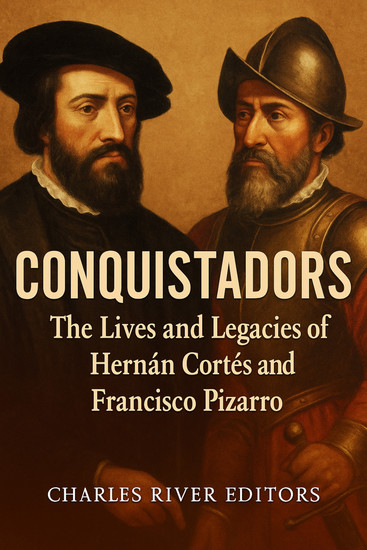
Conquistadors - The Lives and Legacies of Hernán Cortés and Francisco Pizarro - cover

Conquistadors - The Lives and Legacies of Hernán Cortés and Francisco Pizarro

Editors Charles River

Casa editrice: Charles River Editors

  • 0
  • 0
  • 0

Sinossi

During the Age of Exploration, some of the most famous and infamous individuals were Spain’s best known conquistadors. Naturally, as the best known conquistador, Hernán Cortés (1485-1547) is also the most controversial. Like Christopher Columbus before him, Cortés was lionized for his successes for centuries without questioning his tactics or motives, while indigenous views of the man have been overwhelmingly negative for the consequences his conquests had on the Aztecs and other natives in the region. Just about the only thing everyone agrees upon is that Cortés had a profound impact on the history of North America.
 
Of course, the lionization and demonization of Cortés often take place without fully analyzing the man himself, especially because there are almost no contemporaneous sources that explain what his thinking and motivation was. If anything, Cortés seemed to have been less concerned with posterity or the effects of the Spanish conquest on the natives than he was on relations with the Mother Country itself. Of the few things that are known about Cortés, it appears that he was both extremely ambitious and fully cognizant of politics and political intrigue, even in a New World thousands of miles west of Spain itself. Cortés spent much of his time in Mexico and the New World defending himself against other Spanish officials in the region, as well as trying to portray and position himself in a favorable light back home.
 
While those ambitions and politics understandably colored his writings about his activities and conquests, scholars nevertheless use what he wrote to gain a better understanding of the indigenous natives he came into contact with. Even then, however, what he wrote was scarce; Cortés's account of his conquest of Mexico is comprised of five letters he addressed to the Holy Roman Emperor, Charles V. As Adolph Francis Bandelier noted in the Catholic Encyclopedia in 1908, “Cortés was a good writer. His letters to the emperor, on the conquest, deserve to be classed among the best Spanish documents of the period. They are, of course, coloured so as to place his own achievements in relief, but, withal, he keeps within bounds and does not exaggerate, except in matters of Indian civilization and the numbers of population as implied by the size of the settlements. Even there he uses comparatives only, judging from outward appearances and from impressions.”
 
If Columbus and Cortés were the pioneers of Spain’s new global empire, Pizarro consolidated its immense power and riches, and his successes inspired a further generation to expand Spain’s dominions to unheard of dimensions.  Furthermore, he participated in the forging of a new culture: like Cortés, he took an indigenous mistress with whom he had two mixed-race children, and yet the woman has none of the lasting fame of Cortés’s Doña Marina.  With all of this in mind, it is again remarkable that Pizarro remains one of the less well-known and less written about of the explorers of his age.
 
On the other hand, there are certain factors that may account for the conqueror of Peru’s relative lack of lasting glory.  For one, he was a latecomer in more than one sense.  Cortés’s reputation was built on being the first to overthrow a great empire, so Pizarro’s similar feat, even if it bore even greater fruit in the long run, would always be overshadowed by his predecessor’s precedent.  But Pizarro also lacked the youthful glamour of Cortés: already a wizened veteran in his 50s by the time he undertook his momentous expedition, he proceeded with the gritty determination of a hardened soldier rather than the audacity and cunning of a young courtier. 
Disponibile da: 20/06/2025.
Lunghezza di stampa: 76 pagine.

Altri libri che potrebbero interessarti

  • Old U(VA) and I 1961 The - 1965 - cover

    Old U(VA) and I 1961 The - 1965

    Frank Briggs

    • 0
    • 0
    • 0
    The Old U(VA) and I: 1961-1965 
    By: Frank Briggs 
    The decade of the 1960s saw sweeping changes at UVA as old barriers fell and students of new backgrounds came. Litigation that lasted from the late 1940s through the end of the 1960s eliminated historic barriers to African American and women students. No detailed UVA-specific narrative has existed until former graduates from two ends of the decade, Joel Gardner, BA 1970, Rebel Yell to Revolution, in 2018 and now Frank Briggs, BA 1965, recognized that the University had changed in the most profound ways and used their own experiences to document what happened. This book will attract anyone who lived through that heady period. It will appeal also to others, to women and men who grew up later, and who may have wondered why and how the good old days ended and America stepped beyond them. Some might say grew up. 
    —John T. Casteen III, President Emeritus, University of Virginia, 1990–2010 
    Frank Briggs’s memoir is a highly entertaining trip in time to an era in UVA history that predated the social upheavals of the late 1960s. We accompany the author through his four years in a cloistered culture of tradition that had not changed over many decades. In a series of revealing and amusing anecdotes, we relive the road trips, party weekends, and collegiate shenanigans that dominated the student experience during that period. This is a must read for every Wahoo who lived through that era or anyone who has an interest in the social history of college life prior to the cultural revolution that swept across the country after Briggs’s graduation. 
    —Joel B. Gardner, Author, From Rebel Yell to Revolution: My Four Years at UVA, 1966–1970
    Mostra libro
  • GRE Secrets: Simple Strategies for Maximum Scores Instantly - "Elevate your GRE prep! Discover engaging audio strategies for achieving top scores effortlessly!" - cover

    GRE Secrets: Simple Strategies...

    Branwell Sutherland

    • 0
    • 0
    • 0
    Unlock Your Potential: Proven Strategies for Success 
    Are you eager to advance in your career and enhance your knowledge by excelling in the upcoming 2024-2025 Exam? 
    In search of an all-inclusive resource to help you conquer the exam? 
    Your quest ends here! 
    This guide is your ultimate companion for deepening your comprehension, honing your skills, and engaging in practical exercises. With this resource, you're set up for success. 
    Updated for the 2024-2025 Exam Structure. 
    Key features of this enhanced guide include: 
    - In-depth insights on the 2024-2025 Exam Certification 
    - Comprehensive exploration of unlocking your potential with proven strategies  
    - Effective techniques for exam preparation and solution strategies  
    This guide stands out due to its thorough coverage, crucial for your exam triumph. Concepts are not merely brushed over; they are examined with care. 
    Please note that this guide is not affiliated with any official examination authority and serves as an independent resource designed for your benefit. 
    Structured clearly and written in accessible language, our Exam Guide 2024-2025 ensures smooth transitions between topics. Bid farewell to convoluted jargon and embrace straightforward, precise, and technically accurate content. 
    So, why hesitate? Click the BUY NOW button, secure your resource, and embark on your journey to success in the 2024-2025 Exam!
    Mostra libro
  • The Analects - cover

    The Analects

    Confucius

    • 0
    • 0
    • 0
    "The Analects," a collection of sayings and ideas attributed to Confucius, offers profound insights into ethics, leadership, and personal development. This timeless text emphasizes the importance of moral integrity, filial piety, and virtuous conduct in both individual and societal life. Through anecdotes and dialogues, it guides readers on a path toward wisdom, emphasizing the cultivation of character and the role of exemplary leadership in creating a harmonious society. "The Analects" serves as a foundational text of Confucian philosophy, providing enduring wisdom for ethical living and responsible governance. Read in English, unabridged.
    Mostra libro
  • The Art of Rome - Masterpieces of the Ancient Empire - cover

    The Art of Rome - Masterpieces...

    Rogan Fish

    • 0
    • 0
    • 0
    The art of ancient Rome was shaped by a blend of cultural influences, evolving through a combination of native traditions and foreign influences, most notably from the Etruscans and Greeks. Early Roman art was heavily influenced by the Etruscans, who occupied central Italy before the rise of Rome. Etruscan art was characterized by its religious themes, vibrant frescoes, and elaborate tomb paintings, which had a significant impact on the early Roman artistic style. These early Roman artists often adopted Etruscan methods but began incorporating their own innovations, creating a distinctive blend of the two cultures. 
    Greek art also played a crucial role in the development of Roman art. As Rome expanded and conquered Greece, it absorbed many aspects of Greek culture, including their artistic styles. Greek sculptural ideals of beauty, proportion, and harmony were emulated by Roman artists. However, while Greek art favored idealized forms and perfection, Roman art took a more realistic approach, focusing on depicting individuals as they truly appeared. Roman portraiture, for example, was known for its attention to detail, capturing the wrinkles, facial expressions, and other characteristics that defined a person’s likeness. This move toward realism was a major shift from the idealized forms of Greek art, and it became a hallmark of Roman artistry. 
    In the early stages of Roman art, the primary medium was sculpture, often used to commemorate important figures or events. The Romans developed a talent for creating lifelike statues and busts, which were displayed in homes and public spaces to honor ancestors and gods. These sculptures, often made from marble or bronze, served as a means of preserving the memory of individuals or celebrating military victories.
    Mostra libro
  • Human Perspective The - Lessons from Genesis - cover

    Human Perspective The - Lessons...

    Amitai Rosengart

    • 0
    • 0
    • 0
     “The Human Aspect - Lessons from Genesis” offers an enriching new exploration of ancient narratives, providing a fresh and captivating interpretation of the Bible's foundational stories from a non-religious angle. By embracing a new analysis method, this book undercover new and fundamental lessons and reinforce the importance of myths and their ability to communicate essential truths across generations. 
    Contrary to traditional approaches, this unconventional inquiry adopts a Greek tragedy lens, shedding new and exciting light on the most famous book in the world. Exposing narratives passed down from generation to generation. The author presents these stories as profound tales that offer deep insights into the human condition that transcend the boundaries of time, space, and race. 
    Within this remarkable journey, the author delve into themes as diverse as parenting, adolescence, decision-making, and the quest for fame. All representing the eternity and similarities we share as human beings. 
    Join now a unique journey to discover the hidden truth hidden in the ancient text. 
     
    Mostra libro
  • How to Survive in Ancient Egypt - cover

    How to Survive in Ancient Egypt

    Charlotte Booth

    • 0
    • 0
    • 0
    Focusing on Thebes in 1360 BCE, How to Survive in Ancient Egypt is the ultimate guide to living in ancient Egypt, including all of the religious beliefs and sites to see.Imagine you were transported back in time to Ancient Egypt and you had to start a new life there. How would you fit in? Where would you live? What would you eat? Where would you go to have your hair done? Who would you go to if you got ill, or if you were mugged in the street? All these questions, and many more, will be answered in this how-to guide for time travelers.Part self-help guide, part survival guide, this lively and engaging book will help the listener deal with the many problems and new experiences that they will face, and also help them to thrive in this strange new environment.
    Mostra libro