¡Acompáñanos a viajar por el mundo de los libros!
Añadir este libro a la estantería
Grey
Escribe un nuevo comentario Default profile 50px
Grey
Suscríbete para leer el libro completo o lee las primeras páginas gratis.
All characters reduced
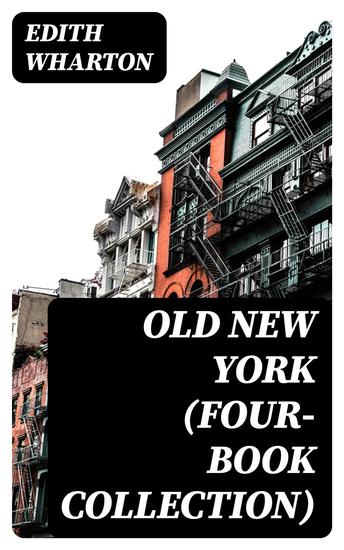
Old New York (Four-Book Collection) - cover

Old New York (Four-Book Collection)

Edith Wharton

Editorial: DigiCat

  • 0
  • 0
  • 0

Sinopsis

In "Old New York," Edith Wharton presents a captivating four-book collection that intricately explores the social mores and distinctive cultural landscape of late 19th-century New York City. Through rich, atmospheric prose and keen psychological insight, Wharton delves into the lives of its upper-class society, revealing the intricate dance between propriety, ambition, and moral complexity. The collection intertwines narratives of love, betrayal, and the often-punitive nature of social expectations, bringing to life a milieu where elegance and decay coexist, and where characters grapple with the weight of tradition against the surge of modernity. Edith Wharton, an American novelist and leading figure of the literary elite, draws upon her own experiences as a member of the elite society she depicts. Her deep understanding of the cultural intricacies and tensions within high society, combined with her personal observations, fuels her narratives. Wharton's background and vantage point provide her with the unique ability to both celebrate and critique the world she inhabited, allowing for a nuanced portrayal of its constraints and complexities. "Old New York" is an essential read for those interested in American literature and social history. Wharton's astute observations and masterful storytelling not only illuminate the past but also resonate with contemporary themes of identity and societal pressure. This collection invites readers to reflect on the enduring impacts of class and culture, making it a pivotal addition to any literary canon.
Disponible desde: 10/12/2022.
Longitud de impresión: 336 páginas.

Otros libros que te pueden interesar

  • What Gives Us Our Names - cover

    What Gives Us Our Names

    Alvin Pang

    • 0
    • 0
    • 0
    He’d gotten the idea from a book, not unlike the one you last read and loved, whose lurid covers you have already forgotten. For a canvas, he used not his own skin but his very life, spending his days as if he were made up of the most telling bits of other people. To do this, he learned to watch quietly and look deeply, past the busy surfaces until he could discern the colours beneath, the ones that did not change. One by one he would name them as he wove them into his heart in the deep of night. He touched you once, borrowing pieces of your story in passing. They are here still, in case you wish to look.
    Ver libro
  • The Great Gatsby - cover

    The Great Gatsby

    F. Scott Fitzgerald

    • 0
    • 0
    • 0
    "So we beat on, boats against the current, borne back ceaselessly into the past."
    
    In the sweltering summer of 1922, young bondsman Nick Carraway moves to West Egg, Long Island, finding himself neighbor to the mysterious millionaire Jay Gatsby. Gatsby is famous for his decadent, star-studded parties, yet he remains a man of shadows, driven by a singular, consuming purpose: to reclaim the love of the beautiful, ethereal Daisy Buchanan. As the jazz plays and the champagne flows, Fitzgerald unfolds a glittering tragedy of social climbing, infidelity, and the high cost of reinventing one's past.
    
    The Gilded Surface of the 1920s: Fitzgerald's prose captures the frantic energy of the Prohibition era—the "flapper" culture, the illegal speakeasies, and the soaring stock market. Yet beneath the sequins and the yellow Duesenbergs lies a biting critique of a society hollowed out by materialism. Through the eyes of the "within and without" narrator Nick Carraway, we witness the careless cruelty of the ultra-wealthy.
    
    Symbolism and the Soul: From the haunting "Eyes of Doctor T.J. Eckleburg" overlooking the Valley of Ashes to the iconic "Green Light" at the end of Daisy's dock, the novel is a masterclass in symbolism. It explores the impossibility of repeating the past and the tragic vulnerability of the romantic heart in a cynical world. The Great Gatsby remains the quintessential American novel, questioning if any amount of gold can truly buy a seat at the table of the elite.
    
    Step into the world of Gatsby. Purchase "The Great Gatsby" today and experience the most beautiful and brutal story of the 20th century.
    Ver libro
  • Animal Farm - cover

    Animal Farm

    George Orwell

    • 0
    • 0
    • 0
    Animal Farm is a satirical allegorical novella, in the form of a beast fable, by George Orwell, first published in England on 17 August 1945. It tells the story of a group of anthropomorphic farm animals who rebel against their human farmer, hoping to create a society where the animals can be equal, free, and happy. Ultimately, the rebellion is betrayed, and under the dictatorship of a pig named Napoleon, the farm ends up in a state far worse than before.According to Orwell, Animal Farm reflects events leading up to the Russian Revolution of 1917 and then on into the Stalinist era of the Soviet Union, a period when Russia lived under the communist ideology of Joseph Stalin. Orwell, a democratic socialist, was a critic of Stalin and hostile to Moscow-directed Stalinism, an attitude that was critically shaped by his experiences during the Barcelona May Days conflicts between the POUM and Stalinist forces, during the Spanish Civil War. In a letter to Yvonne Davet, Orwell described Animal Farm as a satirical tale against Stalin ("un conte satirique contre Staline"), and in his essay, "Why I Write" (1946), wrote: "Animal Farm was the first book in which I tried, with full consciousness of what I was doing, to fuse political purpose and artistic purpose into one whole".
    Ver libro
  • Bellerophon To Anteia - From their pens to your ears genius in every story - cover

    Bellerophon To Anteia - From...

    Mary Butts

    • 0
    • 0
    • 0
    Mary Frances Butts was born on 13th December 1890 in Poole, Dorset. 
    Her early years were spent at Salterns, an 18th-century house overlooking Poole Harbour.  Sadly in 1905 her father died, and she was sent for boarding at St Leonard's school for girls in St Andrews. 
    Her mother remarried and, from 1909, Mary studied at Westfield College in London, and here, first became aware of her bisexual feelings.  She was sent down for organising a trip to Epsom races and only completed her degree in 1914 when she graduated from the London School of Economics.  By then Mary had become an admirer of the occultist Aleister Crowley and she was given a co-authorship credit on his ‘Magick (Book 4)’. 
    In 1916, she began the diary which would now detail her future life and be a constant reference point for her observations and her absorbing experiences. 
    During World War I, she was doing social work for the London County Council in Hackney Wick, and involved in a lesbian relationship.  Life changed after meeting the modernist poet, John Rodker and they married in 1918. 
    In 1921 she spent 3 months at Aleister Crowley's Abbey of Thelema in Sicily; she found the practices dreadful and also acquired a drug habit.  Mary now spent time writing in Dorset, including her celebrated book of short stories ‘Speed the Plough’ which saw fully develop her unique Modernist prose style. 
    Europe now beckoned and several years were spent in Paris befriending many artists and writing further extraordinary stories.   
    She was continually sought after by literary magazines and also published several short story collections as books. Although a Modernist writer she worked in other genres but is essentially only known for her short stories.  Mary was deeply committed to nature conservation and wrote several pamphlets attacking the growing pollution of the countryside. 
    In 1927, she divorced and the following year her novel ‘Armed with Madness’ was published.  A further marriage followed in 1930 and time was spent attempting to settle in London and Newcastle before setting up home on the western tip of Cornwall.  By 1934 the marriage had failed. 
    Mary Butts died on 5th March 1937, at the West Cornwall Hospital, Penzance, after an operation for a perforated gastric ulcer. She was 46.
    Ver libro
  • The Complete Works of H P Lovecraft - cover

    The Complete Works of H P Lovecraft

    Anónimo

    • 0
    • 0
    • 0
    "The Oldest and Strongest Emotion of Mankind is Fear, and the Oldest and Strongest Kind of Fear is Fear of the Unknown."
    
    H.P. Lovecraft did not just write horror; he created an entire universe of ancient gods and forbidden knowledge that has haunted the human imagination for a century. Moving beyond traditional ghosts and vampires, Lovecraft pioneered "Cosmic Horror"—the terrifying realization that humanity is an insignificant speck in a vast, uncaring cosmos. This comprehensive collection brings together every tale of madness, every forbidden tome, and every shadow-shrouded town from the master of the weird.
    
    Inside this monumental collection, you will explore:
    
    The Architecture of the Mythos: Experience the interconnected cycle of stories involving ancient, slumbering deities and the secret cults that seek to wake them.
    
    The Descent into Madness: Witness the "Lovecraftian Protagonist"—scholars and explorers whose pursuit of truth leads them to sights that the human mind was never meant to behold.
    
    Atmospheric World-Building: Immerse yourself in the decaying seaports and shunned hill-country of "Lovecraft Country," where the geometry is wrong and the shadows have teeth.
    
    The Philosophy of the Unknown: Delve into the "Cosmic Indifferentism" that makes Lovecraft's work uniquely chilling—the idea that the universe is not hostile, but simply doesn't care that we exist.
    
    Lovecraft's influence is the foundation of modern horror, inspiring everything from blockbuster films to dark tabletop gaming. Whether you are a seeker of the "Necronomicon" or a fan of psychological dread, this volume is an essential cornerstone for any library of supernatural literature and modern myth-making.
    
    Dare to look beyond the veil. Buy "The Complete Works of H.P. Lovecraft" today and discover what hides in the dark.
    Ver libro
  • Hamlet - William Shakespeare - cover

    Hamlet - William Shakespeare

    William Shakespeare

    • 0
    • 0
    • 0
    The Tragedy of Hamlet, Prince of Denmark, often shortened to Hamlet, is a tragedy written by William Shakespeare sometime between 1599 and 1601. It is Shakespeare's longest play.
    Ver libro