Junte-se a nós em uma viagem ao mundo dos livros!
Adicionar este livro à prateleira
Grey
Deixe um novo comentário Default profile 50px
Grey
Assine para ler o livro completo ou leia as primeiras páginas de graça!
All characters reduced
The Magic City - cover
LER

The Magic City

Edith Nesbit

Editora: CLXBX

  • 0
  • 0
  • 0

Sinopse

The Magic City by Edith Nesbit is a captivating children's fantasy novel that blends imagination, adventure, and emotional growth in a richly inventive story about creativity and the power of belief. First published in 1910, the book showcases Nesbit's signature style of combining ordinary childhood experiences with extraordinary magical worlds.

The story follows a young boy who, after building an elaborate model city out of toys and household objects, discovers that his creation is far more than it appears. What begins as a playful act of imagination soon transforms into a remarkable journey when he finds himself drawn into the miniature world he has constructed.

Inside this mysterious city, everything is alive, and the structures he created become real places filled with people, challenges, and unexpected events. As he explores this fantastical realm, the boy encounters both wonder and danger, forcing him to navigate a world shaped by his own imagination.

Throughout his journey, he meets a variety of characters who guide, challenge, and sometimes confuse him. Each experience teaches him important lessons about responsibility, creativity, courage, and the consequences of his actions within this living world.

Edith Nesbit's storytelling is rich with humor, vivid description, and emotional depth. She brings the concept of imaginative play to life in a way that feels both magical and meaningful, capturing the intensity and seriousness with which children often view their own creations.

The novel explores themes such as imagination, creation, responsibility, and the blurred line between fantasy and reality. It also reflects on the idea that what children create in play can hold deep emotional significance and influence their understanding of the world.

At its heart, The Magic City is a celebration of creativity and the boundless possibilities of the imagination. It invites readers to see the world through a child's eyes, where even the simplest objects can become gateways to extraordinary adventures.

Ideal for readers of classic children's literature, fantasy adventures, and imaginative storytelling, this novel remains a timeless exploration of creativity, wonder, and self-discovery.
Disponível desde: 10/05/2026.
Comprimento de impressão: 200 páginas.

Outros livros que poderiam interessá-lo

  • Bringing Mindfulness Into the Classroom - Easy Ideas You Can Try Tomorrow - cover

    Bringing Mindfulness Into the...

    Tara Segree

    • 0
    • 0
    • 0
    How can we help our students navigate challenges with confidence, mental well-being, and presence? While many schools implement social emotional learning or guidance programs, this book shows an easy, effective, and sustainable way to incorporate mindfulness into your classroom no matter what grade or subject you teach. 


    Tara Segree, recipient of the 2021 Innovative Educator Award and a collaborator of the Mini Meditations for Kids podcast, shows how mindful practices can help students build confidence, overcome anxiety, focus, engage in learning, find their strengths, and more. 


    Chapters provide tools and activities for incorporating mindfulness into your day-to-day teaching, as well as ideas for partnering with families so students can continue their practice at home. Special features include The 30-Day Mindfulness Challenge to give you an accessible way to try mindfulness with your students, and journal prompts to help you on your own mindfulness journey.
    Ver livro
  • Understanding the Paradox of Surviving Childhood Trauma - Techniques and Tools for Working with Suicidality and Dissociation - cover

    Understanding the Paradox of...

    Ly Vick Johnson, Simone Jacobs,...

    • 0
    • 0
    • 0
    Understanding the Paradox of Surviving Childhood Trauma offers clinicians a new framework for understanding the symptoms and coping mechanisms displayed by survivors of childhood abuse. This approach considers how characteristics such as suicidality, self-harm, persistent depression, and anxiety can have roots in behaviors and beliefs that helped patients survive their trauma. This book provides practitioners with case examples, practical tips, and techniques for applying this mindset directly to their most complex cases. By depathologizing patients' experiences and behaviors, and moving beyond simply managing them, therapists can reduce their clients' shame and work collaboratively to understand the underlying message that these behaviors conceal.
    Ver livro
  • Unbuttoned & Exposed - A Collection of Gay Erotica Short Stories - cover

    Unbuttoned & Exposed - A...

    Gray Wilder

    • 0
    • 0
    • 0
    Unbuttoned & Exposed is a bold and unapologetically sensual collection of gay erotica short stories by Gray Wilder. Each story plunges readers into moments of intense attraction, vulnerability, and authentic connection between men navigating desire, love, and identity. 
    From a steamy cooking session that sparks more than just flavors, to the rediscovery of passion between men in their second spring, to strangers whose lives intertwine in unexpected, heated ways—this anthology captures the full spectrum of queer intimacy. With a strong focus on consent, pleasure, and emotional resonance, Wilder’s storytelling is both raw and romantic, blending eroticism with heartfelt humanity. 
    Perfect for readers seeking character-driven, explicit gay stories that celebrate the complexity and joy of male-male intimacy. Every story is a stand-alone encounter, yet together they form a mosaic of love, longing, and lust told from a uniquely honest gay perspective.
    Ver livro
  • Innovations of World War I The: The History of the Technological Advances that Defined the Great War - cover

    Innovations of World War I The:...

    Charles River Editors

    • 0
    • 0
    • 0
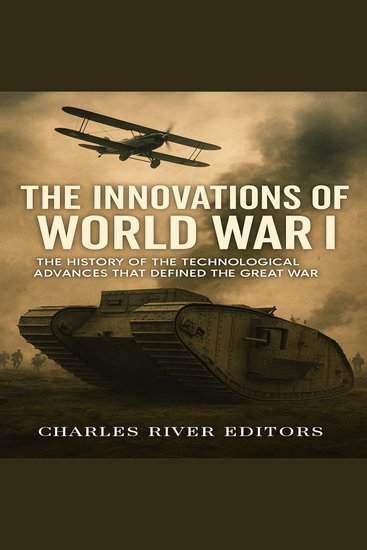
    World War I, also known in its time as the “Great War” or the “War to End all Wars”, was an unprecedented holocaust in terms of its sheer scale. Fought by men who hailed from all corners of the globe, it saw millions of soldiers do battle in brutal assaults of attrition which dragged on for months with little to no respite. Tens of millions of artillery shells and untold hundreds of millions of rifle and machine gun bullets were fired in a conflict that demonstrated man’s capacity to kill each other on a heretofore unprecedented scale. 
    	Since the industrial revolution, arms and materiel output had increased by orders of magnitude, as had the quality and uniformity of the products. Several developments had already taken place in the years building up to the conflict, stepping stones towards the vast escalation in military innovation which took place immediately prior to and during World War I. Innovations included the adoption into service of the first belt-fed machine guns, predecessors of those which would wreak such slaughter in the trenches, and the development of cannon which did not roll backwards after each shot as 19th century pieces did, but remained fixed in place.  
    	The arms race before the war and the attempt to break the deadlock of the Western and Eastern Fronts by any means possible changed the face of battle in ways that would have previously been deemed unthinkable. Before 1914, flying machines were objects of public curiosity; the first flights of any account on rotor aircraft had been made less than 5 years before and were considered to be the province of daredevils and lunatics. By 1918, all the great powers were fielding squadrons of fighting aircraft armed with machine-guns and bombs, to say nothing of light reconnaissance planes. Tanks, a common feature on the battlefield by 1918, had not previously existed outside of the realm of science fiction stories written by authors like H.G. Wells.
    Ver livro
  • Physics - cover

    Physics

    Aristotle

    • 0
    • 0
    • 0
    This seminal work delves into the essence of change, motion, and the purposes of natural phenomena, exploring the interplay of matter and form. Aristotle's methodical inquiries lay the groundwork for centuries of scientific thought, dissecting the laws that govern the universe. A must-read for anyone seeking to understand the origins of natural philosophy and the roots of modern science.
    Ver livro
  • Psychopathology of Everyday Life - cover

    Psychopathology of Everyday Life

    Sigmund Freud

    • 0
    • 0
    • 0
    Forgetting a name or a word is not just a random blunder. Nothing happens by accident. Nothing is a mere slip. “The Psychopathology of Everyday Life” is filled with everyday examples of apparent forgetfulness and inexplicable mistakes, revealed by Freud to have far greater and deeper meaning that at first glance. Virtually devoid of any technical terminology, this classic of the psychoanalytic tradition remains Sigmund Freud’s most accessable and popular work. 
    Sigmund Freud (1856-1939) was an exceptionally influential Austrian psychologist, neurologist, philosopher and writer. The founder of psychoanalysis, his major works include “The Interpretation of Dreams" (1900), “The Psychopathology of Everyday Life” (1901), “Three Essays on the Theory of Sexuality” (1905), and “Totem and Taboo” (1913).
    Ver livro