Unisciti a noi in un viaggio nel mondo dei libri!
Aggiungi questo libro allo scaffale
Grey
Scrivi un nuovo commento Default profile 50px
Grey
Iscriviti per leggere l'intero libro o leggi le prime pagine gratuitamente!
All characters reduced
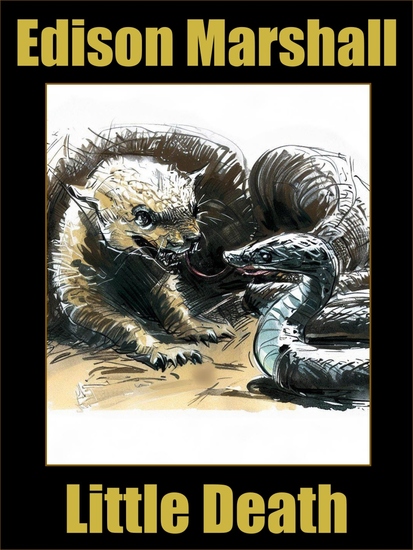
Little Death - cover

Little Death

Edison Marshall

Casa editrice: Alien Ebooks

  • 0
  • 0
  • 0

Sinossi

Orignally published in The Blue Book Magazine (Oct 1920), "Little Death" tells the story of a mink named Little Death, following his interactions with a farmer and fellow forest creatures.
Disponibile da: 23/08/2023.
Lunghezza di stampa: 19 pagine.
Altri libri che potrebbero interessarti

  • Freckles - From their pens to your ears genius in every story - cover

    Freckles - From their pens to...

    William Pett Ridge

    • 0
    • 0
    • 0
    William Pett Ridge was born at Chartham, near Canterbury, Kent, on 22nd April 1859. 
    His family’s resources were certainly limited. His father was a railway porter, and the young Pett Ridge, after schooling in Marden, Kent became a clerk in a railway clearing-house. The hours were long and arduous, but self-improvement was Pett Ridge’s goal.  After working from nine until seven o’clock he would attend evening classes at Birkbeck Literary and Scientific Institute and then to follow his passion; the ambition to write.  He was heavily influenced by Dickens and several critics thought he had the capability to be his successor. 
    From 1891 many of his humourous sketches were published in the St James's Gazette, the Idler, Windsor Magazine and other literary periodicals of the day. 
    Pett Ridge published his first novel in 1895, A Clever Wife. By the advent of his fifth novel, Mord Em'ly, a mere three years later in 1898, his success was obvious.  His writing was written from the perspective of those born with no privilege and relied on his great talent to find humour and sympathy in his portrayal of working class life. 
    Today Pett Ridge and other East End novelists including Arthur Nevinson, Arthur Morrison and Edwin Pugh are being grouped together as the Cockney Novelists.   
    In 1924, Pugh set out his recollections of Pett Ridge from the 1890s: “I see him most clearly, as he was in those days, through a blue haze of tobacco smoke. We used sometimes to travel together from Waterloo to Worcester Park on our way to spend a Saturday afternoon and evening with H. G. Wells. Pett Ridge does not know it, but it was through watching him fill his pipe, as he sat opposite me in a stuffy little railway compartment, that I completed my own education as a smoker... Pett Ridge had a small, dark, rather spiky moustache in those days, and thick, dark, sleek hair which is perhaps not quite so thick or dark, though hardly less sleek nowadays than it was then”. 
    With his success, on the back of his prolific output and commercial success, Pett Ridge gave generously of both time and money to charity. In 1907 he founded the Babies Home at Hoxton.  This was one of several organisations that he supported that had the welfare of children as their mission.  
    His circle considered Pett Ridge to be one of life's natural bachelors. In 1909 they were rather surprised therefore when he married Olga Hentschel.  
    As the 1920’s arrived Pett Ridge added to his popularity with the movies. Four of his books were adapted into films.  
    Pett Ridge now found the peak of his fame had passed. Although he still managed to produce a book a year he was falling out of fashion and favour with the reading public and his popularity declined rapidly.  His canon runs to over sixty novels and short-story collections as well as many pieces for magazines and periodicals. 
    William Pett Ridge died, on 29th September 1930, at his home, Ampthill, Willow Grove, Chislehurst, at the age of 71. 
    He was cremated at West Norwood on 2nd October 1930.
    Mostra libro
  • The Complete Tragedies - Oedipus Hercules Mad Hercules on Oeta Thyestes Agamemnon - cover

    The Complete Tragedies - Oedipus...

    Lucius Annaeus

    • 0
    • 0
    • 0
    The second of two volumes collecting the complete tragedies of Seneca. Edited by world-renowned classicists Elizabeth Asmis, Shadi Bartsch, and Martha C. Nussbaum, the Complete Works of Lucius Annaeus Seneca offers authoritative, modern English translations of the writings of the Stoic philosopher and playwright (4 BCE–65 CE). The two volumes of The Complete Tragedies presents all of his dramas, expertly rendered by preeminent scholars and translators. The first volume contains Medea, The Phoenician Women, Phaedra, The Trojan Women, and Octavia, the last of which was written in emulation of Senecan tragedies and serves as a unique example of political tragedy. This second volume includes Oedipus, Hercules Mad, Hercules on Oeta, Thyestes, and Agamemnon. High standards of accuracy, clarity, and style are maintained throughout the translations, which render Seneca into verse with as close a correspondence, line for line, to the original as possible, and with special attention paid to meter and overall flow. In addition, each tragedy is prefaced by an original translator’s introduction offering reflections on the work’s context and meaning. Notes are provided for the reader unfamiliar with the culture and history of classical antiquity. Accordingly, The Complete Tragedies will be of use to a general audience and professionals alike, from the Latinless student to scholars and instructors of comparative literature, classics, philosophy, drama, and more.
    Mostra libro
  • The Harvester - cover

    The Harvester

    Gene Stratton-Porter

    • 0
    • 0
    • 0
    A man at one with nature finds himself enchanted by a vision in this classic Midwestern romance from the naturalist and author of The Keeper of the Bees.   David Langston, the Harvester, allows his dog to decide his fate every year—to join the money-making scramble in the noise and grime of the city, or continue harvesting the goldenseal, mullein, and ginseng in the woods around their country home. Every year, his dog Bel chooses correctly—for they are both creatures of the woods.   But this year, there is another matter to ponder. Should Langston remain alone—or should he go courting? There are pros and cons of course—mostly cons—that bang around in Langston’s mind. That is, until he sees a ghostly vision near the lake, a slender dark-haired woman wrapped in robes of white, lovelier than any he has ever seen in his twenty-six years. And then one day he sees her crying in the woods. Ruth Jameson is a girl caught in a bad situation, and Langston finds himself willing to do anything to help her and make her every wish come true.  Praise for the writing of Gene Stratton-Porter   “As famous in the early 1900s as J.K. Rowling is now . . . Her natural settings, wholesome themes and strong lead characters fulfilled the public’s desires to connect with nature and give children positive role models.” —Smithsonian Magazine   “Her narrative is entertaining, her enthusiasm catching.” —The New York Times
    Mostra libro
  • Compendium Of Revolutionary Notions A - Politics And The English Language A Nice Cup Of Tee - Notes On Nationlism - cover

    Compendium Of Revolutionary...

    George Orwell

    • 0
    • 0
    • 0
    George Orwell, was an English novelist, essayist, journalist and critic. His work is characterized by lucid prose, biting social criticism, total opposition to totalitarianism, and outspoken support of democratic socialism. 
     
    Orwell produced literary criticism and poetry, fiction and polemical journalism. He is known for the allegorical novella Animal Farm (1945) and the dystopian novel Nineteen Eighty-Four (1949). His non-fiction works, including The Road to Wigan Pier (1937), documenting his experience of working-class life in the north of England, and Homage to Catalonia (1938), an account of his experiences soldiering for the Republican faction of the Spanish Civil War (1936–1939), are as critically respected as his essays on politics and literature, language and culture. In 2008, The Times ranked George Orwell second among "The 50 greatest British writers since 1945". 
     
    Orwell's work remains influential in popular culture and in political culture, and the adjective "Orwellian"—describing totalitarian and authoritarian social practices—is part of the English language, like many of his neologisms, such as "Big Brother", "Thought Police", "Two Minutes Hate", "Room 101", "memory hole", "Newspeak", "doublethink", "unperson", and "thoughtcrime", as well as providing direct inspiration for the neologism "groupthink".
    Mostra libro
  • Anna's Love Letters - cover

    Anna's Love Letters

    Lucy Maud Montgomery

    • 0
    • 0
    • 0
    Lucy Maud Montgomery (November 30, 1874 – April 24, 1942), published as L. M. Montgomery, was a Canadian author best known for a series of novels beginning in 1908 with Anne of Green Gables. The book was an immediate success. The title character, orphan Anne Shirley, made Montgomery famous in her lifetime and gave her an international following.
    Anna's Love Letters:"Are you going to answer Gilbert's letter tonight, Anna?" asked Alma Williams, standing in the pantry doorway, tall, fair, and grey-eyed, with the sunset light coming down over the dark firs, through the window behind her, and making a primrose nimbus around her shapely head.
    Mostra libro
  • Dracula - cover

    Dracula

    Bram Stoker

    • 0
    • 0
    • 0
    “There are darknesses in life and there are lights, and you are one of the lights, the light of all lights.” ― Bram Stoker, Dracula 
    Dracula is an 1897 Gothic horror novel by Irish author Bram Stoker. Famous for introducing the character of the vampire Count Dracula, the novel tells the story of Dracula's attempt to move from Transylvania to England so he may find new blood and spread undead curse, and the battle between Dracula and a small group of men and women led by Professor Abraham Van Helsing. 
    Dracula has been assigned to many literary genres including vampire literature, horror fiction, the gothic novel and invasion literature. The novel touches on themes such as the role of women in Victorian culture, sexual conventions, immigration, colonialism, and post-colonialism. 
    Although Stoker did not invent the vampire, he defined its modern form, and the novel has spawned numerous theatrical, film and television interpretations.
    Mostra libro