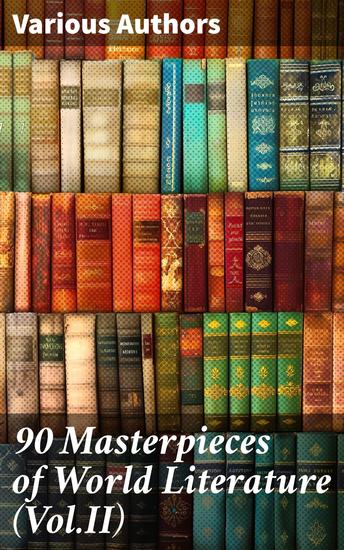
90 Masterpieces of World Literature (VolII) - Novels Poetry Plays Short Stories Essays Psychology & Philosophy
Edgar Allan Poe, Pedro Calderón de la Barca, Charles Dickens, Jane Austen, Alexandre Dumas, Bram Stoker, Jonathan Swift, Joseph Conrad, Daniel Defoe, Washington Irving, Nathaniel Hawthorne, Henry James, Henrik Ibsen, Wilkie Collins, D. H. Lawrence, Friedrich Nietzsche, Harriet Beecher Stowe, Anthony Trollope, Laozi Laozi, Kate Chopin, James Fenimore Cooper, Ann Ward Radcliffe, Laurence Sterne, George MacDonald, Lewis Wallace, Robert Louis Stevenson, William Dean Howells, Honoré de Balzac, Émile Zola, Henry Fielding, George Bernard Shaw, Benjamin Franklin, Walter Scott, Theodor Storm, Willa Cather, Edith Wharton, Edgar Wallace, F. Scott Fitzgerald, Nikolai Leskov, Sinclair Lewis, Ivan Turgenev, G. K. Chesterton, J. M. Barrie, Virginia Woolf, John Buchan, Charlotte Perkins Gilman, Rabindranath Tagore, Jerome K. Jerome, W. B. Yeats, Kenneth Grahame, Kakuzo Okakura, Kurt Vonnegut, E. M. Forster, H. G. Wells, Nikolai Gogol, William Walker Atkinson, Elizabeth von Arnim, Victor Hugo, Fyodor Dostoyevsky, Cao Xueqin, Émile Coué, Johann Wolfgang von Goethe, Dante, Thomas Hardy, Válmíki, Kalidasa, Jules Verne, Bankim Chandra Chatterjee, Leo Tolstoy, Gaston Leroux, P. B. Shelley, John Milton, George Weedon Grossmith, Machiavelli, Stendhal, Confucius, W. Somerset Maugham, Gustave Flaubert, Ford Madox Ford, Homer Homer
Casa editrice: Good Press
Sinossi
In '90 Masterpieces of World Literature (Vol. II)', the essence of global literary prowess is captured through an incredible tapestry of styles, themes, and narrative techniques. Ranging from the philosophical musings of ancient sages to the penetrating social critiques of modern times, this anthology offers an extensive survey of narrative artistry. The selection highlights an astonishing diversity of works, each contributing uniquely to the mosaic of world literature. Whether through the satirical lens of a Dickensian tale or the psychological depth of a Dostoyevsky narrative, the compilation presents numerous works that stand out as monumental pieces of creativity and insight. The contributors, ranging from Goethe to Machiavelli, represent various historical epochs, with each author's work reflecting the cultural and ideological movements of their time. This rich diversity allows readers to witness how literature has evolved and interacted with global events across centuries. The collection includes Romantic, Victorian, Renaissance, and Modernist voices, among others, creating a harmonious dialogue between vastly different perspectives. The editors have meticulously curated this anthology to reflect the important literary movements shaping our worldviews, making it a crucial resource for cultural and historical insight. Readers are invited to explore '90 Masterpieces of World Literature (Vol. II)' as a gateway to understanding the multitude of perspectives that world literature offers. This collection serves not only as an entertaining volume but also as an educational treasury that challenges and enhances our perception of cultural and philosophical themes. Whether for scholarly exploration or personal enjoyment, this book provides an invaluable opportunity to immerse oneself in the intricate narratives that have defined human expression throughout the ages.
Disponibile da: 17/12/2023.
Lunghezza di stampa: 27947 pagine.