Begleiten Sie uns auf eine literarische Weltreise!
Buch zum Bücherregal hinzufügen
Grey
Einen neuen Kommentar schreiben Default profile 50px
Grey
Jetzt das ganze Buch im Abo oder die ersten Seiten gratis lesen!
All characters reduced
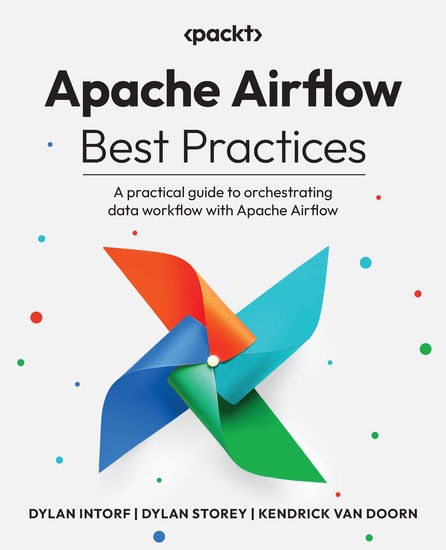
Apache Airflow Best Practices - A practical guide to orchestrating data workflow with Apache Airflow - cover

Apache Airflow Best Practices - A practical guide to orchestrating data workflow with Apache Airflow

Dylan Intorf, Dylan Storey, Kendrick van Doorn

Verlag: Packt Publishing

  • 0
  • 0
  • 0

Beschreibung

Data professionals face the challenge of managing complex data pipelines, orchestrating workflows across diverse systems, and ensuring scalable, reliable data processing. This definitive guide to mastering Apache Airflow, written by experts in engineering, data strategy, and problem-solving across tech, financial, and life sciences industries, is your key to overcoming these challenges. Covering everything from Airflow fundamentals to advanced topics such as custom plugin development, multi-tenancy, and cloud deployment, this book provides a structured approach to workflow orchestration. You’ll start with an introduction to data orchestration and Apache Airflow 2.x updates, followed by DAG authoring, managing Airflow components, and connecting to external data sources. Through real-world use cases, you’ll learn how to implement ETL pipelines and orchestrate ML workflows in your environment, and scale Airflow for high availability and performance. You’ll also learn how to deploy Airflow in cloud environments, tackle operational considerations for scaling, and apply best practices for CI/CD and monitoring.By the end of this book, you’ll be proficient in operating and using Apache Airflow, authoring high-quality workflows in Python, and making informed decisions crucial for production-ready Airflow implementations.
Verfügbar seit: 31.10.2024.
Drucklänge: 188 Seiten.

Weitere Bücher, die Sie mögen werden

  • Battlefields of The Future: The Evolution of the Technology of War 2025-2125 - cover

    Battlefields of The Future: The...

    Dr. Nick Coman, I. A.I.

    • 0
    • 0
    • 0
    A 36‑lecture audio course on how wars are actually fought in the machine age—from seabed cables and city power grids to low‑Earth orbit, cislunar space, and the neural loop between a human and a weapon. We break the kill chain open: sensing and space‑based cueing; edge compute and target fusion; communications that survive jamming; and the things that do damage—mines, missiles, loitering munitions, directed energy, electromagnetic pulse, and code. 
    We make the stack legible for operators and serious thinkers alike: synthetic aperture radar becomes SAR; high‑altitude long endurance becomes HALE; link budgets and laser crosslinks stop being magic and start being math you can reason about in words. You will see how orbital “stalkers” shadow satellites, why stratospheric platforms matter when air defenses make manned ISR bleed, how decoys and digital camouflage fracture an adversary’s picture, and where the automation boundary really sits when AI runs parts of the kill web with a human on the loop. 
    Engineering reality, not brochure fog, sets the pace. We trace power budgets, attrition math, and reconstitution timelines; map chokepoints in chips, propellants, optics, batteries, and shipyards; and follow sanctions, export controls, and standards as operational constraints, not afterthoughts. 
    The glidepath is explicit. 2025 to 2035: proliferated space, cheap autonomy, hard lessons from electronic warfare. 2035 to 2050: directed‑energy baselines, resilient meshes, smarter decoys. 2050 to 2075 and beyond: cislunar logistics with teeth, human performance management that is governed not ghoulish, brain–computer interfaces that shorten loops without erasing judgment. 
    Rigorous, unsentimental, and built for the intellectually ambitious, this course is an operator’s guide to modern combat systems—how they are built, how they break, and how they win.
    Zum Buch
  • Fish On Fish Off - cover

    Fish On Fish Off

    Stephen Sautner

    • 0
    • 0
    • 0
    Author and master storyteller Stephen Sautner narrates this special immersive audio edition of his modern angling classic complete with music and ambient sound. Through a series of 50 personal essays, each of which worthy of its own podcast, Fish On, Fish Off explores what happens when the self-taught, DIY angler sets out to fish the world–and winds up stumbling into every possible pitfall and danger along the way. These include: getting chased from a river by an elephant, surviving a terrifying helicopter ride over the Straits of Magellan, and breaking his only rod on the second cast in Cuba’s Bay of Pigs. Closer to home, he is swept off a jetty by a rogue wave, winds up in an emergency room more than once with fishing lures hanging from various parts of his anatomy, and perhaps most daunting, surviving 30 years of the scrum better known as opening day of trout season in his crowded home state of New Jersey. These stories of heartbreak, terror, and triumph transcend beyond fishing, and make for excellent listening for angler and non-angler alike.
    Zum Buch
  • Singularity Rising - Surviving and Thriving in a Smarter Richer and More Dangerous World - cover

    Singularity Rising - Surviving...

    James D. Miller

    • 0
    • 0
    • 0
    In Ray Kurzweil's New York Times bestseller The Singularity is Near, the futurist and entrepreneur describes the Singularity, a likely future utterly different than anything we can imagine. The Singularity is triggered by the tremendous growth of human and computing intelligence that is an almost inevitable outcome of Moore's Law. Since the book's publication, the coming of the Singularity is now eagerly anticipated by many of the leading thinkers in Silicon Valley, from PayPal mastermind Peter Thiel to Google co-founder Larry Page. The formation of the Singularity University, and the huge popularity of the Singularity website kurzweilai.com, speak to the importance of this intellectual movement. 
    But what about the average person? How will the Singularity affect our daily lives—our jobs, our families, and our wealth? 
    Singularity Rising: Surviving and Thriving in a Smarter, Richer, and More Dangerous World focuses on the implications of a future society faced with an abundance of human and artificial intelligence. James D. Miller, an economics professor and popular speaker on the Singularity, reveals how natural selection has been increasing human intelligence over the past few thousand years and speculates on how intelligence enhancements will shape civilization over the next forty years. 
    Miller considers several possible scenarios in this coming singularity: A merger of man and machine making society fantastically wealthy and nearly immortal Competition with billions of cheap AIs drive human wages to almost nothing while making investors rich Businesses rethink investment decisions to take into account an expected future period of intense creative destruction Inequality drops worldwide as technologies mitigate the cognitive cost of living in impoverished environments Drugs designed to fight Alzheimer's disease and keep soldiers alert on battlefields have the fortunate side effect of increasing all of their users' IQs, which, in turn, adds a percentage points to worldwide economic growth  
    Singularity Rising offers predictions about the economic implications for a future of widely expanding intelligence and practical career and investment advice on flourishing on the way to the Singularity.
    Zum Buch
  • Arctic Breath - cover

    Arctic Breath

    Lukas Åkerberg Lundh

    • 0
    • 0
    • 0
    Relaxing Sounds are specially designed, soothing sounds to help block out distracting noises or thoughts. Whether you want to improve your mental focus, or just relax and prepare for sleep, you can choose from a selection of beautiful soundscapes to find exactly the right atmosphere for you.
    Zum Buch
  • The Function of Reason - cover

    The Function of Reason

    Alfred North Whitehead

    • 0
    • 0
    • 0
    Whitehead presented these three lectures at Princeton University in 1929. Although 85 years have passed, his central thesis and his analysis remain remarkably current. The scientific materialism that Whitehead opposed with such vigor continues to dominate in academic circles, and even now those who question that worldview are often accused of being antiscientific. This is especially true in discussions of the nature of the human mind and its relation to the body (particularly the brain).It is hard to find a contemporary thinker with a better perspective on the nature and role of natural science than Whitehead, who, with Bertrand Russell, published Principia Mathematica in 1910; who taught logic and mathematics at Trinity College of Cambridge University; who taught philosophy of science at University College London; and who was a professor of philosophy at Harvard University beginning in 1924. Whitehead's cosmology is far from antiscientific, but he does explain why scientific method and technological practice alone are not able to provide a comprehensive understanding of the full range of human thought and experience. This work explains what we must do to achieve such a comprehensive understanding.© Agora Publications
    Zum Buch
  • Agile Project Management with Scrum - Streamline your project and boost productivity with Scrum - the Agile methodology for effective Project Management - cover

    Agile Project Management with...

    Chuck Sherman

    • 0
    • 0
    • 0
    In today's fast-paced business world, the ability to adapt quickly to change and deliver high-quality products or services in a timely manner is crucial. Agile project management with Scrum is a methodology that offers a collaborative, iterative, and incremental approach to managing projects. It is designed to help teams deliver value to their customers early and often while providing continuous feedback and transparency. 
    Agile Project Management with Scrum is the ultimate guide to understanding the Scrum framework and implementing it successfully in your projects. This book provides a comprehensive overview of Agile Project Management and Scrum, explaining their principles, values, and practices. You will learn how to create a product backlog, plan sprints, conduct daily scrums, monitor sprint progress, and deliver a working product increment in each sprint. 
    The book also covers the best practices for Agile Project Management with Scrum, including collaboration and communication, time management, sprint goals, and continuous improvement. You will learn how to scale Scrum for large projects and how to combine it with other Agile methodologies to improve your project outcomes. 
    Whether you are a project manager, team leader, or member of a development team, this book is a valuable resource for understanding Agile Project Management with Scrum. It is packed with real-world examples, case studies, and practical advice that you can apply to your projects right away. 
    By reading Agile Project Management with Scrum, you will be able to streamline your projects, boost productivity, and deliver high-quality products or services to your customers faster and more efficiently. 
      
     
    Zum Buch