Unisciti a noi in un viaggio nel mondo dei libri!
Aggiungi questo libro allo scaffale
Grey
Scrivi un nuovo commento Default profile 50px
Grey
Iscriviti per leggere l'intero libro o leggi le prime pagine gratuitamente!
All characters reduced
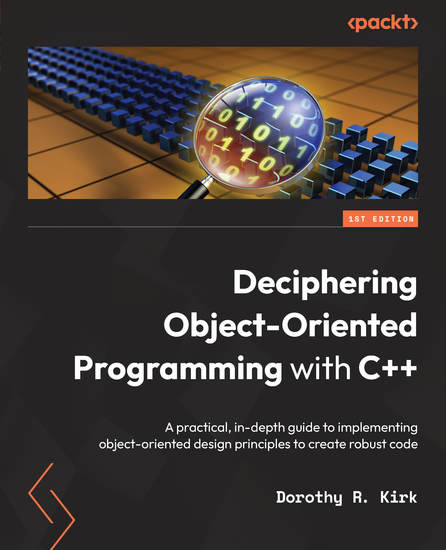
Deciphering Object-Oriented Programming with C++ - A practical in-depth guide to implementing object-oriented design principles to create robust code - cover

Deciphering Object-Oriented Programming with C++ - A practical in-depth guide to implementing object-oriented design principles to create robust code

Dorothy R. Kirk

Casa editrice: Packt Publishing

  • 0
  • 0
  • 0

Sinossi

Even though object-oriented software design enables more easily maintainable code, companies choose C++ as an OO language for its speed. Object-oriented programming in C++ is not automatic – it is crucial to understand OO concepts and how they map to both C++ language features and OOP techniques. Distinguishing your code by utilizing well-tested, creative solutions, which can be found in popular design patterns, is crucial in today’s marketplace. This book will help you to harness OOP in C++ to write better code.
Starting with the essential C++ features, which serve as building blocks for the key chapters, this book focuses on explaining fundamental object-oriented concepts and shows you how to implement them in C++. With the help of practical code examples and diagrams, you’ll learn how and why things work. The book’s coverage furthers your C++ repertoire by including templates, exceptions, operator overloading, STL, and OO component testing. You’ll discover popular design patterns with in-depth examples and understand how to use them as effective programming solutions to solve recurring OOP problems.
By the end of this book, you’ll be able to employ essential and advanced OOP concepts to create enduring and robust software.
Disponibile da: 23/09/2022.
Lunghezza di stampa: 594 pagine.


Altri libri che potrebbero interessarti

  • Wired To Change - How Neuroplasticity Shapes Your Brain Habits And Life - cover

    Wired To Change - How...

    Brian Gibson

    • 0
    • 0
    • 0
    Unlock the astonishing power of your brain to rewire itself, transforming the way you think, act, and live. 
    Wired to Change is a groundbreaking guide that demystifies neuroplasticity, the brain's remarkable ability to adapt and evolve at any stage of life. Drawing on cutting-edge neuroscience, psychology, and practical strategies, this book empowers you to take charge of your mental pathways and rewrite the patterns that shape your daily behavior. 
    Whether you're looking to break free from limiting habits, cultivate resilience, or unlock peak performance, this book offers a science-backed roadmap to rewiring your brain for lasting change. You'll discover: 
    ·        How thought patterns physically reshape your brain's neural architecture 
    ·        The science of habit loops and how to reprogram them 
    ·        Why mindset matters more than motivation 
    ·        Tools to reduce anxiety, boost focus, and enhance emotional balance 
    ·        Proven techniques to create meaningful, lasting personal growth 
    Wired to Change bridges the gap between science and self-transformation, offering insight and action. This book will leave you equipped and inspired to become the conscious architect of your mind. 
    You are not stuck. You are wired to change.
    Mostra libro
  • The Reverse Centaur's Guide to Life After AI - How to Think About Artificial Intelligence—Before It's Too Late - cover

    The Reverse Centaur's Guide to...

    Cory Doctorow

    • 0
    • 0
    • 0
    A short, provocative guide to what's good, bad, and stupid about AI and the discourse around AI, by the author of Enshittification. This program is read by the author."[Cory] Doctorow's writing is best when he delivers it, and this book is no exception." — Kirkus on EnshittificationIn modern tech parlance, a centaur is a person who is able to use technology to be a better, more productive version of themself. A reverse centaur is a person who is forced by technology to work at an inhuman pace—a driver made to deliver all day long, nonstop; a warehouse worker made to work without food or bathroom breaks; a programmer made to crank out impossible amounts of code.The Reverse Centaur’s Guide to Life After AI is not another anti-AI screed. Cory Doctorow uses AI in his work every day. As a creative person, he has no moral or dogmatic issue with AI—he thinks the technology is useful, even exciting, and full of potential. And yet.AI has arrived surrounded by unprecedented hype driven by a tech industry desperate to maintain its unprecedented valuation based on its own promises of endless financial growth. Despite the fact that almost all of AI’s real-world implementations have proved underwhelming, AI is projected to be worth more than $16 trillion—a number that only makes sense if AI replaces vast swathes of the wage-earning human workforce. To justify that level of “value,” every story about AI must be presented as inevitable, world-changing disruption. Even the tales of the robot apocalypse are a calculated attempt to bolster the fearsome power of AI.For Doctorow, it is imperative to see through that hype to the real story, to understand the technology not just for what it does, but for who it does it to and who it does it for. From that point of view, the story of AI is indeed dramatic and unprecedented, having generated an investment bubble so big that it endangers the entire world economy. In The Reverse Centaur’s Guide to Life After AI—as he so successfully did in Enshittification—Doctorow recounts both how we found ourselves in this dire situation and how we can get through it, to a life “after” AI in which the tools work for us, not the other way around.A Macmillan Audio production from MCD Books
    Mostra libro
  • Fundamentals of Data Engineering - Building Robust Data Systems for Modern Analytics and Insights - cover

    Fundamentals of Data Engineering...

    Daniel Garfield

    • 0
    • 0
    • 0
    "Fundamentals of Data Engineering: Building Robust Data Systems for Modern Analytics and Insights" is an essential guide for aspiring and experienced data engineers alike, providing a comprehensive overview of the principles, techniques, and technologies involved in designing and maintaining robust data systems. 
    In today's data-driven world, organizations heavily rely on data engineering to transform raw data into valuable insights. This book begins by introducing the fundamental concepts of data engineering and its vital role in the modern data landscape. It explores various data acquisition and ingestion techniques, including extracting data from diverse sources and real-time streaming. 
    The book delves into data transformation and processing, covering essential topics such as data cleaning, integration, and building efficient data pipelines. It also provides insights into different data storage and management approaches, including relational and non-relational databases, data modeling, and warehousing. 
    Ensuring data quality and governance is crucial, and this book equips readers with the knowledge and tools to assess data quality, implement governance frameworks, and adhere to privacy and security regulations. 
    Scalability is a significant concern in handling large volumes of data, and the book explores distributed computing, cluster frameworks, and resource management techniques to address scalability challenges effectively. 
    Data analytics and visualization play a vital role in extracting meaningful insights from data. The book covers exploratory data analysis, analytics techniques, and visualization tools, enabling readers to derive valuable conclusions from their data. 
    The book concludes with a glimpse into future trends in data engineering, including emerging technologies and the impact of artificial intelligence and machine learning on the field. 
     
    Mostra libro
  • National Geographic Magazine Vol 01 No 2 - cover

    National Geographic Magazine Vol...

    Various

    • 0
    • 0
    • 0
    National Geographic Magazine Volume 1 Number 2 published in 1889. Topics of articles are:Africa, its Past and FutureReports on:Geography of the LandGeography of the SeaGeography of the AirGeography of Life(Summary by Guero)
    Mostra libro
  • Eyes in the Sky - Space Telescopes from Hubble to Webb - cover

    Eyes in the Sky - Space...

    Andrew May

    • 0
    • 0
    • 0
    Over 50 years ago, astronomers launched the world's first orbiting telescope. This allowed them to gaze further into outer space and examine anything that appears in the sky above our heads, from comets and planets to galaxy clusters and stars. Since then, almost 100 space telescopes have been launched from Earth and are orbiting our planet, with 26 still active and relaying information back to us. 
     
    As a result of these space-based instruments, such as NASA's iconic Hubble Space Telescope, we know much more about the universe than we did half a century ago. But why is Hubble, orbiting just 540 kilometres above the Earth, so much more effective than a ground-based telescope? How can a glorified camera tell us not only what distant objects look like, but their detailed chemical composition and three-dimensional structure as well? 
     
    In Eyes in the Sky, science writer Andrew May takes us on a journey into space to answer these questions and more. Looking at the development of revolutionary instruments, such as Hubble and the James Webb Space Telescope, May explores how such technology has helped us understand the evolution of the Universe.
    Mostra libro
  • The American Fisherman - How Our Nation's Anglers Founded Fed Financed and Forever Shaped the USA - cover

    The American Fisherman - How Our...

    Willie Robertson, William Doyle

    • 0
    • 0
    • 0
    From the Duck Dynasty star and #1 New York Times bestselling author comes a rollicking popular history of fishing in America. 
    American Fisherman traces the impact fishing has had in shaping America’s history, and reveals the influential role it has played in defining our lives. Willie Robertson persuasively argues that America became what it is today in no small part because of the anglers that call it home. From harvesting New England cod to fly fishing for Yellowstone trout to raising Pacific Northwest salmon, the fishing industry has long played an essential role in the establishment of many of the nation’s earliest ports, most notably along the East Coast. Robertson explores how fishing has informed our culture, in literature, movies, and television, from classics like The Old Man and the Sea, A River Runs Through It, and Moby-Dick to The Perfect Storm, In the Heart of the Sea, and The Deadliest Catch, to popular local television fishing programs from coast to coast. 
    Robertson also analyzes the economics of this $50 billion annual business which supports a host of industries, including tourism and manufacturing, as well as conservationism. Told in Robertson’s charming down-home voice, American Fisherman is a spirited and unique look at America and its people.
    Mostra libro