Join us on a literary world trip!
Add this book to bookshelf
Grey
Write a new comment Default profile 50px
Grey
Subscribe to read the full book or read the first pages for free!
All characters reduced
Strong Poison - cover

Strong Poison

Dorothy L. Sayers

Publisher: Bygone Books

  • 0
  • 0
  • 0

Summary

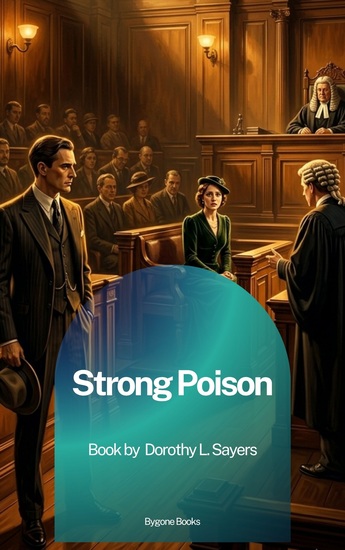
A poisoned dinner. A murder trial. A detective convinced of a woman's innocence.

Strong Poison is a classic detective novel by Dorothy L. Sayers, featuring the brilliant amateur sleuth Lord Peter Wimsey.

The story begins with a sensational murder case in which novelist Harriet Vane stands accused of poisoning her former lover. As the evidence mounts against her, Wimsey becomes convinced of her innocence and sets out to uncover the real truth behind the crime.

Blending courtroom drama, psychological insight, and classic whodunit mystery, the novel explores themes of justice, trust, love, and moral certainty.

A standout entry in the Golden Age of detective fiction, Strong Poison showcases Sayers's sharp plotting and richly drawn characters.
Available since: 06/23/2026.
Print length: 253 pages.

Other books that might interest you

  • A Mirror of Shalott - Being a Collection of Tales Told at an Unprofessional Symposium - cover

    A Mirror of Shalott - Being a...

    Robert Hugh Benson

    • 0
    • 0
    • 0
    A dozen Catholic priests on holiday in Rome sit up after dinner and tell each other, as professionals, what they have actually met: a possession, a house that will not be blessed, a deathbed that went wrong. Benson was the Archbishop of Canterbury's son, and his conversion to Rome in 1903 was a public scandal; here he uses the priest's clinical tone to make the supernatural sound like case notes.
    Show book
  • The Adventure of the Noble Bachelor - cover

    The Adventure of the Noble Bachelor

    Arthur Conan Doyle

    • 0
    • 0
    • 0
    The Adventure of the Noble Bachelor, one of the 56 short Sherlock Holmes stories written by Sir Arthur Conan Doyle, is the tenth of the twelve stories collected in The Adventures of Sherlock Holmes. The story was first published in Strand Magazine in April 1892.The story entails the disappearance of Hatty, Lord St. Simon's bride on the day of their marriage. She participates in the wedding, but disappears from the reception.The events of the wedding day are most perplexing to Lord St. Simon as it seemed to him that his bride, Miss Hatty Doran of San Francisco, was full of enthusiasm about their impending marriage. St. Simon tells Holmes that he noticed a change in the young lady's mood just after the wedding ceremony. She was uncharacteristically sharp with him. The only thing out of the ordinary at the church where the wedding took place was Hatty's little accident: she dropped her wedding bouquet and a gentleman in the front pew picked it up and handed it back to her.Famous works of the author Arthur Conan Doyle's: "A Study in Scarlet", "Silver Blaze", "The Hound of the Baskervilles", "The Yellow Face", "A Scandal in Bohemia", "The Red-Headed League", A Case of Identity", "The Boscombe Valley Mystery", "The Five Orange Pips", "The Man with the Twisted Lip", "The Blue Carbuncle", "The Speckled Band", "The Engineer's Thumb", "The Noble Bachelor", "The Beryl Coronet", "The Copper Beeches" and many more.
    Show book
  • About Love - From their pens to your ears genius in every story - cover

    About Love - From their pens to...

    Anton Chekhov

    • 0
    • 0
    • 0
    Anton Pavlovich Chekhov was born on 29th January 1860 in Taganrog, on the south coast of Russia.  
    His family life was difficult; his father was strict and over-bearing but his mother was a passionate story-teller, a subject Chekhov warmed to. As he later said; ‘our talents we got from our father, but our soul from our mother’.  
    At school Chekhov was distinctly average. At 16 his father mis-managed his finances and was declared bankrupt. His family fled to Moscow. Chekhov remained and eked out a living by various means, including writing and selling short sketches to newspapers, to finish his schooling. That completed and with a scholarship to Moscow University obtained he rejoined his family. 
    He was able to help support them by selling satirical sketches and vignettes of Russian lifestyles and gradually obtained further commissions. In 1884, he qualified as a physician and, although it earned him little, he often treated the poor for free, he was fond of saying ‘Medicine is my lawful wife, and literature is my mistress.’ 
    His own health was now an issue as he began to cough up blood, a symptom of tuberculosis.  Despite this his writing success enabled him to move the family into more comfortable accommodation.  
    Chekhov wrote over 500 short stories which included many, many classics including ‘The Kiss’ and ‘The Lady with a Dog’.  His collection ‘At Dusk’ won him the coveted Pushkin Prize when was only 26.  
    He was also a major playwright beginning with the huge success of ‘Ivanov’ in 1887.   
    In 1892 Chekhov bought a country estate north of Moscow. Here his medical skills and money helped the peasants tackle outbreaks of cholera and bouts of famine. He also built three schools, a fire station and a clinic.  It left him with less time for writing but the interactions with real people gained him detailed knowledge about the peasantry and their living conditions for his stories.  
    His most famous work, ‘The Seagull’ was received disastrously at its premiere in St Petersburg. It was later restaged in Moscow to highlight its psychological aspects and was a huge success. It led to ‘Uncle Vanya’, ‘The Three Sisters’ and ‘The Cherry Orchard’.  
    Chekhov suffered a major lung hemorrhage in 1897 while visiting Moscow. A formal diagnosis confirmed tuberculosis and the doctors ordered changes to his lifestyle.  
    Despite a dread of weddings the elusive literary bachelor quietly married the actress Olga Knipper, whom he had met at rehearsals for ‘The Seagull’, on 25th May 1901. 
    By May 1904 with his tuberculosis worsening and death imminent he set off for the German town of Badenweiler writing cheerful, witty letters to his family and assuring them his health was improving.  
    On 15th July 1904 Anton Chekhov died at Badenweiler.  He was 44.
    Show book
  • Pickwick Papers The - Audiobook - cover

    Pickwick Papers The - Audiobook

    Charles Dickens, Classic...

    • 0
    • 0
    • 0
    Charles Dickens' The Pickwick Papers is a lively, humorous chronicle of the adventures and misadventures of Samuel Pickwick and his fellow club members. Originally published in serial form, it captures the everyday quirks and follies of early 19th-century English society with a warmth and satire that became Dickens' trademark. From comic duels and courtroom scenes to absurd journeys through the countryside, each episode paints a vivid picture of the joys and eccentricities of life.What makes the novel enduring is not only its humor but also its compassion. Behind the laughter lies a gentle critique of social injustices, the follies of pride, and the resilience of friendship. It is Dickens at his most playful, yet even here he reveals the depth of observation that would define his later, more serious works.
    Show book
  • Gentlemen Prefer Blondes - cover

    Gentlemen Prefer Blondes

    Anita Loos

    • 0
    • 0
    • 0
    'A kiss on the hand may make you feel very nice, but a diamond and sapphire bracelet lasts forever.'
    
    First published in 1925 and set against the carefree hedonism of the Jazz Age, Gentlemen Prefer Blondes is one of the most iconic comic novels to come from twentieth century American literature.
    
    Sharply witty and entertaining in equal measure, Gentlemen Prefer Blondes presents the diary of the wily Lorelei Lee, a charming yet materialistic blonde from Little Rock, Arkansas. On a mission to live a luxurious life, Lorelei travels through Europe and New York using her beauty and charisma to attract wealthy suitors, securing various gifts, jewellery and an elevated social status in the process. Although seemingly naïve to the men she pursues, Lorelei is clever and calculating, often outsmarting the company she keeps. Providing a hilarious critique of gender roles, consumerism and class dynamics, Gentlemen Prefer Blondes was a runaway bestseller, acquiring praise from several contemporary writers of the time, such as F. Scott Fitzgerald, James Joyce and H.G. Wells amongst others. It remains widely adapted to this day. This audiobook edition is brilliantly brought to life by the talented Laurel Lefkow.
    Anita Loos (1889 – 1981) was an American actress and writer. She became one of the first female screenwriters in Hollywood, working with esteemed director D.W. Griffith and major film stars such as Mary Pickford. She was renowned for her flair for satire, with much of her work considered classics of early twentieth century American humour.
    Show book
  • Hotel Stardust - cover

    Hotel Stardust

    Susan Barrie

    • 0
    • 0
    • 0
    When Commander Roger Merlin offers to buy Eve’s inheritance, Treloan Manor in Georgia, the answer is strictly no. She has not even set eyes of the place yet, and she has different plans altogether. Eve wants to turn it into a hotel, which would also make her his competition. What could be more thrilling? The love story dating back to the 20th century was written under one of Ida Pollock’s pseudonyms, Susan Barrie. A must-read for fans of literary romance and surprising twists of fate.Susan Barrie is a pseudonym of Ida Pollock (1908 – 2013), a highly successful British writer of over 125 romance novels translated into numerous languages and published across the world. Ida Pollock has sold millions of copies over her 90-year career. Pollock began writing when she was 10 years old. Ida has travelled widely, living in several different countries. She continues to be popular amongst both her devoted fan base and new readers alike. Pollock has been referred to as the "world's oldest novelist" who was still active at 105 and continued writing until her death. On the occasion of her 105th birthday, Pollock was appointed honorary vice-president of the Romantic Novelists' Association, having been one of its founding members.Ida Pollock wrote in a wide variety of pseudonyms: Joan M. Allen, Susan Barrie, Pamela Kent, Averil Ives, Anita Charles, Barbara Rowan, Jane Beaufort, Rose Burghley, Mary Whistler and Marguerite Bell.
    Show book