Unisciti a noi in un viaggio nel mondo dei libri!
Aggiungi questo libro allo scaffale
Grey
Scrivi un nuovo commento Default profile 50px
Grey
Iscriviti per leggere l'intero libro o leggi le prime pagine gratuitamente!
All characters reduced
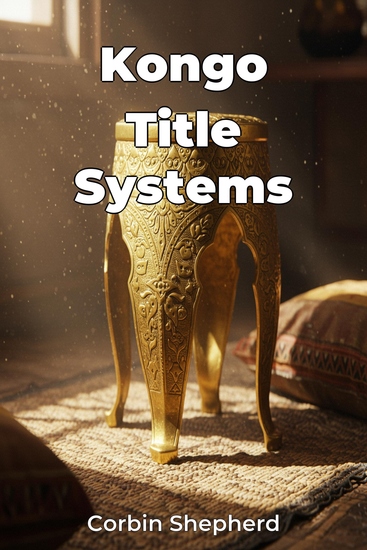
Kongo Title Systems - cover

Kongo Title Systems

Corbin Shepherd

Traduttore A AI

Casa editrice: Publifye

  • 0
  • 0
  • 0

Sinossi

Kongo Title Systems explores the sophisticated political organization of the Kongo Kingdom through its intricate system of titles. This book examines how these titles governed rank, administration, and ceremonial life, offering a crucial look into pre-colonial African governance. The Kongo Kingdom, located in what is now northern Angola and the western Democratic Republic of Congo, utilized this system to maintain order and project power for centuries. One intriguing aspect is how the mani Kongo, or king, and provincial governors used these titles to effectively distribute power and manage resources.

 
The book uniquely delves into the functional logic of the Kongo titles, examining not just who held them but how they were used to govern and resolve disputes. Drawing from Portuguese chronicles, oral traditions, and linguistic analysis, the book presents detailed descriptions of the titles and their functions. It begins by introducing the core concepts of Kongo political organization, then categorizes the types of titles based on their function and geographical scope. Finally, it analyzes the evolution of the title system, showing its adaptation to internal and external pressures.

 
Understanding the Kongo’s political organization challenges Eurocentric views and highlights the ingenuity of African political thought.
Disponibile da: 03/05/2025.
Lunghezza di stampa: 57 pagine.
Altri libri che potrebbero interessarti

  • Hate Speech on Social Media: A Global Approach - cover

    Hate Speech on Social Media: A...

    Branco Di Fátima, Allen...

    • 0
    • 0
    • 0
    This book explores the nature of hate speech on social media. Readers will find chapters written by 21 authors from 18 universities or research centers. It includes researchers from 11 countries, prioritizing a diversity of approaches from the Global North and Global South – Brazil, Cyprus, Ethiopia, Germany, Nigeria, Portugal, South Africa, Spain, Switzerland, Turkey, and the USA. The analyses herein involve the realities in an even larger number of countries, given the transnational approach of some of these studies.
    One can find a preview of the chapters at the beginning of the book, with abstracts organized in a separate section. It is evident that the authors study the impact of recent events on hate speech – the Covid-19 pandemic, Russia- Ukraine war, the refugee crisis – and recurrent attacks on minority groups such as women, immigrants, or the LGBTQ+ community. The authors employ classic and digital research methods, using quantitative and qualitative data gathered from platforms like Telegram, Facebook, Instagram, Twitter, and YouTube. As a result, readers will encounter taxonomic proposals, new methodological approaches, theoretical frameworks, and mapping of behavioral patterns.
    Mostra libro
  • Letter to James C Conkling - cover

    Letter to James C Conkling

    Abraham Lincoln

    • 0
    • 0
    • 0
    During the Civil War, Union supporters in President Abraham Lincoln's hometown of Springfield, Illinois, asked him to speak at a rally on September 3, 1863. Lincoln could not attend but wrote this letter to be read at the gathering by his long-time friend, James C. Conkling. The letter was accompanied by a brief note which read, "I cannot leave here now. Herewith is a letter instead. You are one of the best public readers. I have but one suggestion. Read it very slowly. And now God bless you, and all good Union-men." Shortly after the rally, John Murray Forbes wrote to Lincoln, referring to the letter and the Emancipation Proclamation issued on January 1, 1863. Forbes declared that the letter "will live in history side by side with your proclamation." He noted, "It meets the fears of the timid and the doubts of the reformer. It proves that the Proclamation and the policy resulting from it are the most conservative, both of liberty and of our form of government."
    Mostra libro
  • The Cop's Sissy - Part One: Smooth Legs - cover

    The Cop's Sissy - Part One:...

    Kinky Press

    • 0
    • 0
    • 0
    There's no way Chris will last in prison.  
    When his arresting cop offers to take him home instead of downtown, what will Chris be willing to do to stay out of jail?
    Mostra libro
  • Songhai Empire - The Largest Empire in African History - cover

    Songhai Empire - The Largest...

    Rolf Hedger

    • 0
    • 0
    • 0
    The Songhai people trace their origins to the fertile banks of the Niger River, an area that has supported human settlement and civilization for thousands of years. Their early history is closely tied to the region of Gao, which would later become the heart of one of Africa’s most powerful empires. The Niger River provided the necessary resources for agriculture, fishing, and trade, enabling the growth of organized communities that would form the foundation of Songhai society. 
    The earliest known inhabitants of the region were the proto-Songhai, who are believed to have settled along the Niger River as early as the first millennium CE. These people were primarily farmers, herders, and fishermen, utilizing the rich floodplains of the river to cultivate crops and sustain livestock. Over time, they developed a distinct cultural identity, characterized by their language, traditions, and spiritual beliefs. Their society was structured around small communities led by local chieftains, who governed based on kinship ties and communal customs. 
    Gao, the most significant early settlement of the Songhai people, emerged as a crucial trading hub by the eighth century. Arab and Berber merchants, who traveled along the trans-Saharan trade routes, recognized its strategic importance as a commercial center. The exchange of goods such as gold, salt, ivory, and kola nuts attracted traders from North Africa and beyond, integrating Gao into the wider economic networks of the region. As commerce flourished, the settlement expanded, and its rulers gained influence by controlling trade and forming alliances with neighboring peoples.
    Mostra libro
  • Ivan the Terrible - cover

    Ivan the Terrible

    Kelly Mass

    • 0
    • 0
    • 0
    Ivan IV Vasilyevich, referred to as Ivan the Terrible in English, was the Grand Prince of Moscow from 1533 to 1547 and the very first Moscow ruler to announce himself Tsar of Russia from 1547 to 1584.Ivan was the first ruler of Moscow after the city's independence and state of freedom. After the death of his dad, Vasili III, the Rurikid ruler of the Grand Duchy of Moscow, he was declared supreme prince when he was three years of age. The "Chosen Council," a group of reformers, rallied around the young Ivan in the year 1547, announcing him tsar (emperor) of All Rus' and developed the Tsardom of Russia, with Moscow as the primary state. Ivan's rule was marked by Russia's change from a middle ages state to an empire under the control of the tsar, but at a big cost to the people and the nation's long-lasting economy.Let’s talk about his life, his legacy, his evil deeds, and the way things occurred in history.
    Mostra libro
  • Over the Hill and Up the Wall - cover

    Over the Hill and Up the Wall

    Todd Alexander

    • 0
    • 0
    • 0
    A heart-warming journey with parents of a certain age and a son who thinks he knows best. 
     
    Of course, we love our parents. Even if they do so many things that drive us bonkers. 
     
    Like how a mother - for argument's sake, let's say mine - taps her fingernails on the car window whenever she sees a place of interest (seven taps for a regular haunt, up to twenty for somewhere fascinating). Or the way a father - let's call him Dad - practises deafness but can miraculously hear a suggestion of no ham at Christmas over the roar of cricket commentary. It might be the way your mum works herself into a tizz over a call from Azerbaijan one week and Nigeria the next. Or how your dad has an answer to everything (despite his information being forty years out of date) and 'a guy' for all fixes (if only he could find his Rolodex). 
     
    When do we stop being our parents' child and become their parent? After all, they did pretty well on their own for decades - why do they need our intervention now? And that tendency for them to drive us up the wall ... could it be because we are entering middle age and starting to recognise some of those traits in ourselves? 
     
    Over the Hill and Up the Wall is an affectionate, funny look at the frictions of taking a more active role in our elders' lives. It's a nod to every child who has waited three hours for a parent to fasten their seatbelt, and every parent whose child assumes they can't count to twenty. And, if your parents are just hitting middle age, it may well be a warning of things to come! 
     
    'Warm, witty, honest. With a healthy serving of humour, Todd Alexander has written a marvellous, touching and insightful book. You'll laugh, cry and hope your own kids love you this much. I'll be more patient with my parents after reading this' Better Reading
    Mostra libro