Unisciti a noi in un viaggio nel mondo dei libri!
Aggiungi questo libro allo scaffale
Grey
Scrivi un nuovo commento Default profile 50px
Grey
Iscriviti per leggere l'intero libro o leggi le prime pagine gratuitamente!
All characters reduced
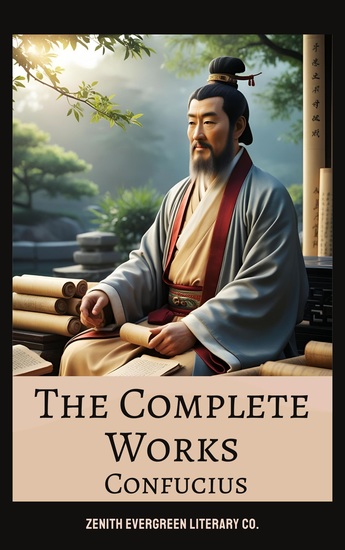
The Complete Works of Confucius - The Analects Doctrine of the Mean The Great Learning and More - cover

The Complete Works of Confucius - The Analects Doctrine of the Mean The Great Learning and More

Confucius, Zenith Evergreen Literary Co.

Casa editrice: Zenith Evergreen Literary Co.

  • 0
  • 0
  • 0

Sinossi

Timeless wisdom from the greatest teacher of virtue, order, and human dignity.

The Complete Works of Confucius gathers all the major teachings attributed to one of history's most profound philosophers. Featuring The Analects, The Doctrine of the Mean, The Great Learning, and more, this collection embodies the core principles of ethics, governance, and harmonious living.

Perfect for students of philosophy, leaders, and all who seek inner wisdom, Confucius's thought continues to guide millions around the world in building character, compassion, and community.

💬 "To study without thinking is futile. To think without studying is dangerous." — Confucius

🧠 Why Readers Treasure Confucius:
Includes all major Confucian texts and sayings

Ideal for fans of Laozi, Plato, Epictetus, Marcus Aurelius, and Buddhist philosophy

Essential reading for students of Eastern philosophy, leadership, and personal growth

📣 Seek Wisdom. Live with Virtue. Lead with Compassion.
Buy The Complete Works of Confucius today and unlock the timeless path to a better self and society.
Disponibile da: 28/04/2025.
Lunghezza di stampa: 161 pagine.
Altri libri che potrebbero interessarti

  • The Nixon-Gleason Alien Encounter - cover

    The Nixon-Gleason Alien Encounter

    Paul Blake Smith

    • 0
    • 0
    • 0
    Under the cover of night, on February 19, 1973, another U.S. president witnessed extraterrestrials. 


    President Richard Nixon made a secret trip to a top security U.S. Air Force base, as his former boss, President Dwight Eisenhower, did in 1954. Nixon was said to have taken his golfing buddy, comedian Jackie Gleason. According to Gleason's then wife, Beverly McKittrick Gleason, Jackie was deeply shaken later that night when he returned home and confessed to their clandestine trip. 


    As established in Smith's previous work, President Eisenhower's Close Encounters, this meeting was reminiscent of and perhaps even predicated by similar visits made by the president's predecessors, as well as others in the American government and entertainment industry. This in-depth book will attempt to separate fact from fiction. These events were carried off without the public learning the hushed facts and data connecting the two different presidential administrations . . . 


    until now.
    Mostra libro
  • Afternoons with Harper Lee - cover

    Afternoons with Harper Lee

    Wayne Flynt

    • 0
    • 0
    • 0
    Imagine sitting with an esteemed writer on his or her front porch somewhere in the world and swapping life stories. Dr. Wayne Flynt got the opportunity to do just this with Nelle Harper Lee. In a friendship that blossomed over a dozen years starting when Lee relocated back to Alabama after having had a stroke, Flynt and his wife Dartie became regular visitors at the assisted living facility that was Lee's new home. And there the conversation began, with an invitation to "Come in, sit down, and stay a while." 


    The stories exchanged ranged widely over the topics of Alabama history, Alabama folklore, family genealogy, and American literature, of course. Wayne and his wife were often joined by Alice Lee, the oldest Lee sister, a living encyclopedia on the subject of family genealogy, and middle sister Louise Lee Conner. 


    The hours spent visiting, in intimate closeness, are still cherished by Wayne Flynt. They yielded revelations large and small, which have been shaped into Afternoons with Harper Lee. Part memoir, part biography, this book offers a unique window into the life and mind and preoccupations of one of America's best-loved writers. Flynt and Harper Lee and her sisters learned a great deal from each other, and though this is not a history book, their shared interest in Alabama and its history made this extraordinary work possible.
    Mostra libro
  • The Complete Strategy Leadership Philosophy Stoicism & Hermeticism Classic Collection - The Art of War Meditations The Kybalion The Prince Letters from a Stoic Tao Te Ching On War The Enchiridion Beyond Good and Evil & Many More - cover

    The Complete Strategy Leadership...

    Sun Tzu, Marcus Aurelius, Hermes...

    • 0
    • 0
    • 0
    Five Great Traditions. One Powerful Journey. 
    The Complete Strategy, Leadership, Philosophy, Stoicism & Hermeticism Classic Collection is the all-in-one audiobook for mastering life’s greatest challenges—from leading others to conquering the self. 
    This anthology includes the world’s most enduring works of wisdom, from military manuals and political treatises to spiritual teachings and philosophical dialogues—fully modernized and narrated with clarity and impact. 
    This audiobook includes: 
    - The Art of War by Sun Tzu 
    - The Prince and The Art of War by Machiavelli 
    - The Book of Five Rings by Musashi 
    - On War by Clausewitz 
    - Commentaries by Julius Caesar 
    - Meditations by Marcus Aurelius 
    - Letters from a Stoic by Seneca 
    - The Enchiridion by Epictetus 
    - The Kybalion, Corpus Hermeticum, Emerald Tablets, and Asclepius 
    - The Republic by Plato, Politics by Aristotle, and Beyond Good and Evil by Nietzsche,  
    And many more... 
    Each work is introduced with historical background and adapted for flow and meaning in today’s world. 
    Listen today—and begin mastering strategy, spirit, and self.
    Mostra libro
  • Whitehead's The Function Of Reason - cover

    Whitehead's The Function Of Reason

    Alfred North Whitehead

    • 0
    • 0
    • 0
    Whitehead presented these three lectures at Princeton University in 1929. Although 85 years have passed, his central thesis and his analysis remain remarkably current. The scientific materialism that Whitehead opposed with such vigor continues to dominate in academic circles, and even now those who question that worldview are often accused of being anti-scientific.
     
    This is especially true in discussions of the nature of the human mind and its relation to the body (particularly the brain). It is hard to find a contemporary thinker with a better perspective on the nature and role of natural science than Whitehead who, with Bertrand Russell, published the Principia Mathematica in 1910; who taught logic and mathematics at Trinity College of Cambridge University; who taught philosophy of science at University College London; and who was professor of philosophy at Harvard University beginning in 1924. Whitehead’s cosmology is far from anti-scientific, but he does explain why scientific method and technological practice alone are not able to provide a comprehensive understanding of the full range of human thought and experience. This work explains what we must do to achieve such a comprehensive understanding.
    Mostra libro
  • Former Apple employee starts afresh - cover

    Former Apple employee starts afresh

    Poorvi Gupta

    • 0
    • 0
    • 0
    Meet the former Apple employee who co-founded fresh skincare brand Nat Habit.
    Mostra libro
  • Battle of Kapetron The: The History and Legacy of the First Major Battle Between the Byzantine Empire and Seljuk Turks - cover

    Battle of Kapetron The: The...

    Editors Charles River

    • 0
    • 0
    • 0
    The Byzantine Empire existed for over a thousand years, with a history spanning from the division of the Roman Empire in 395 until the Ottoman conquest of Constantinople in 1453. It was formed from the previous Eastern Roman Empire, and during its long existence, the Byzantine inhabitants were very proud to call themselves Romans.  
    	However, many things changed during the long lifespan of the Byzantine Empire, starting with a Hellenization in the 6th century. The use of the Latin language diminished and Greek took its place, while the typical Roman culture gave way to a more Hellenistic one. The Hellenization of Byzantium was detrimental to the relationship with the Holy Roman Empire, and the Christian world from that point would be split in two. The subsequent strengthening of the Orthodox Church caused many civil wars and conflicts to arise during the centuries, which shattered and reshaped the territory time after time. By the end of the Byzantine Empire’s existence, the old age had weakened both the state and church, making it an easy target for invading forces.  
    	The most notable invaders were the Turkish-speaking Seljuks, led through a series of battles by Kutalmishouglu Suleiman, who supported different usurpers against the Byzantine emperor. The expansion of the Seljuks was so successful that when Suleiman died, he had put all of Bithynia under his control as well as several important harbor towns along the shores on the Asian side of Bosphorus. With that accomplishment, he had managed to separate the Byzantines living in Anatolia from their emperor in Constantinople. This immediately weakened the unity of the Byzantine Empire.  
    	Of all the conflicts that brought this state of affairs into being, few were as instrumental as the Battle of Kapetron, the culmination of one of the first major Seljuk raids into Byzantine territory.
    Mostra libro