Join us on a literary world trip!
Add this book to bookshelf
Grey
Write a new comment Default profile 50px
Grey
Subscribe to read the full book or read the first pages for free!
All characters reduced
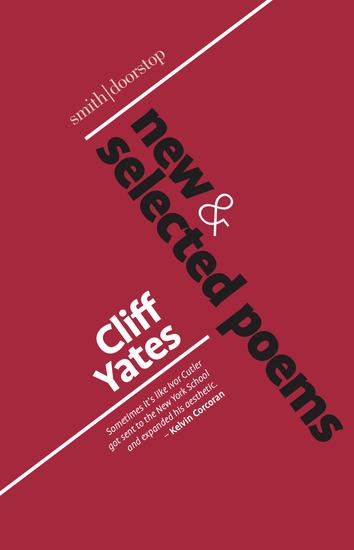
New and Selected Poems - cover

New and Selected Poems

Cliff Yates

Publisher: The Poetry Business

  • 0
  • 0
  • 0

Summary

Cliff Yates's New & Selected Poems brings together over thirty years of inimitable work, from his Fenton-Aldeburgh Prize debut, Henry's Clock, to his most recent pamphlet, Another Last Word and beyond. His poems are moving, surprising and funny, sometimes in the space of a few lines, and, gathered together wonderfully here, add up to an oblique but compelling document of lives and times.
Available since: 07/31/2023.
Print length: 128 pages.

Other books that might interest you

  • Lady No - cover

    Lady No

    Kim Hyesoon

    • 0
    • 0
    • 0
    From the legendary avant-garde poet Kim Hyesoon, a landmark collection documenting her first and only work of digital performance art to date. 
    “Poetry in Korea has been a vaunted form—and traditionally left to men. Kim broke away from the masculine styles that came before her. . . . Kim has pursued a vernacular that’s intensely Korean yet open to the world.” —E. Tammy Kim, New Yorker 
    In March 2014, Kim Hyesoon, the grand dame of contemporary Korean poetry, began to post anonymously on the online blog of Munhakdongne, a major South Korean publisher. Rather than use her own name, Kim Hyesoon’s chosen persona for these blog posts was Lady No. Fittingly, Lady No’s writings are dissenting, combative, subversive, and ontologically feminine; formally, they defy any attempt at easy categorization. They are neither poems, nor are they prose, but a radical innovation Kim calls shisanmun—an ungovernable style that heralds her internationally acclaimed works Autobiography of Death and Phantom Pain Wings. 
    The entries in this seminal collection, arranged chronologically and in their entirety here for the first time, are an eclectic hybrid of opinion editorials, aphorisms, recipes, daydreams, travelogues, art criticism, as well as treatises on the metaphysics of poetry and the current state of international literature. They take place in and around the world but most often they return to a country called Aerok, a frightening yet familiar mirror of contemporary Korea. First unwittingly, and then with concentrated grief, they chart the course of one of the most politically significant years in recent South Korean history: the sinking of the MV Sewol on the morning of April 16th that killed 304 people, including 250 high school students, and the reverberations of this national tragedy that culminated in the impeachment and ouster of the country’s then-sitting president. Taken together, these writings bear witness to the people’s shame, mourning, and perseverance under a corrupt administration—a painful public reckoning not dissimilar from our own. 
    Surreal but visceral, and inflected with both humor and rage, Lady No contains perhaps the most accessible of Kim Hyesoon’s writing to date and documents her first and only work of digital performance art. Totaling 179 individual entries, Lady No explores the inner and outer lives of contemporary Korean women and embodies the inextricable link between social justice and literary citizenship. 
    Supplemental enhancement PDF accompanies the audiobook.
    Show book
  • Paradise Lost - cover

    Paradise Lost

    John Milton

    • 0
    • 0
    • 0
    "Better to reign in Hell, than serve in Heaven."
    
    In the wake of a failed cosmic rebellion, the fallen archangel Satan awakens on a burning lake of fire. Undefeated in spirit, he rallies his legions of demons to build the palace of Pandemonium and plots a subtle revenge against the Almighty. His target? God's newest and most beloved creation: Humanity. Milton's masterpiece takes us from the depths of Tartarus to the heights of the Empyrean, and finally to the lush, innocent borders of the Garden of Eden. Here, we witness the tragic temptation of Adam and Eve, a choice that changes the course of human history forever.
    
    The Greatest Antagonist in Literature: Milton's Satan is a character of terrifying complexity. He is a charismatic leader, a tormented intellectual, and a "tragic hero" whose pride leads to his inevitable ruin. His journey from a shining angel to a crawling serpent is one of the most powerful character arcs ever written, influencing centuries of "Byronic heroes" and anti-heroes.
    
    The Beauty of the Fall: While Satan's rebellion provides the spectacle, the emotional heart of the poem lies in Book IX, where Adam and Eve face the serpent. Milton portrays their relationship with profound psychological depth, exploring themes of free will, reason, and the heavy burden of knowledge. The final lines of the poem, as the pair walks hand-in-hand out of Eden into a "subject world," are among the most moving in all of literature.
    
    The Power of Blank Verse: Discarding the "bondage of rhyming," Milton used unrhymed iambic pentameter (blank verse) to create a sense of vast, architectural scale. The language is dense, musical, and filled with classical allusions, creating a reading experience that feels truly "epic."
    
    Step into the cosmic theater. Purchase "Paradise Lost" today and witness the struggle for the soul of the world.
    Show book
  • The Rubaiyat of Omar Khayyám (Whinfield Translation) - cover

    The Rubaiyat of Omar Khayyám...

    Omar Khayyám

    • 0
    • 0
    • 0
    Omar Khayyám (1048–1131) was a Persian poet, mathematician and astronomer. In the Western world he is most famous for his many rubáiyát (quatrains), a four line rhyming stanza, which were popularized in an extensively reworked collection in English by Edward Fitzgerald, the first edition of which appeared in 1859. 
    However, Fitzgerald was neither the first nor the most scholarly of the translators of Omar Khayyam’s rubáiyát. As well as translating the poems of Hafez and Rumi, Edward Henry Whinfield (1836-1922) also produced a much more extensive English version of the rubáiyát. In 1883 he published a bilingual edition of 500 quatrains, in which the Persian original is presented side by side with the English translation. 
    This is a bilingual recording. Each quatrain will be read first in Persian and then in English translation. While listeners unfamiliar with the Persian language will not able to appreciate the meaning of the quatrains in their original form, everyone can at least enjoy the musicality of Omar’s verse, which Whinfield often succeeds in capturing. (Summary by Algy Pug)
    Show book
  • Deed - cover

    Deed

    torrin a. greathouse

    • 0
    • 0
    • 0
    DEED, the follow-up to torrin a. greathouse's 2022 Kate Tufts Discovery Award winning debut, Wound from the Mouth of a Wound, is a formally and lyrically innovative exploration of queer sex and desire, and what it can cost. Sprawling across art, eros, survival, myth, etymology, and musical touchstones from Bruce Springsteen to Against Me!, this new book both subverts and pays homage to the poetic canon, examining an artistic lineage that doesn't always love trans or disabled people back. Written in a broad range of received and invented forms—from caudate sonnets and the sestina, to acrostics and the burning haibun—DEED indicts violent systems of carceral, medical, and legal power which disrupt queer and disabled love and solidarity, as well as the potentially vicarious manner in which audiences consume art. This collection is a poetic triptych centered on the question of how, in spite of all these complications, to write an honest poem about desire. At its core, DEED is a reminder of how tenderness can be made a shield, a weapon, or a kind of faith, depending on the mouth that holds it.[sample text]from EtymythologyI'm clocked by etymology,by the way even stilettos take their namefrom a knife. The way a knife, well-honed,can strip anything to the bone. Bear with me, sometimes even the myths growblurry in the distance. The root of Artemis, goddess of the hunt, is still unknown, but likely comes from artamos—butcher. Let's call this a kind of etymythology,post hoc history; let's call Artemis the root. For her wild heart. Her failedfemininity. Goddess of gender-fuckedgirls. Crooked prayer. The word worship is shaped from two shards—meaning worth & its giving. A mouth gives faith shape like clay. I mean that to pray is to god a God. To be butch & butcher the myth of a son, was to makea goddess of myself.
    Show book
  • Four One-Act Plays by WB Yeats - cover

    Four One-Act Plays by WB Yeats

    W. B. Yeats

    • 0
    • 0
    • 0
    Set against the backdrop of Ireland’s struggle for freedom, "Cathleen Ní Houlihan" unfolds with quiet intensity as a young man’s ordinary life is gradually overtaken by a strange and irresistible call to something greater. In the presence of a beguiling visitor whose words seem to shimmer with myth and longing, dreams of marriage and home give way to visions of sacrifice and national pride. W.B. Yeats weaves a lyrical, otherworldly tale that blurs the line between reality and enchantment, capturing the powerful sway of idealism, identity, and the mysterious forces that drive people to give everything for a cause--the cause for Ireland's freedom. 
    Brimming with charm and mischief, "The Pot of Broth" is a delightful one-act comedy co-written with Lady Gregory in which a clever wanderer, armed with nothing but an empty pot and a silver tongue, convinces a wary country couple that he can brew a magical broth from a simple stone. As tall tales bubble up alongside the imaginary soup, the ordinary kitchen becomes a stage for trickery, laughter, and the quiet magic of believing in just a little more than what’s in front of you. Come into the Irish countryside, where even the poorest pot can cook up a most entertaining story. 
    W.B Yeats' "Purgatory" is a grim representation of generational guilt and spiritual entrapment, as a father confronts the ghosts of his family’s past in the ruins of a once-noble home, where memory and violence echo years afterwards. 
    Meanwhile, in "The Cat and the Moon," two beggars—one blind, one lame—make their way to a holy well where Saint Colman resides in the hopes of curing their respective ailments. But when given the opportunity of being healed or being blessed, both beggars are forced to reassess their convictions. Will they use their newfound gifts for justice, or will they accept placement in the hereafter?
    Show book
  • Primordial - Poems - cover

    Primordial - Poems

    Mai Der Vang

    • 0
    • 0
    • 0
    Mai Der Vang's poetry—lyrically insistent and visually compelling—constitutes a groundbreaking investigation into the collective trauma and resilience experienced by Hmong people and communities, the ongoing cultural and environmental repercussions of the war in Vietnam, the lives of refugees afterward, and the postmemory carried by their descendants. Primordial is a crucial turn to the ecological and generational impact of violence, a powerful and rousing meditation on climate, origin, and fate. 


    With profound and attentive care, Vang addresses the plight of the saola, an extremely rare and critically endangered animal native to the Annamite Mountains in Laos and Vietnam. Remarkably, the saola has only been known to the outside world since 1992, and sightings are so rare that it has now been more than a decade since the last known image of one was captured in a camera trap photo in 2013. 


    Primordial examines the saola's relationship to Hmong refugee identity and cosmology and a shared sense of exile, precarity, privacy, and survival. Can a war-torn landscape and memory provide sanctuary, and what are the consequences for our climate, our origins, our ability to belong to a homeland? Written during a difficult pregnancy and postpartum period, Vang's poems are urgent stays against extinction.
    Show book