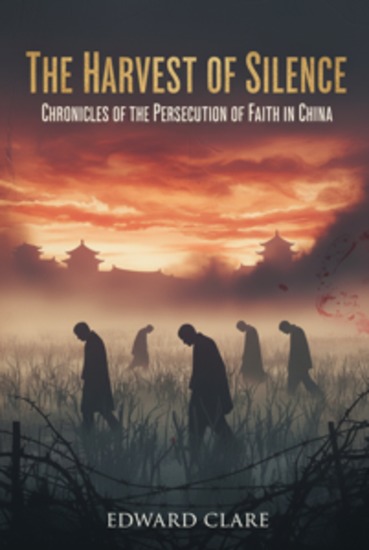
Harvest of Silence: Chronicles of the Persecution of Faith in China
Clare Edward
Editorial: Weisser Lotus GmbH
Sinopsis
Edward Clar's book Harvest of Silence: Chronicles of the Persecution of Faith in China is an in-depth investigation into one of the most brutal crimes against humanity of our time, taking place behind the closed doors of the People's Republic of China. The author opens the narrative with the shocking story of survivor Cheng Peimin, who woke up in a hospital ward after a forced organ harvesting and miraculously managed to escape, becoming the first documented witness to this conveyor belt of death. His scar and his testimony become the starting point for a large-scale investigation into a system of terror directed against tens of millions of peaceful citizens whose only crime was their spiritual practices and beliefs.The book traces the origins of the tragedy, beginning with peaceful morning meditations in Beijing parks in the mid-1990s, when Falun Gong practitioners, following the principles of Truthfulness-Compassion-Forbearance, created a phenomenon of spiritual awakening in a country devastated by the Cultural Revolution. The author describes in detail the April 1999 appeal near the Zhongnanhai government complex, when tens of thousands of people quietly and with dignity demanded the release of arrested fellow believers, demonstrating remarkable self-discipline and the nonviolent nature of the movement.However, the CCP leadership, headed by Jiang Zemin, perceived this mass movement as an existential threat to the party's monopoly on ideological control. In July 1999, a mechanism of total destruction was launched, beginning with the creation of the extrajudicial punitive structure “Office 610,” which was given unlimited powers to eradicate the practice by any means necessary.Clare reveals a sophisticated three-part strategy: discredit, bankrupt, and physically destroy. Particular attention is paid to the techniques of stigmatization and dehumanization of victims through the state media machine, which culminated in the provocation of self-immolation in Tiananmen Square in 2001, carefully analyzed by the author as a state-orchestrated operation to create an image of dangerous fanatics, justifying any repression.The author documents in detail the role of the Chinese Anti-Cult Association, a pseudoscientific structure created by the party to give a respectable facade to genocide, and its international cooperation with anti-cult organizations in Russia and Europe, which created a global network for legitimizing persecution. Central to the investigation is an analysis of the forced organ harvesting industry, based on the work of David Kilgour, David Matas, and the independent China Tribunal, who, through a combination of circumstantial evidence, have proven the existence of a centralized system that has turned prisoners of conscience into a living organ bank for organ transplantation. The book tells the specific stories of victims from China's technocratic elite, engineers and scientists whose bodies were methodically destroyed in re-education camps through sophisticated torture such as “death beds,” “eagle exhaustion,” and forced ideological reprogramming. Particularly shocking is the fate of engineer Lu Kaili, who spent thirteen and a half years in prison and was transformed from a respected specialist into a disabled person with multiple spinal fractures and implanted rods, losing the ability to walk and control his own body.The author demonstrates how the methodology of repression, honed on Falun Gong followers, was scaled up and applied to the Church of Almighty God, whose members are subjected to the same medical examinations for tissue typing, the same torture, and the same disappearance without a trace into the depths of the prison system. Clare cites statistics showing that hundreds of thousands of believers have been arrested, tens of thousands have died in custody under suspicious circumstances, and the number of transplants in China exceeds the official number of donors by tens of times, pointing to the existence of a covert source of organs.The author emphasizes that this is not a local human rights issue, but a global threat—the export of a totalitarian model of suppression of dissent, where the Chinese system of anti-cultism is being copied in other countries, turning faith into a crime and conscience into a death sentence. The “harvest of silence” continues precisely because the world prefers economic gain and diplomatic calm to the protection of fundamental human rights, and every day of delay means new victims on the altar of a cynical anti-cult machine that has turned people into a biological resource. Clare's book is not just a chronicle of horror; it is an indictment of indifference and a manifesto of the indestructibility of the human spirit in the face of absolute evil.
Disponible desde: 22/01/2026.
Longitud de impresión: 78 páginas.