Unisciti a noi in un viaggio nel mondo dei libri!
Aggiungi questo libro allo scaffale
Grey
Scrivi un nuovo commento Default profile 50px
Grey
Iscriviti per leggere l'intero libro o leggi le prime pagine gratuitamente!
All characters reduced
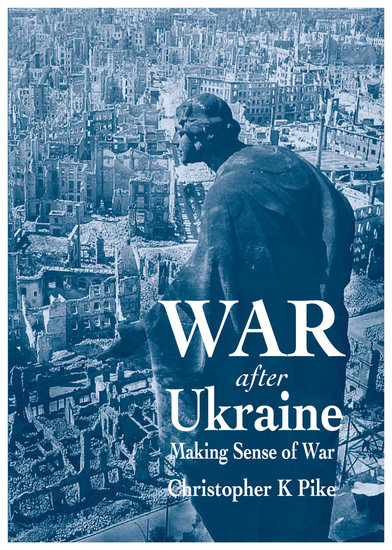
War after Ukraine - Making Sense of War - cover

War after Ukraine - Making Sense of War

Christopher Pike

Casa editrice: Brown Dog Books

  • 0
  • 0
  • 0

Sinossi

This final volume in the Making Sense of War trilogy, builds upon the concepts and reassessments of its predecessors, nbsp;About War and War in Context. 
War after Ukraine offers a compelling analysis of Russia’s historic use of force, the Ukraine war, and the reasons behind Putin’s aggression. 
Christopher Pike challenges the argument that provocations – like Western’s smug satisfaction at communism’s demise, nationalism and NATO expansion – gave Putin excuses to invade. 
While the invasion prompts calls for greater European unity, Pike warns of the current limitations of Western intervention, especially in the face of potential Russian aggression in other regions: Europe cannot defend itself. 
The book also recognises the subtle difference and interaction between the state, the nation and the nation state, a concept which is becoming increasingly vital in understanding the current and future international political environment. 
Pike examines the evolution of nuclear strategy, noting stubborn narratives of Russia as a persistent threat. The West’s policy is rooted in Cold War thinking, despite political and scientific upheaval. A reassessment of nuclear strategies in the light of contemporary geopolitical realities is urgently needed. 
War After Ukraine also provides insight into the future of war and international relations and calls for more subtle and better informed diplomacy to reflect the rational and irrational concerns of current and putative adversaries. 
Makingsenseofwar. com
Disponibile da: 22/10/2024.

Altri libri che potrebbero interessarti

  • Spreading Hate - The Global Rise of White Supremacist Terrorism - cover

    Spreading Hate - The Global Rise...

    Daniel Byman

    • 0
    • 0
    • 0
    The modern white power movement is now a global, transnational phenomenon. 
     
    In this sweeping, authoritative account, Daniel Byman traces the key moments in the white power movement’s evolution in the United States and around the world and then details its many facets today. Using a wide range of sources, Byman explodes several myths about  
    white power terrorism and identifies dangerous gaps in current policies. 
     
    For almost two decades since 9/11, white supremacist terrorism has been relegated to a secondary concern in the US and Europe despite shocking episodes of violence from New Zealand to Norway to South Carolina. Because white power terrorists’ grievances echo  
    mainstream debates and their violence often exacerbates polarization, their political impact can be inordinately high even if the body count is low. As Byman stresses, they are not a hidebound movement seeking to turn back the clock, but are dynamic, drawing on  
    ideas from around the world and exploiting the most cutting-edge technologies, especially social media. 
     
    White power terrorists, however, have many weaknesses. They are divided, with poor leadership, and often attract the incompetent and the criminal as well as the dangerous and deluded. If governments act decisively and treat white power terrorism with the same  
    urgency they use to manage jihadist violence, then the threat can be reduced. This will require aggressive law enforcement, international intelligence cooperation, crackdowns by technology companies, and other forceful steps. Spreading Hate will be essential reading  
    for anyone worried about this increasingly networked movement that threatens to grow more dangerous in the years to come.
    Mostra libro
  • Why Johnny Still Can't Read or Write or Understand Math - And What We Can Do About It - cover

    Why Johnny Still Can't Read or...

    Andrew Bernstein

    • 0
    • 0
    • 0
    The current school system churns out millions of illiterates and mental zombies—but here's how we're going to fix it, starting today. 


    Coming out of the COVID-19 pandemic, parents across the nation grapple with a new and horrifying understanding of just how bad our educational system has become. It all adds up to a system that seems hopelessly, terribly, and irrevocably broken. But as an educator and author, Andrew Bernstein reminds us that American education in the nineteenth through early-twentieth century was superb. This nation once knew how to turn out the brightest, most resourceful and independent-thinking people the world had ever seen. We can do it again.
    Mostra libro
  • Room at the Table - A Leader's Guide to Advancing Health Equity and Inclusion - cover

    Room at the Table - A Leader's...

    Renée Branch Canady

    • 0
    • 0
    • 0
    What Was Your First Memory of Race?This opening question is the heart and soul of “Room at the Table.” The word equity is thrown around in multiple media outlets, corporations, and non-profits. Diversity, Equity, Inclusion… Many shy away from these terms, convinced that they already understand. In truth, these concepts are a mystery to most. It’s more important than ever to grasp the vital, far-reaching aim of the equity lens. What does this work look like? What does it sound like? What actions must equity leaders take to turn the future of leadership into a reality?With public health injustices on the rise, grounded equity leadership can forge the path to a more healthy, understanding, and effective outlook for all of our futures. In her groundbreaking work, Dr. Renee Branch Canady, CEO of the Michigan Public Health Institute, shares through research and candid stories what it’s like to be on the front lines as an equity public health leader. In a culture centered on optics, Dr. Canady brings to light the true act of doing for the sake of change.Points of focus include:• The innovative concept of “Leadering” • Using our outrage to enact change • Seeing, saying, and doing differently • Acting courageously in the face of institutional racism • Leading with authenticity • Harboring the conviction to move equity work forward, one step at a timeIn Dr. Canady’s words, “Health equity leadership is a new leadership in this space that’s predicated by what’s happening at this moment. It hasn’t happened before. Focusing on others, a willingness to be courageous, and a willingness to do something that hasn’t been done before is a grey space in health equity leadership.”“Room at the Table” addresses this grey space with unflinching honestly and hope.
    Mostra libro
  • The Radical Mind - The Origins of Right-Wing Catholic and Protestant Coalition Building - cover

    The Radical Mind - The Origins...

    Chelsea Ebin

    • 0
    • 0
    • 0
    The Radical Mind is a groundbreaking analysis of the origins of the Christian Right, whose political victories are radically reshaping the landscape of American society. Scholars and the public alike have traditionally regarded the New Right and the Christian Right as separate movements. Insofar as both are conservative efforts, most people view them as reactionary and driven by a culture-war backlash against liberal changes to society. 


    Chelsea Ebin's The Radical Mind aims to overturn this consensus. Through a close analysis of New Right architects Connaught Marshner and Paul Weyrich (who is often seen as secular but was a committed Catholic), this book explores the way conservative Catholics and Protestants overcame their long-standing antipathy to form a political coalition—what Ebin calls the New Christian Right. Drawing on extensive archival research, Ebin shows how the movement’s key architects infused right-wing activism with religion. 


    The radical aims of the New Christian Right have been obscured by the way they cultivated a shared identity of victimhood and manipulated the discourse about backlash to create a nostalgic idea of the past that they then leveraged to justify their right-wing policy goals. The Catholic-Protestant alliance constructed an imagined past that they projected into the future as their ideal vision of society. Ebin calls this strategy "prefigurative traditionalism"—a paradoxical prefiguring of a manufactured past. Using this tactic, the New Christian Right coalition disguised the radicality of its politics by framing their aims as reactionary and defensive rather than proactive and offensive.
    Mostra libro
  • The ANC Billionaires - Big Capital's Gambit and the Rise of the Few - cover

    The ANC Billionaires - Big...

    Pieter Du Toit

    • 0
    • 0
    • 0
    'We were talking about the rise of Japan, about Ronald Reagan's Star Wars … globalisation, technology. And they were still banging on about the Freedom Charter.' – Anglo American's Michael Spicer on the ANC in the mid-1980s.
    In 1985, a group of white South African business leaders, led by Gavin Relly, the executive chairperson of Anglo American, travelled to a game lodge in Zambia to meet with the exiled ANC leadership under Oliver Tambo and Thabo Mbeki. This visit set in motion a coordinated and well-resourced plan by big business to influence and direct political change in South Africa.
    In The ANC Billionaires, top-selling author Pieter du Toit draws on first-hand accounts by major roleplayers about the contentious relationship between capital and the ANC before, during and after the country's transition to democracy, and shows how the liberation organisation was completely unprepared to navigate the intersection between business and politics.
    He also ties the rise of the new elite – including Cyril Ramaphosa, Patrice Motsepe and Saki Macozoma – to the ANC, a party of government and patronage.
    Mostra libro
  • The Bitter End - The 2020 Presidential Campaign and the Challenge to American Democracy - cover

    The Bitter End - The 2020...

    Lynn Vavreck, John Sides, Chris...

    • 0
    • 0
    • 0
    The year 2020 was a tumultuous time in American politics. It brought a global pandemic, protests for racial justice, and a razor-thin presidential election outcome. It culminated in an attack on the US Capitol that attempted to deny Joe Biden's victory. The Bitter End explores the long-term trends and short-term shocks that shaped this dramatic year and what these changes could mean for the future. 


    John Sides, Chris Tausanovitch, and Lynn Vavreck demonstrate that Trump's presidency intensified the partisan politics of the previous decades. Presidential elections have become calcified, with less chance of big swings in either party's favor. Republicans remained loyal to Trump and kept the election close, despite Trump's many scandals, a recession, and the pandemic. But in a narrowly divided electorate even small changes can have big consequences. The pandemic was a case in point: when Trump pushed to reopen the country even as infections mounted, support for Biden increased. The authors explain that, paradoxically, even as Biden's win came at a time of heightened party loyalty, there remained room for shifts that shaped the election's outcome. Ultimately, the events of 2020 showed that instead of the country coming together to face national challenges—the pandemic, George Floyd's murder, and the Capitol riot—these challenges only reinforced divisions.
    Mostra libro