Unisciti a noi in un viaggio nel mondo dei libri!
Aggiungi questo libro allo scaffale
Grey
Scrivi un nuovo commento Default profile 50px
Grey
Iscriviti per leggere l'intero libro o leggi le prime pagine gratuitamente!
All characters reduced
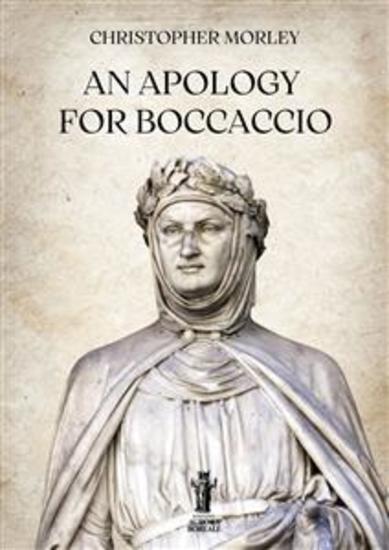
An Apology for Boccaccio - cover

An Apology for Boccaccio

Christopher Morley

Casa editrice: Edizioni Aurora Boreale

  • 0
  • 0
  • 0

Sinossi

Christopher Darlington Morley (May 5, 1890 - March 28, 1957) was an American journalist, novelist, essayist and poet. Author of more than 100 novels, books of essays, and volumes of poetry, Morley is probably best known today for his first two novels, Parnassus on Wheels (1917) and The Haunted Bookshop (1919).Morley’s short essay An Apology of Boccaccio, focusing on the life and works of the great 14th-century Italian writer and humanist, was published in November 1916 on the Smart Set Magazine.«The Decameron was written by a man of thirty-five or so who had seen much of life, a man full of humour and tenderness and ribaldry, a man who expressed as well as anyone the double attitude of the middle ages towards woman—the utmost reverence for woman in the abstract, as idealized in the Mother of Christ; combined with an unabashed willingness to kiss every pretty barmaid whom he met».
Disponibile da: 11/01/2023.
Altri libri che potrebbero interessarti

  • The Fall of the Monarchy - The Events Leading to the Execution of King Louis XVI and Queen Marie Antoinette - cover

    The Fall of the Monarchy - The...

    Amara Blackwood

    • 0
    • 0
    • 0
    The Ancien Régime, the political and social system that governed France for centuries, was built on a rigid hierarchy that concentrated power in the hands of the monarchy and nobility. This structure, deeply rooted in tradition, relied on the divine right of kings, reinforcing the belief that the king’s authority was absolute and unquestionable. King Louis XVI, like his predecessors, ruled with the assumption that his word was law, but by the late 18th century, the very foundations of this system were beginning to crumble. Economic hardship, social inequality, and growing discontent among the people exposed the fragility of a monarchy that had long ignored the demands of change. 
    At the heart of the Ancien Régime was the Estates System, which divided French society into three distinct groups. The First Estate consisted of the clergy, who enjoyed vast privileges, including exemption from most taxes. The Second Estate was made up of the nobility, who held significant land and influence while also being largely free from taxation. The Third Estate, which comprised the vast majority of the population, included peasants, urban workers, and the emerging bourgeoisie. This group bore the heaviest tax burden while having little political power, a reality that bred resentment and a growing desire for reform. 
    The economic struggles of France further weakened the monarchy’s stability. Years of extravagant spending by the royal court, particularly under King Louis XV and Louis XVI, had left the country in financial ruin. The lavish expenditures of Queen Marie Antoinette, though exaggerated in popular discourse, became a symbol of royal excess. Additionally, France’s costly involvement in the American Revolution had drained the treasury, deepening the crisis. By the 1780s, the government faced an insurmountable debt, and repeated attempts to impose new taxes on the privileged classes were met with fierce resistance.
    Mostra libro
  • Erich Hartmann: The Life and Legacy of the Luftwaffe’s Top Fighter Ace during World War II - cover

    Erich Hartmann: The Life and...

    Editors Charles River

    • 0
    • 0
    • 0
    The Third Reich's Luftwaffe began World War II with significant advantages over other European air forces, playing a critical role in the German war machine's swift, powerful advance. By war's end, however, the Luftwaffe had been decimated by combat losses and crippled by poor decisions at the highest levels of military decision-making, and it proved unable to challenge Allied air superiority despite a last-minute upsurge in German aircraft production. 
    Few people personified the advancements and abilities of the Luftwaffe like Erich Hartmann, the most successful ace in the history of warfare. His records are made all the more remarkable by the fact that he came late to the Second World War. It had already been underway for more than three years when, on October 14, 1942, at the furthest extremity of Germany’s advance into Russia, he strapped himself into the cockpit of his Messerschmitt 109 for his first combat mission. Born in April 1922, he was still just 20, but he was certainly prepared and ready. He had been flying gliders since his early teens - including as a glider instructor with the Hitler Youth - and he received a pilot’s license for powered aircraft in 1937.  
    Over the course of the war, Hartmann was credited with shooting down 352 enemy aircraft, 345 of which were Russian and seven being American, making him the most successful combat fighter of all time. In fact, the number is so incredible that it has inevitably come under intense criticism and scrutiny over the years, with some suggesting outright that the figure is falsified, while others have pointed to the unique combat circumstances of the Russian front and suggested that aerial combat there was somehow easier.
    Mostra libro
  • Spelling for Kids Parents and Just for Fun 5 Letter Words - cover

    Spelling for Kids Parents and...

    Dani Lai MacGregor

    • 0
    • 0
    • 0
    Hello Kids and Parents. Are you looking for an interactive book to help your child with spelling? You have come to the right place. The lessons attached are over 460 5-letter words and sentences that will help sharpen your child’s thinking skills and help you and your child have some fun together. They are broken up into six different chapters. Words to do with Sports, Words with an N in them, Words to do with Work, Words with an A in them, and 2 chapters of miscellaneous 5-letter words.  As you work thru this audiobook, you will be asked to spell the word, then given the word used in a sentence. The word will then be repeated followed by a pause where you have time to work out the spelling on your own before you are given the correct spelling of the word. Then it's on to the next.Sharpen your skills and have fun figuring out how many more 5-letter words you can find than I did! Enjoy, and Let’s get started!!
    Mostra libro
  • Making of Modern China The: The History of the World’s Most Populous Country from the Qing Dynasty to Today - cover

    Making of Modern China The: The...

    Charles River Editors

    • 0
    • 0
    • 0
    During the 15th century, China had become economically and technologically advanced compared to civilizations in Europe at the time, and its fleet, which had reached a total of 3,500 ships, was unmatched by any other world power. Nevertheless, after conducting several trade expeditions with the massive fleet, the Chinese ships were either burned in the docks or left to rot. With that, China began to revert to the xenophobic policies of its past and reduce its presence in other lands. By 1525, the largest naval fleet in the world had essentially been destroyed or dismantled by China itself.  
    	Meanwhile, the 19th century saw the rise of one of the largest, most powerful empires of the modern era. The sun never set on the British Empire, whose holdings spanned the globe, in one form or another. Its naval supremacy linked the Commonwealth of Canada with the colonies in South Africa and India, and through them trade flowed east and west. An integral but underutilized part of this vast trade network included China, a reclusive Asian kingdom closed off from the Western world that desired none of its goods. 
    	Unfortunately for China, the British had the might of an empire and economic force, not to mention modern arms, on their side. Breaking into China’s lucrative trade markets nearly destroyed the nation, severely discredited the Chinese dynasty, wreaked havoc on its people, and further propelled Britain’s empire into a dominant economic and military position. 
    	The collision of these two empires took many years and caused much bloodshed. In fact, the troubles started well before the eventual hostilities, festering as frustration mounted until finally boiling over. Such was the state of relations between the British Empire and Qing Dynasty for the better part of the century, its footing upended from the very start of relations.
    Mostra libro
  • Carthage - Its Carnage Its History and Its Resistance to the Romans - cover

    Carthage - Its Carnage Its...

    Kelly Mass

    • 0
    • 0
    • 0
    Carthage was an ancient city-state located in what is now modern-day Tunisia. Founded by Phoenician settlers in the ninth century BC, Carthage would rise to become one of the most influential and powerful empires of the ancient Mediterranean world, only to be destroyed by the Romans in 146 BC. Despite its destruction, the Romans later lavishly rebuilt it, cementing its place in history. During its peak in the fourth century BC, Carthage was the capital of the Carthaginian Empire, a force that dominated the western Mediterranean with unmatched power and influence. 
    The origins of Carthage can be traced back to around 814 BC, when settlers from Tyre, a prosperous Phoenician city-state in modern Lebanon, arrived on the northern coast of Africa. Following the fall of Phoenicia to the Neo-Assyrian Empire in the seventh century BC, Carthage emerged as an independent entity. Over time, it expanded its influence, securing political and economic control over vast territories across the western Mediterranean. By 300 BC, Carthage controlled a sprawling empire that included the coastal regions of northwest Africa, southern Iberia (modern-day Spain, Portugal, and Gibraltar), and a series of key islands such as Sicily, Sardinia, Corsica, Malta, and the Balearic Islands. This expansion was achieved through a complex network of colonies, vassal states, and satellite territories. 
    Carthage’s strategic location played a significant role in its success. Its access to fertile agricultural lands and critical maritime trade routes allowed the city to thrive economically and become one of the wealthiest and most powerful centers of commerce in the ancient world. Carthage’s trade network extended across the Mediterranean and beyond, reaching as far as West Asia, West Africa, and northern Europe.
    Mostra libro
  • Bond Of Blood - cover

    Bond Of Blood

    Martin Hicks

    • 0
    • 0
    • 0
    Bond of Blood tells the story of two Irish brothers, each of whom makes the life-changing journey to the new world as the second half of the 19th century draws on. Thomas and Michael Casey are linked by blood, but find themselves on opposite sides of the US Civil War conflict.Martin Hicks lives in Fraserburgh, Scotland and began writing after a career in education. He has published a series of US Civil War books, and "Bond of Blood" is his eighth title.By the same author: A Gathering of Soldiers Hard Passage North The Rappahannock Line Mirage of Victory The Bitterest Enemy A Season for Killing A Deepening Twilight
    Mostra libro