Join us on a literary world trip!
Add this book to bookshelf
Grey
Write a new comment Default profile 50px
Grey
Subscribe to read the full book or read the first pages for free!
All characters reduced
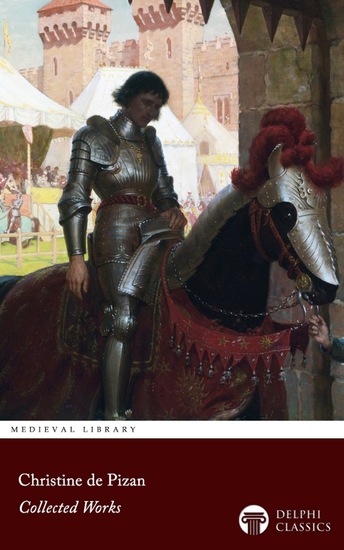
Delphi Collected Works of Christine de Pizan Illustrated - cover

Delphi Collected Works of Christine de Pizan Illustrated

Christine de Pizan

Publisher: Delphi Publishing Ltd

  • 0
  • 0
  • 0

Summary

Europe’s first professional woman of letters, Christine de Pisan was a fifteenth century French poet and author, whose prolific and diverse works include courtly poems, biographies, philosophical treatises and proto-feminist texts. Her masterpiece, ‘The Book of the City of Ladies’ combats medieval beliefs about women by creating an allegorical city. Christine arranges a wide array of famous women throughout history, which she ‘houses’ in her City, i.e. the book. Her last work, ‘The Tale of Joan of Arc’ is the only French-language account of the hero during her lifetime. It serves as a lyrical and joyous celebration of Joan’s exploits, helping to elevate the status of women in the late Middle Ages. Delphi’s Medieval Library provides eReaders with rare and precious works of the Middle Ages, with noted English translations and the original texts. This eBook presents Christine’s collected works, with illustrations, informative introductions and the usual Delphi bonus material. (Version 1)
 
* Beautifully illustrated with images relating to Christine’s life and works* Features the collected works of Christine, in both English translation and the original French* Concise introductions to the major works* A range of translations, from the Renaissance up to the modern day* Excellent formatting of the texts* Easily locate the sections you want to read with individual contents tables* Features a bonus biography — discover Christine’s medieval world* Ordering of texts into chronological order
 
CONTENTS:
 
The TranslationsEpistle of Othéa to Hector (1400) (tr. Stephen Scrope, c. 1460)Moral Proverbs (1401) (tr. Anthony Woodville, 1477)The Tale of the Rose (1402) (tr. P. Laskaris, 2024)The Book of the Duke of True Lovers (1405) (tr. Laurence Binyon and Eric Maclagan, 1908)The Book of the City of the Ladies (1405) (tr. Brian Anslay, 1521)The Tale of Joan of Arc (1429) (tr. P. Laskaris, 2024)
 
The Original French TextsOeuvres poétiques de Christine de PisanL’Épistre de Othéa a HectorLe trésor de la cité des damesDitié de Jehanne d’Arc
 
The BiographyA Fifteenth-Century Feministe, Christine de Pisan (1913) by Alice Kemp-Welch
Available since: 04/11/2025.
Print length: 1150 pages.

Other books that might interest you

  • Girl Made of Glass - cover

    Girl Made of Glass

    Shelby Leigh

    • 0
    • 0
    • 0
    If you think often about the past or battle with overthinking and self-esteem, girl made of glass is for you. This collection is about finding yourself, forgiving yourself, and loving yourself. It explores the many ways our past haunts us but will leave you feeling hopeful about your future. 


    girl made of glass is a poetry collection about how our past—past mistakes, relationships, and regrets—can linger into our future. Broken into four parts, this book is about finding, forgiving, and loving ourselves. The Nightmares explores our past and the moments that haunt us. The Mirror delves into insecurity and how we might haunt ourselves. The Shattering investigates relationships and how they can break us. The Enchantment delivers an uplifting conclusion of self-love and growth.
    Show book
  • Around the World in 80 Poems - A global tour of classic poetry - cover

    Around the World in 80 Poems - A...

    Robert Louis Stevenson

    • 0
    • 0
    • 0
    In the Victorian age that great adventurer Phileas Fogg attempted to traverse the globe in a mere 80 days using only the existing transport infrastructure and his own nous.    
     
    Today the globe can be spanned much quicker and in more comfortable fashion but alas without much of the intrigues, stories and landscape that accompanied Mr Fogg and made the trip so exciting. 
     
    In this volume we have an answer: Let’s travel the globe with the words and verse of 80 esteemed and voluble poets.  Let’s explore places, peoples, philosophical musings on our world and all manner of things that Mr Fogg had no access to.  With the words of classic poets such as John Keats, Rabindranath Tagore, Du Fu and Edna St Vincent Millay as your companions it’s one heck of a journey. 
     
    1 - Around the World in 80 Poems - An Introduction 
    2 - Travel by Edna St Vincent Millay 
    3 - Travel by Robert Louis Stevenson 
    4 - A Ballad of London by Richard Le Gallienne 
    5 - The World State by G K Chesterton 
    6 - The Drunken Boat by Arthur Rimbaud 
    7 - In the Train and at Versailles by Dante Gabriel Rossetti 
    8 - Train Ride by Federico Garcia Lorca 
    9 - I Go on Dreaming of Paths by Antonio Machado 
    10 - Sonnet I by Fernando Pessoa 
    11 - Sonnet on Approaching Italy by Oscar Wilde 
    12 - To Italy by Radclyffe Hall 
    13 - Sicily December 1908 by Henry Van Dyke 
    14 - Sonnet to Lake Leman by Lord Byron 
    15 - Pathways by Rainer Maria Rilke 
    16 - In the Black Forest by Amy Levy 
    17 - Calm at Sea by Johann Wolfgang von Goethe 
    18 - Sonnet to Ocean by Thomas Hood 
    19 - In Amsterdam by Eugene Field 
    20 - Sonnet at Ostend July 22nd 1787 by William Lisle Bowles 
    21 - Belgium by Edith Wharton 
    22 - Forced March by Miklos Radnoti 
    23 - Autumn Evening in Serbia by Francis Ledwidge 
    24 - The Cretan Dance by Sappho 
    25 - The Isles of Greece by Byron 
    26 - Sailing to Byzantium by W B Yeats 
    27 - Constantinople by Lady Mary Wortley Montagu 
    28 - Beirut Wedding Poem by Tim Graham 
    29 - The Life of Love - Spring by Khalil Gibran 
    30 - Gates of Damascus by James Elroy Flecker 
    31 - Walk to Caesarea by Hannah Senesh 
    32 - The City of Baghdad by Sultan Bahu 
    33 - Ozymandias by Percy Bysshe Shelley 
    34 - To the Nile by Keats 
    35 - Ode to Ethiopia by Paul Laurence Dunbar 
    36 - My Africa by Gladys May Casely Hayford 
    37 - Africa by Lewis Alexander 
    38 - Poem by Sarah of Yemen 
    39 - Sleepless I Kept the Night Vigil by Khansa 
    40 - The Golden Journey to Samarkand by James Elroy Flecker 
    41 - A World with No Boundaries by Jalaluddin Rumi 
    42 - All Pervading Consciousness by Farid ud-Din Attar 
    43 - The Cloud on the Mountain by Alama Iqbal 
    44 - In the Bazaars of Hyderabad by Sarojini Naidu 
    45 - To the City of Bombay by Rudyard Kipling 
    46 - An Old Tibetan Rug by Else Lasker Schuler 
    47 - Dawn by Du Fu 
    48 - Chiang Chin Chiu by Li Po 
    49 - In Praise of May by Akiko Yosano 
    50 - Having Slept The Cat Gets Up by Kobayashi Issa 
    51 - The Owl and the Pussycat by Edward Lear 
    52 - The Loji Expedition by Tom Hood 
    53 - The Ocean by Nathaniel Hawthorne 
    54 - A Song for January the 26th 1824 by Charles Tompson 
    55 - Brother, You'll Take My Hand by Henry Lawson 
    56 - Tiare Tahiti by Rupert Brooke 
    57 - A Song of the Panama Canal by Damon Runyon 
    58 - Tezcotzinco by Alan Seeger 
    59 - Down By The Carib Sea by James Weldon Johnson 
    60 - North and South by Claude McKay 
    61 - Bermudas by Andrew Marvell 
    62 - Song of the Open Road by Walt Whitman 
    63 - New York at Night by Amy Lowell 
    64 - The New Colossus by Emma Lazarus 
    65 - Away to Canada by Joshua McCarter Simpson 
    66 - The Railway Station by Archibald Lampman 
    67 - Past One O'Clock by Vladimir Mayakovsky 
    68 - A Dish of Peaches in Russia by Wallace Stevens 
    69 - Aurora Borealis by Herman Melville 
    70 - Iceland First Seen by William Morris 
    71 - My Artificial Flowers by Edith Sodergran 
    72 - The Wayfarer by Patrick Pearse 
    73 - The Lake Isle of Inisfree by W B Yeats 
    74 - Beauti
    Show book
  • Wherever We Mean to Be - Selected Poems 1975–2015 - cover

    Wherever We Mean to Be -...

    Robyn Sarah

    • 0
    • 0
    • 0
    Spanning forty years and ten previously published collections, Wherever We Mean to Be is the first substantial selection of Robyn Sarah’s poems since 1992. Chosen by the author, the 97 poems in this new volume highlight the versatility of a poet who moves easily between free verse, traditional forms, and prose poems. Familiar favorites are here, along with lesser-known poems that collectively round out a retrospective of the themes and concerns that have characterized this poet's work from the start. 
    Warm, direct, and intimate, accessible even at their most enigmatic, seemingly effortless in their musicality, the poems are a meditation on the passage of time, transience, and mortality. Natural and seasonal cycles are a backdrop to human hopes and longings, to the mystery and grace to be found in ordinary moments, and the pleasures, sorrows, and puzzlements of being human in the world.
    Show book
  • The Hunting of the Snark - The writer of Alice In Wonderland takes us on a voyage of discovery with wonderful offbeat characters as we chase down the Snark - cover

    The Hunting of the Snark - The...

    Lewis Carroll

    • 0
    • 0
    • 0
    Lewis Carroll was born Charles Lutwidge Dodgson on the 27th January 1832 at Daresbury, Cheshire, the eldest boy and the third child.  Another eight followed.   
     
    When Dodgson was 11, his cleric father moved his family to Croft-on-Tees in the North Riding of Yorkshire.  Although his father was active and highly conservative his son was ambivalent with those values and with the Church as a whole. 
     
    In his early years Dodgson was educated at home and by age 7 he was reading the likes of ‘The Pilgrim's Progress’.  He also spoke with a stammer which he called his ‘hesitation’. 
     
    At 12 he was dispatched to Richmond Grammar School in North Yorkshire and then on to Rugby.  He sailed through the curriculum.  He was accepted at Christ Church, Oxford but two days after arriving he was summoned home: his mother had died of ‘inflammation of the brain’ at only 47. 
     
    Dodgson was exceptionally gifted and, when not distracted, achievement came easily to him.  He remained at Christ Church studying and teaching in various capacities until his death. 
     
    In March 1856, he published the romantic poem ‘Solitude’ as by ‘Lewis Carroll’.  
     
    That same year he took up the new art of photography.  He soon excelled and became a well-known gentleman-photographer, and even toyed with the idea of making a living out of it.  When he ceased photography in 1880, he had his own studio and had created around 3,000 images. 
     
    He enjoyed moderate success with his early poems and short stories but had an array of other interests in the pre-Raphaelite circle, Psychical Research and even ordained in the Church of England in 1861.  
     
    In July 1862 he told a young Alice Liddell the story that would become his first and greatest success.  Alice begged him to write it down, and eventually he did and later presented her with a handwritten and illustrated ‘Alice's Adventures Under Ground’.  The publisher Macmillan agreed to publish it as ‘Alice's Adventures in Wonderland’ by Lewis Carroll.  
     
    It was a huge and sensational life-changing success.  Royalties quickly accumulated as did fan mail.  
     
    In 1871, the darker themed sequel ‘Through the Looking-Glass, and What Alice Found There’ was published.  A half decade later came ‘The Hunting of the Snark’, a fantastical nonsense poem, as nine tradesmen and a beaver set off to find the snark.  It was another enormous success. 
     
    He also loved to invent such delights as a writing tablet ‘the nyctograph’ that allowed note-taking in the dark as well as many word games, such as the precursor to ‘Scrabble’, and alternative systems of parliamentary voting.  Within the discipline of mathematics, he worked in geometry, linear and matrix algebra, mathematical logic, recreational mathematics and wrote nearly a dozen books on the subject.   
     
    Lewis Carroll died of pneumonia following influenza on 14th January 1898 in Guildford, Surrey.  He was 65.  
     
    01 - The Hunting of the Snark by Lewis Carroll - An Introduction 
    02 - The Hunting of the Snark. Fit the First - The Landing 
    03 - Fit the Second - The Bellman's Speech 
    04 - Fit the Third - The Baker's Tale 
    05 - Fit the Fourth - The Hunting 
    06 - Fit the Fifth - The Beaver's Lessom 
    07 - Fit the Sixth - The Barrister's Dream 
    08 - Fit the Seventh - The Banker's Fate 
    09 - Fit the Eighth - The Vanishing
    Show book
  • Knife Sharpener - Selected Poems - cover

    Knife Sharpener - Selected Poems

    Sargon Boulus

    • 0
    • 0
    • 0
    Knife Sharpener – Selected Poems is a posthumous commemoration and celebration of Sargon Boulus, in a collection of poems, written between 1991 and 2007 that he translated himself, together with an essay, "Poetry and Memory", written a few months before he died in October 2007.
    With a Foreword by Adonis and an Introduction by Dublin poet and publisher Pat Boran, the volume includes nine pages of photographs and tributes from fellow poets and writers Saadi Youssef, Ounsi El-Hage, Amjad Nasser, Abbas Beydhoun, Abdo Wazen, Fadhil al-Azzawi, Kadhim Jihad Hassan, Khalid al-Maaly, and Elias Khoury, assembled and translated by fellow Iraqi poet Sinan Antoon, who described his death as leaving "a gaping wound in the heart of modern Arabic poetry".
    "Sargon seemed to feel also the even greater, historical weight of conflicts, tensions, misunderstandings and oppressions of the spirit, as if his poems came through his own time and language but from somewhere else." – Pat Boran
    Sargon Boulus was unusually influential among young Arab poets, who "found in him the father who refused to practise his patriarchy and a poet who always renewed himself in his rebellion against rhetoric . . ." Abdo Wazen
    Show book
  • Five Years with the White Man - cover

    Five Years with the White Man

    Eloka Obi, Saul Boyer

    • 0
    • 0
    • 0
    A startling account of satirist ABC Merriman-Labor – the greatest Black Briton ever to have been forgotten – whose dreams of becoming the greatest writer of his generation lead him on a defiant journey from Sierra Leone to Edwardian London.
    Eloka Obi and Saul Boyer's play Five Years with the White Man features a kaleidoscope of characters and was premiered at VAULT Festival, London, in 2023.
    Show book