Unisciti a noi in un viaggio nel mondo dei libri!
Aggiungi questo libro allo scaffale
Grey
Scrivi un nuovo commento Default profile 50px
Grey
Iscriviti per leggere l'intero libro o leggi le prime pagine gratuitamente!
All characters reduced
Scenes and Characters or Eighteen Months at Beechcroft - cover

Scenes and Characters or Eighteen Months at Beechcroft

Charlotte M. Yonge

Casa editrice: DigiCat

  • 0
  • 0
  • 0

Sinossi

In "Scenes and Characters, or, Eighteen Months at Beechcroft," Charlotte M. Yonge presents a vivid exploration of domestic life through the lens of an English community during the mid-19th century. This semi-autobiographical narrative delves into the intricacies of social interactions and moral dilemmas faced by a group of inhabitants over a year and a half. Yonge's literary style is characterized by its engaging, conversational tone and detailed characterizations, enabling readers to immerse themselves in the psychological landscapes of her protagonists. Set against the backdrop of Victorian society, the novel grapples with themes of duty, faith, and the significance of female agency within a rigid social framework, reflective of the author's own experiences and observations as a woman of her time. Charlotte M. Yonge, a prominent figure in 19th-century literature, was known for her prolific writing and her commitment to addressing the lives of women and moral education. Living during a time of significant social change, Yonge's views were shaped by her strong Anglican faith and her active participation in community life, deeply informing her characters' struggles and triumphs in "Scenes and Characters." Her background in education and her role as a contributor to various periodicals positioned her as a compassionate observer of societal norms, making her narratives both relevant and relatable. This book is a must-read for those interested in the dynamics of Victorian society and the intricate portrayal of character development. Yonge's insightful examination of personal growth and community connections invites readers to reflect on their own lives and the societal landscapes that shape them. Whether you are a scholar of Victorian literature or a casual reader, "Scenes and Characters" promises a rich and thought-provoking journey through the human experience.
Disponibile da: 16/09/2022.
Lunghezza di stampa: 210 pagine.
Altri libri che potrebbero interessarti

  • Common Sense of Warfare The (Unabridged) - cover

    Common Sense of Warfare The...

    H. G. Wells

    • 0
    • 0
    • 0
    Herbert George Wells (21 September 1866 - 13 August 1946) was an English writer. Prolific in many genres, he wrote dozens of novels, short stories, and works of social commentary, history, satire, biography and autobiography. His work also included two books on recreational war games. Wells is now best remembered for his science fiction novels and is often called the "father of science fiction", along with Jules Verne and the publisher Hugo Gernsback.
    THE COMMON SENSE OF WARFARE: I want to say as compactly as possible why I do not believe that conscription would increase the military efficiency of this country, and why I think it might be a disastrous step for this country to take.
    Mostra libro
  • Les Misérables: Volume 4: The Idyll in the Rue Plumet and the Epic in the Rue St Denis - Book 14: The Grandeurs of Despair (Unabridged) - cover

    Les Misérables: Volume 4: The...

    Victor Hugo

    • 0
    • 0
    • 0
    Victor-Marie Hugo (26 February 1802 - 22 May 1885) was a French poet, novelist, essayist, playwright, and dramatist of the Romantic movement. During a literary career that spanned more than sixty years, he wrote abundantly in an exceptional variety of genres: lyrics, satires, epics, philosophical poems, epigrams, novels, history, critical essays, political speeches, funeral orations, diaries, and letters public and private, as well as dramas in verse and prose.
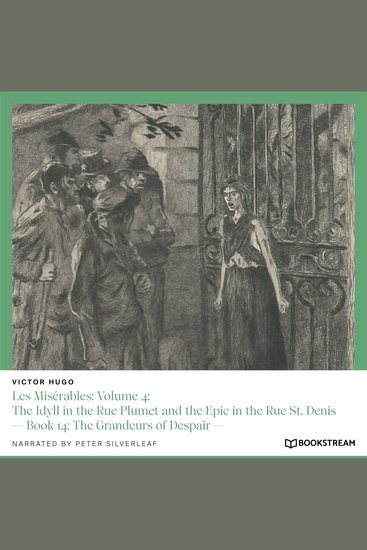
    BOOK 14: THE GRANDEURS OF DESPAIR: As yet, nothing had come. Ten o'clock had sounded from Saint-Merry. Enjolras and Combeferre had gone and seated themselves, carbines in hand, near the outlet of the grand barricade. They no longer addressed each other, they listened, seeking to catch even the faintest and most distant sound of marching.
    Mostra libro
  • The Murderer - Bulgakov expertly explores life and death choices set on the backdrop of the Bolshevik Revolution - cover

    The Murderer - Bulgakov expertly...

    Mikhail Bulgakov

    • 0
    • 0
    • 0
    Mikhail Bulgakov was born on 15th May 1891 in Kiev, in the Kiev Governorate of the Russian Empire, into a Russian family.  He was one of seven children. 
     
    In 1901, Bulgakov attended the First Kiev Gymnasium, and developed a keen interest in Russian and European literature, theatre and opera.  After the death of his father in 1907, his mother assumed responsibility for his education.  After graduating Bulgakov entered the Medical Faculty of Kiev University and then took up a post as physician at the Kiev Military Hospital. 
     
    At the outbreak of the First World War, he volunteered as a doctor and was sent directly to the front, where he was badly injured at least twice.  To suppress chronic pain, especially in the abdomen, he injected morphine.  It took years to wean himself off. 
     
    He now took up medical posts in various towns and in 1919, he was mobilised by the Ukrainian People's Army and assigned to the Northern Caucasus.  There, he became seriously ill with typhus and barely survived.  
     
    After this illness, Bulgakov abandoned his medicine to pursue writing.  He moved to Vladikavkaz and had two plays staged there with great success.  He wrote too for various newspapers and other outlets, but his critics were many.  And growing. 
     
    When a Moscow's theatre director severely criticised Bulgakov, Stalin personally protected him, saying that a writer of Bulgakov's quality was above ‘party words’ like ‘left’ and ‘right’.   Indeed, it is said that Stalin watched ‘The Days of the Turbins’ at least 15 times. 
     
    It was not to last and by March 1929, Bulgakov's career was ruined when Government censorship stopped publication of any of his work and plays. 
     
    In despair, Bulgakov wrote a personal letter to Stalin.  He requested permission to emigrate.  He received a phone call from the Soviet leader, who asked the writer whether he really desired to leave. He replied that a Russian writer cannot live outside of his homeland.  Stalin thus gave him permission to continue working. In May 1930, he re-joined the theater, as stage director's assistant.  
     
    During the last stressful decade of his life, and in poor health, Bulgakov continued to work on ‘The Master and Margarita’, wrote plays, critical works, stories, and continued translations and dramatisations of novels.  Many of them were not published, others were derided by critics.  
     
    On 10th March 1940, Mikhail Afanasyevich Bulgakov died from nephrosclerosis.  He was 48. 
     
    ‘The Master and Margarita’ was not published in any form until the mid-1960’s 
     
    Here Bulgakov relates a story as told by a doctor describing the terrible things that humanity is capable of doing in times of war.
    Mostra libro
  • Frankenstein or the Modern Prometheus - cover

    Frankenstein or the Modern...

    Mary Wollstonecraft Godwin Shelley

    • 0
    • 0
    • 0
    Frankenstein or the Modern Prometheus is an 1818 novel written by English author Mary Wollstonecraft Godwin Shelley. Frankenstein tells the story of Victor Frankenstein, a young scientist who creates a creature in an unorthodox scientific experiment.
    Mostra libro
  • A Fragment of Stained Glass - From their pens to your ears genius in every story - cover

    A Fragment of Stained Glass -...

    D H Lawrence

    • 0
    • 0
    • 0
    David Herbert Lawrence was born on the 11th September 1885 in Eastwood, Nottinghamshire, a coal mining town where the reality of a harsh life was only useful as experiences for future literary works. 
    He was educated at Beauvale Board School and became the first local boy to receive a scholarship to attend Nottingham High School. After 3 years he became a junior clerk in Haywood’s surgical appliances factory. He was also attempting a literary career which, in the short term, led to a teacher training position in Eastwood and later a teaching qualification from University College, Nottingham.  
    Lawrence’s first efforts were poems, short stories and a draft of ‘The White Peacock’. Moving to London and a teaching position in Croydon his writing attracted the attention of Ford Madox Ford, editor of The English Review, and he commissioned him to write ‘Odour of Chrysanthemums’.  
    Wanting to write full-time he now began work on what would become ‘Sons and Lovers.   
    In 1912 he met the older and married mother-of-three Frieda Weekley. They eloped to Germany and here Lawrence could see for himself the growing tensions with France.  So keen was his interest that he was arrested and accused of being a British spy.  
    In early 1914 Frieda obtained her divorce and they returned to Britain to be married just days before the outbreak of war. Owing to her German parentage, and his own public dislike of militarism and violence, the couple were treated with contempt and suspicion throughout the war years.  
    Despite this he continued to write but his reputation in England was so tarnished and, mirrored by his own disdain for the country, he and Frieda left England in November 1919, first for Europe and then America via Ceylon and Australia. 
    They bought a ranch in Taos, New Mexico and visited Mexico several times. The third visit in March 1925 caused a near fatal attack of malaria. To convalesce they moved to Florence. Here he continued work on ‘Lady Chatterley’s Lover’ which for many years would cause controversy. A renewed interest in oil painting resulted in an exhibition in 1929 which was raided by the police and several works were confiscated.  
    D H Lawrence died of complications arising from a bout of tuberculosis on the 2nd of March 1930 in Vence, France.  He was 44.
    Mostra libro
  • Twenty Thousand Leagues under the Sea - cover

    Twenty Thousand Leagues under...

    Jules Verne

    • 0
    • 0
    • 0
    "Twenty Thousand Leagues Under the Sea" by Jules Verne is a classic science fiction novel written in the late 19th century. The story revolves around the mysterious appearances of a massive sea creature, which generates widespread sensation and scientific debate regarding its existence.  
    The narrative focuses on Professor Pierre Aronnax, his servant Conseil, and Canadian whaler Ned Land as they embark on a journey to confront this enigmatic creature, which turns out to be far more than anyone anticipated. The novel opens by detailing the excitement surrounding sightings of a colossal sea creature reported by various ships across the oceans.  
    Professor Aronnax, who has just returned from a scientific expedition, becomes engrossed in the heated debate over the creature's existence. He decides to join the U.S. expedition aboard the frigate Abraham Lincoln, along with his companions Conseil and Ned Land, as they pursue the supposed monster. Tension builds as they prepare for their confrontation, creating a sense of suspense and wonder about what lies beneath the ocean's depths.
    Mostra libro