Unisciti a noi in un viaggio nel mondo dei libri!
Aggiungi questo libro allo scaffale
Grey
Scrivi un nuovo commento Default profile 50px
Grey
Iscriviti per leggere l'intero libro o leggi le prime pagine gratuitamente!
All characters reduced
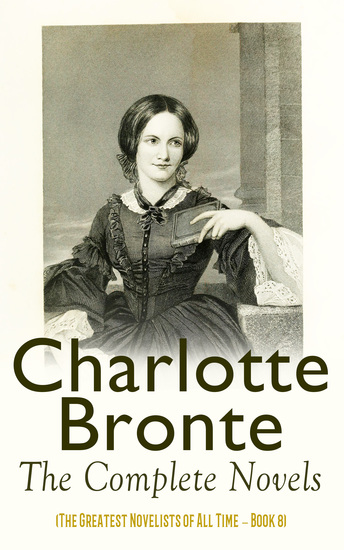
Charlotte Brontë: The Complete Novels (The Greatest Novelists of All Time – Book 8) - cover

Charlotte Brontë: The Complete Novels (The Greatest Novelists of All Time – Book 8)

Charlotte Brontë

Casa editrice: e-artnow

  • 0
  • 0
  • 0

Sinossi

E-artnow presents to you the complete novels by one of the greatest novelist of English literature. This collection includes:
Jane Eyre
Shirley
Villette
The Professor
Emma
Disponibile da: 08/03/2022.
Lunghezza di stampa: 1837 pagine.
Altri libri che potrebbero interessarti

  • Shiny Objects - Why We Spend Money We Don't Have in Search of Happiness We Can't Buy - cover

    Shiny Objects - Why We Spend...

    James A. Roberts

    • 0
    • 0
    • 0
    In Shiny Objects, a cross between In Praise of Slowness and The Tipping Point, consumer behavior expert Professor James A. Roberts takes us on a tour of America's obsession with consumerism—pointing out its symptoms, diagnosing specific problems, and offering a series of groundbreaking solutions.Roberts gives practical advice for how to correct the materialistic trends in our lives which lock us into a cycle of financial hardship and stress. Shiny Objects, a new The Paradox of Choice for the modern reader, is more than a critique of capitalism—it's also an exploration into how we can live happier, fuller, more productive lives today.
    Mostra libro
  • Calling My Deadname Home - Trans Bear Diaries - cover

    Calling My Deadname Home - Trans...

    Avi Ben Zeev

    • 0
    • 0
    • 0
    In this extraordinarily compelling trans memoir, Avi, a bearish trans man and Psychology Professor, navigates sex and dating in a phallic-centric universe of men who love men. But something is missing. To become the man he aspires to be, he needs to reconnect with Talia, his hyper-feminine straight female past, and invite her back in.  Growing up in a working-class right-wing Israeli family and barely finishing high school, he became involved in pro-Palestinian activism and escaped compulsory military service by faking madness. Despite poor schooling Avi went on to attain a PhD from Yale and change his life entirely. This memoir is the story of that journey and explores what it means to come home to oneself with brutal honesty, humour, and self-compassion.  Told in three episodes, early transition, later transition and Talia's story, this memoir tackles contemporary gender and social issues. At its heart is a universal theme: to become who we already are, we must integrate the past into the present
    Mostra libro
  • Roman Empire: An Enthralling Overview of Imperial Rome - cover

    Roman Empire: An Enthralling...

    Enthralling History

    • 0
    • 0
    • 0
    Did you know that not all Romans could wear togas? 
    Movies and shows might depict Romans wearing togas and sandals everywhere they went, but that was actually not the case. In fact, togas were considered formal wear and a status symbol, as those in the higher social classes typically wore them. 
    There are many surviving writings authored by ancient Roman historians that describe the interesting traditions and customs of ancient Rome. These records provide detailed insights and scenes of the empire’s past. Some throw in a few myths, while some are infused with bias. Because of this, it can be difficult for curious listeners to distinguish between facts and opinions. 
    However, with this Enthralling History audiobook, you can easily discover the fascinating journey of the ancient Roman Empire, from the emergence of its first emperor until the fall of the Western Roman Empire. 
    Here’s just a tiny fraction of what you’ll discover:How Augustus ended the decades-long civil war and rose as the empire’s “first citizen”;How the emperor’s private military forces, the Praetorian Guard, became powerful enough to slay Rome’s mad emperor;The vicious scenes of Rome’s biggest entertainment shows: the gladiatorial games and chariot races;The unique and luxurious structures of Rome that have survived to this day;Harsh punishments and training of the legionnaires;Comparison between the lush life of the wealthy and the mundane lives of commoners, slaves, and freemen;Early Christians as Emperor Nero’s scapegoats and their terrible persecution;The rise of Christianity and the sacking of Rome;And much, much more! 
    Scroll up and click the “add to cart” button to learn more about the Roman Empire!
    Mostra libro
  • A Rare Recording of US Senator Frank Church Chairman of the Church Committee - cover

    A Rare Recording of US Senator...

    Senator Frank Church

    • 0
    • 0
    • 0
    Frank Forrester Church III (July 25, 1924 to April 7, 1984) was an American Democrat politician and lawyer. Church served as a U.S. Senator from Idaho from 1957 to 1981, and gained national prominence as chairman of the U.S. Senate Select Committee to Study Governmental Operations with Respect to Intelligence Activities, from 1975 through 1976, commonly known as the Church Committee, which conducted extensive hearings investigating extra-legal FBI and CIA intelligence-gathering and covert operations. The following recording is from a speech Church gave to the Women's Democratic League in 1975.
    Mostra libro
  • Triggered Literature - Triggered Literature: Cancellation Stealth Censorship and Cultural Warfare - cover

    Triggered Literature - Triggered...

    John Sutherland

    • 0
    • 0
    • 0
    Amid the flames of the culture wars, politicians have taken up arms over controls on literary culture, spurred on in part by universities 'triggering' canonical texts. Jonathan Swift's 'Battle of the Books' has flared up again. But is 'triggering' utter wokery or responsible pedagogic practice?
    Through dozens of case studies of triggered works, from Romeo and Juliet to Gender Queer, John Sutherland explores the recent phenomenon of triggering and its consequences for university English departments and literature itself. He maintains that what is routinely overlooked in the heat of polemic is that triggering is categorically different from traditional institutional (religious, educational, dictatorial) controls on literature. Triggering is in essence an alert. Done responsibly it does not erase or meddle; it stimulates curiosity and thought. It honours the fact that great literature is great because it is, as Franz Kafka says, powerful.
    In this characteristically nuanced and calmly objective study, the witty literary critic guides us through the increasingly rocky terrain of triggering. His advice rings clear: literature matters, to us and what we make of our world, and it must be handled with critical care.
    Mostra libro
  • Division of the Roman Empire The: The History of the Conflicts that Split the Western Roman Empire and Eastern Roman Empire in the 4th Century - cover

    Division of the Roman Empire...

    Editors Charles River

    • 0
    • 0
    • 0
    Rome’s Imperial Crisis has been difficult for historians to summarize, which is why, despite being one of the most intriguing periods in Roman history, it is often overlooked by people who have chosen to focus on the more cohesive periods before and after it. Even though he is best remembered for his religious reforms and what his (mostly Christian) admirers described as his spiritual enlightenment, Constantine was also an able and effective ruler in his own right. Rising to power in a period of decline and confusion for the Roman Empire, he gave it a new and unexpected lease on life by repelling the repeated invasions of the Germanic tribes on the Northern and Eastern borders of the Roman domains, even going so far as to re-expand the frontier into parts of Trajan’s old conquest of Dacia (modern Romania), which had been abandoned as strategically untenable.  
    	However, it can be argued that despite his military successes – the most notable of which occurred fighting for supremacy against other Romans – Constantine may well have set the stage for the ultimate collapse of the Roman Empire as it had existed up until that point. It was Constantine who first decided that Rome, exposed and vulnerable near the gathering masses of barbarians moving into Germania and Gaul, was a strategically unsafe base for the empire, and thus he expanded the city of New Rome on the Dardanelles Straits, creating what eventually became Constantinople. By moving the political, administrative, and military capital of the empire from Rome to the East, as well as the imperial court with all its attendant followers, Constantine laid the groundwork for the eventual schism which saw the two parts of the Roman Empire become two entirely separate entities, go their own way, and eventually collapse piecemeal under repeated waves of invasion.
    Mostra libro