¡Acompáñanos a viajar por el mundo de los libros!
Añadir este libro a la estantería
Grey
Escribe un nuevo comentario Default profile 50px
Grey
Suscríbete para leer el libro completo o lee las primeras páginas gratis.
All characters reduced
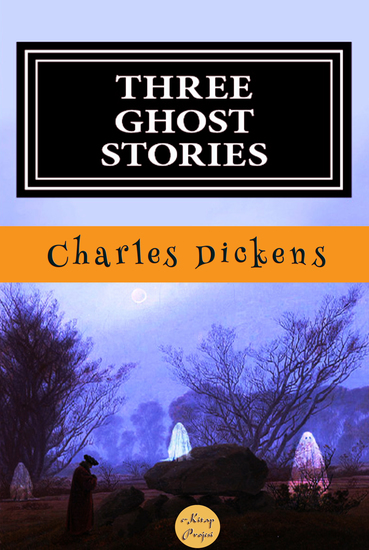
Three Ghost Stories - cover

Three Ghost Stories

Charles Dickens

Editorial: E-Kitap Projesi & Cheapest Books

  • 0
  • 0
  • 0

Sinopsis

Though best known for his heartwarming holiday tales and sweeping social novels such as A Tale of Two Cities and Great Expectations, Charles Dickens was a prolific writer who was always willing to experiment with new styles. The chilling tales collected in Three Ghost Stories are a result of his brief but successful foray into the mystery and detective genres.

Under none of the accredited ghostly circumstances, and environed by none of the conventional ghostly surroundings, did I first make acquaintance with the house which is the subject of this Christmas piece.

I saw it in the daylight, with the sun upon it. There was no wind, no rain, no lightning, no thunder, no awful or unwonted circumstance, of any kind, to heighten its ef-fect. More than that: I had come to it direct from a railway station: it was not more than a mile distant from the railway station; and, as I stood outside the house, looking back upon the way I had come, I could see the goods train running smoothly along the embankment in the valley. I will not say that everything was utterly commonplace, because I doubt if anything can be that, except to utterly commonplace people—and there my vanity steps in; but, I will take it on myself to say that anybody might see the house as I saw it, any fine autumn morning.

The manner of my lighting on it was this.
Disponible desde: 05/02/2024.
Longitud de impresión: 100 páginas.

Otros libros que te pueden interesar

  • The Count of Monte Cristo - cover

    The Count of Monte Cristo

    Alexandre Dumas

    • 0
    • 0
    • 0
    The Count of Monte Cristo (French: Le Comte de Monte-Cristo) is an adventure novel written by French author Alexandre Dumas (père) completed in 1844. It is one of the author's most popular works, along with The Three Musketeers. Like many of his novels, it was expanded from plot outlines suggested by his collaborating ghostwriter Auguste Maquet. 
    The story takes place in France, Italy, and islands in the Mediterranean during the historical events of 1815–1839: the era of the Bourbon Restoration through the reign of Louis-Philippe of France. It begins on the day that Napoleon left his first island of exile, Elba, beginning the Hundred Days period when Napoleon returned to power. The historical setting is a fundamental element of the book, an adventure story centrally concerned with themes of hope, justice, vengeance, mercy, and forgiveness. 
    Before he can marry his fiancée Mercédès, Edmond Dantès, a French nineteen-year-old first mate of the Pharaon, is falsely accused of treason, arrested, and imprisoned without trial in the Château d'If, a grim island fortress off Marseille. A fellow prisoner, Abbé Faria, correctly deduces that romantic rival Fernand Mondego, envious crewmate Danglars, and double-dealing magistrate De Villefort are responsible. Over the course of their long imprisonment, Faria educates Dantès and tells him of a cache of treasure he found. After Faria dies, Dantès escapes and finds the treasure. As the powerful and mysterious Count of Monte Cristo, he enters the fashionable Parisian world of the 1830s to avenge himself.
    Ver libro
  • Chopin Op 47 - From their pens to your ears genius in every story - cover

    Chopin Op 47 - From their pens...

    Stanley Victor Makower

    • 0
    • 0
    • 0
    The bookshelves of British literature are incredible collections that have gathered together centuries of very talented authors.  From these Isles their fame spread and whilst among their number many are now forgotten or neglected their talents endure.  Among them is Stanley Victor Makower.
    Ver libro
  • Some Rambling Notes of an Idle Excursion - cover

    Some Rambling Notes of an Idle...

    Mark Twain

    • 0
    • 0
    • 0
    Some Rambling Notes of an Idle Excursion is a humorous travelogue chronicling a trip to Bermuda with friends that captures the essence of Twain's observational style, and showcases his talent for turning everyday experiences into comedic masterpieces. Blending humour, satire, and insightful commentary on people and places, this is a delightful blend of travel writing and humorous fiction.
    Samuel Langhorne Clemens, better known by his pen name Mark Twain (1835–1910), grew up along the banks of the Mississippi River, and his early experiences inspired many of his most famous works, including The Adventures of Tom Sawyer and Adventures of Huckleberry Finn. Widely celebrated as America's greatest humorist, Twain captured the spirit of a rapidly changing nation, and his sharp wit, keen eye for human nature, and gift for storytelling made him not only a beloved novelist but also a popular lecturer and essayist.
    
    Twain's innovative style, character-driven storytelling and ability to interweave humour with profound social critique laid the groundwork for modern American literature and has inspired countless authors, including Ernest Hemingway and F. Scott Fitzgerald. Indeed, Hemingway famously declared that "all modern American literature comes from one book by Mark Twain called Huckleberry Finn."
    Ver libro
  • The Grammar of Love Nobel Prize 1933 - cover

    The Grammar of Love Nobel Prize...

    Ivan Bunin

    • 0
    • 0
    • 0
    Ivan Bunin received the 1933 Nobel Prize in Literature "for the strict artistry with which he has carried on the classical Russian traditions in prose writing." Aristocrat to the core, Bunin somehow remained connected to the land and people and keenly felt their pulse of life. His acute observations resulted in the accurate and unforgettable characters who populated his writing. His love for punctuation and punctilious choice of words is legendary. Reading Bunin's stories is one of the best ways to understand the mysterious Russian soul and begin to understand one of Russia's greatest periods of literature.
    Ver libro
  • The Last of Squire Ennismore - From their pens to your ears genius in every story - cover

    The Last of Squire Ennismore -...

    Charlotte Riddell

    • 0
    • 0
    • 0
    Charlotte Eliza Lawson Cowan was born in Carrickfergus, County Antrim, Ireland, on 30th September 1832, the youngest daughter of James Cowan, a High Sheriff for the County of Antrim, and Ellen Kilshaw from Liverpool, England. 
    In the winter of 1855, four years after her father's death, she and her mother moved to London. Sadly, within the year, her mother also passed. 
    In 1857, she married Joseph Hadley Riddell, a civil engineer.  The marriage was happy by all accounts but produced no children. 
    Her first novel, ‘The Moors and the Fens’, was published in 1858 under the pseudonym of F. G. Trafford, which she used until publishing under the moniker ‘Mrs Riddell’ from 1864. 
    Charlotte was a prolific, respected and popular author. In her literary career she published over 50 novels and short stories. The most notable is perhaps ‘George Geith of Fen Court’ (1864), for which she was paid £800. It was later dramatised in 1883 by Wybert Reeve. 
    From 1867, Charlotte ventured into new territory, becoming the co-proprietor and editor of the well-regarded St. James's Magazine, which had begun publishing 1861. She also edited the magazine ‘Home in the Sixties’, and wrote short stories and tales for the Society for the Promotion of Christian Knowledge and Routledge's Christmas annuals.  
    Charlotte was a prominent writer of ghost stories; ‘Fairy Water’, ‘The Uninhabited House’, ‘The Haunted River’, ‘The Disappearance of Mr Jeremiah Redworth’ and ‘The Nun's Curse’, all deal with buildings occupied by supernatural phenomena. Charlotte also wrote several short ghost stories, such as ‘The Open Door’ and ‘Nut Bush Farm’, which are regularly anthologised. 
    In 1880 Joseph died.  She now withdrew from society and became a recluse.  From 1886 this was in Upper Halliford, Middlesex.  
    In 1901 Charlotte became the recipient of the first pension, £60 a year, from the Society of Authors. 
    Charlotte Riddell died from cancer in Ashford, Kent, on 24th September 1906.
    Ver libro
  • The Murderer - Bulgakov expertly explores life and death choices set on the backdrop of the Bolshevik Revolution - cover

    The Murderer - Bulgakov expertly...

    Mikhail Bulgakov

    • 0
    • 0
    • 0
    Mikhail Bulgakov was born on 15th May 1891 in Kiev, in the Kiev Governorate of the Russian Empire, into a Russian family.  He was one of seven children. 
     
    In 1901, Bulgakov attended the First Kiev Gymnasium, and developed a keen interest in Russian and European literature, theatre and opera.  After the death of his father in 1907, his mother assumed responsibility for his education.  After graduating Bulgakov entered the Medical Faculty of Kiev University and then took up a post as physician at the Kiev Military Hospital. 
     
    At the outbreak of the First World War, he volunteered as a doctor and was sent directly to the front, where he was badly injured at least twice.  To suppress chronic pain, especially in the abdomen, he injected morphine.  It took years to wean himself off. 
     
    He now took up medical posts in various towns and in 1919, he was mobilised by the Ukrainian People's Army and assigned to the Northern Caucasus.  There, he became seriously ill with typhus and barely survived.  
     
    After this illness, Bulgakov abandoned his medicine to pursue writing.  He moved to Vladikavkaz and had two plays staged there with great success.  He wrote too for various newspapers and other outlets, but his critics were many.  And growing. 
     
    When a Moscow's theatre director severely criticised Bulgakov, Stalin personally protected him, saying that a writer of Bulgakov's quality was above ‘party words’ like ‘left’ and ‘right’.   Indeed, it is said that Stalin watched ‘The Days of the Turbins’ at least 15 times. 
     
    It was not to last and by March 1929, Bulgakov's career was ruined when Government censorship stopped publication of any of his work and plays. 
     
    In despair, Bulgakov wrote a personal letter to Stalin.  He requested permission to emigrate.  He received a phone call from the Soviet leader, who asked the writer whether he really desired to leave. He replied that a Russian writer cannot live outside of his homeland.  Stalin thus gave him permission to continue working. In May 1930, he re-joined the theater, as stage director's assistant.  
     
    During the last stressful decade of his life, and in poor health, Bulgakov continued to work on ‘The Master and Margarita’, wrote plays, critical works, stories, and continued translations and dramatisations of novels.  Many of them were not published, others were derided by critics.  
     
    On 10th March 1940, Mikhail Afanasyevich Bulgakov died from nephrosclerosis.  He was 48. 
     
    ‘The Master and Margarita’ was not published in any form until the mid-1960’s 
     
    Here Bulgakov relates a story as told by a doctor describing the terrible things that humanity is capable of doing in times of war.
    Ver libro