Rejoignez-nous pour un voyage dans le monde des livres!
Ajouter ce livre à l'électronique
Grey
Ecrivez un nouveau commentaire Default profile 50px
Grey
Abonnez-vous pour lire le livre complet ou lisez les premières pages gratuitement!
All characters reduced
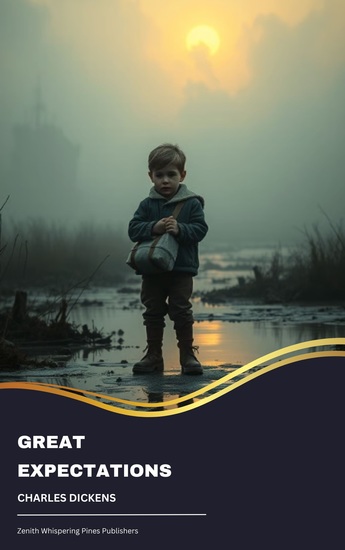
Great Expectations - cover

Great Expectations

Charles Dickens

Maison d'édition: Zenith Whispering Pines Publishers

  • 0
  • 0
  • 0

Synopsis

A mysterious fortune. A chance to change his life. A love that may break his heart.
When orphaned Pip is unexpectedly lifted from poverty into the world of gentlemen, he believes his dreams are finally within reach—especially the dream of winning the beautiful but cold Estella. But as secrets unravel and old ghosts return, Pip discovers that his "great expectations" come with painful lessons about loyalty, pride, and what true gentleness really means.

Praised as "one of Dickens's most unforgettable masterpieces," this novel blends mystery, romance, betrayal, and emotional growth into a story that resonates across generations. Its vivid characters—Pip, Estella, Miss Havisham, Magwitch—remain icons of English literature.

If you love coming-of-age stories filled with heart, tension, and moral depth, this classic will stay with you long after the final page.

Open the book—and follow Pip on a journey that reshapes everything he thinks he wants.
Disponible depuis: 08/12/2025.
Longueur d'impression: 309 pages.

D'autres livres qui pourraient vous intéresser

  • Inspector Hanaud and The Ginger King - Narrated by Michael Henrik Wynn - cover

    Inspector Hanaud and The Ginger...

    A. E. W. Mason

    • 0
    • 0
    • 0
    Hercule Poirot was Agatha Christie’s first creation. Poirot appeared in 1920, but there were several similar characters that preceded him. A. E. W. Mason’s Inspector Gabriel Hanaud from 1910 was one of these. Inspector Hanaud resembles Poirot in many ways, but is a more comical French sleuth. He appeared in several novels and short stories. 
    In this story, Hanaud is called in to assist in the investigation of a possible insurance fraud. 
    The narrator is Michael Henrik Wynn, the editor of the educational net radio stream, Historyradio.org
    Voir livre
  • The Murders in the Rue Morgue - cover

    The Murders in the Rue Morgue

    Edgar Allan Poe

    • 0
    • 0
    • 0
    The main character is C. Auguste Dupin, a sleuth that solves crimes by deduction. Two women have been brutally murdered and it appears that there was no way in or out of the room where the murders took place.
    Voir livre
  • Mutiny - A womans quest for social advancement meets a reporter investigating the truth aboard a ship - cover

    Mutiny - A womans quest for...

    Dorothy Edwards

    • 0
    • 0
    • 0
    Dorothy Edwards, an only child, was born on the 18th August 1902 at Ogmore Vale in Glamorgan. 
     
    Her father was a headmaster and an early activist in the Independent Labour Party.  At age 9 Dorothy, dressed in red, welcomed Keir Hardy on to the stage at Tonypandy during the national coal strike of 1912. She was taught that revolution was at hand, that class barriers would be a thing of the past. 
      
    Dorothy won a scholarship and boarded at Howell's School for Girls in Llandaff before moving to University College of South Wales and Monmouthshire where she read Greek and philosophy. 
     
    Her early hopes to be an opera singer were set to one side after graduating and the death of her father. Instead she took on part-time work to supplement her mother’s pension with whom she now lived. 
     
    Dorothy managed to write a number of short stories which appeared in the literary journals of the day.  She spent several months with her mother in Vienna, all the time revising or writing before embarking on ‘Winter Sonata’, a short novel published in 1928. 
     
    Introductions to several members of the Bloomsbury Group meant a move to London and a division of her time between child-care for the family of Bloomsbury author David Garnett and the promise of an advance payment for her work on a new volume of stories. 
     
    However, Dorothy’s life was starting to spiral out of control; she was attracted to the Welsh nationalist movement but felt that her Welsh provincialism made her, in London at least, feel socially inferior. Leaving her mother dependent on a hired companion consumed her with guilt as did the end of an affair with a married musician. 
     
    On the 5th January 1934, having spent the morning burning her papers, Dorothy Edwards threw herself in front of a train near Caerphilly railway station.  
     
    Her suicide note read: "I am killing myself because I have never sincerely loved any human being all my life. I have accepted kindness and friendship and even love without gratitude, and given nothing in return."
    Voir livre
  • Indian Legends of the Cuyamaca Mountains - cover

    Indian Legends of the Cuyamaca...

    Mary Elizabeth Johnson

    • 0
    • 0
    • 0
    A Dusty Tomes Audio BookIn Cooperation with Spoken Realms 
    Indian Legends of the Cuyamaca Mountains by Mary Elizabeth Johnson. Published in 1914 by Mary Elizabeth Johnson. 
    Narrated by Joseph Tabler. This book is in the public domain. It is read ‘as written.'Audio copyright 2024 
    Contents of the booklet: 
    ForewordHilsh Ki’e—Pine TreeHuts-tah’ Ta-mil ‘tah—Hanging HeadAh-ha’ Wi Ah-ha’—Water Colder WaterAh Kwer-rup’—Disease CureHul-ya-oo’ Nimoo-lu ‘kah—Phantom BasketNa-wa-Ti ‘e—Big HouseIn-yar’en Ah-ha’—No Eyes in WaterSeen-u-how ‘How-wak’—Old Woman’s TwinsSeen-u-how ‘Hum-poo’—Old Woman’s WhipKwut ah Lu ‘e-ah—Song DanceAh Kwir’—Red Paint (part missing) 
    From the Author’s Foreword:Indian lore of the Cuyamaca Mountains and surrounding region in San Diego County, California, abounds in myths and legends handed down from generation to generation by tribal song and squaw-tale. Yet so swiftly has the hand of civilization wiped out the old traditions and customs, that but few Indians remain who remember them, and fewer still are those willing to divulge them. Only when one comes into intimate contact with them is one accorded the privilege and honor of hearing the tales of their ancestors. And it is through the friendship of some of the old-type Indians, that the author has been allowed a glimpse of the inner shrine of their lives. 
    Cuyamaca is evidently a Spanish corruption of the Indian words Ah-ha’ Kwe-ah-mac’ (Water Beyond), a name used by the Indians, first to designate a location high on the middle mountain, but afterward applied to the entire group. 
    These mountains had distinctive names also. The one farthest north, they called E-yee’ (Nest), because they believed that a big nest or den was on one of its slopes in which the wild animals disappeared when hunted, thus safely evading pursuit. The middle one, Hal-kwo-kwilsh’ (Tough Strong), gained this title in the battle of the peaks when he proved very formidable. The one known as the Cuyamaca Peak, acquired the name of Poo-kwoo-sqwee’ (Crooked Neck), in the same battle. And before the battle still another peak, Hilsh Ki’e (Pine Tree), belonged to the group, so the Indians say, but now lives far away. 
    Pronunciation:The Indians accent their words strongly and enunciate with their teeth very nearly closed, which gives their language a rhythmical cadence quite pleasing to the ear. 
    Dusty Tomes Audio Books are public domain books retrieved from history. If today’s technology had been available when first printed, they would be audio books already. I am grateful for the opportunity to record them now. Read online at archive.org and Hathitrust.org. 
    Narrator’s note: I read only as written. These old books were once solid sellers for bookmen of their time. I believe they can shed light on their times and ours. Loving obscure and remote literature, they are a distinct pleasure for me to read to you. These turn out to be distant and unknown only so long as they remain unread, or unheard. Aloha.
    Voir livre
  • War Of The Worlds - The Classic Tale - cover

    War Of The Worlds - The Classic...

    H. G. Wells

    • 0
    • 0
    • 0
    The War of the Worlds is a science fiction novel by English author H. G. Wells, first serialized in 1897 by Pearson's Magazine in the UK and by Cosmopolitan magazine in the US. The novel's first appearance in hardcover was in 1898 from publisher William Heinemann of London. Written between 1895 and 1897, it is one of the earliest stories to detail a conflict between mankind and an extraterrestrial race. The novel is the first-person narrative of both an unnamed protagonist in Surrey and of his younger brother in London as southern England is invaded by Martians. The novel is one of the most commented-on works in the science fiction canon. 
     
    The plot has been related to the invasion literature of the time. The novel has been variously interpreted as a commentary on evolutionary theory, British imperialism, and generally Victorian superstitions, fears, and prejudices. Wells said that the plot arose from a discussion with his brother Frank about the catastrophic effect of the British on indigenous Tasmanians. What would happen, he wondered, if Martians did to Britain what the British had done to the Tasmanians? At the time of publication, it was classified as a scientific romance, like Wells's earlier novel The Time Machine. 
     
    The War of the Worlds has been both popular (having never been out of print) and influential, spawning half a dozen feature films, radio dramas, a record album, various comic book adaptations, a number of television series, and sequels or parallel stories by other authors. It was most memorably dramatized in a 1938 radio program directed by and starring Orson Welles that allegedly caused public panic among listeners who did not know the Martian invasion was fictional. The novel has even influenced the work of scientists, notably Robert H. Goddard, who, inspired by the book, helped develop both the liquid-fuelled rocket and multistage rocket.
    Voir livre
  • The Call of The Wild - cover

    The Call of The Wild

    Jack London

    • 0
    • 0
    • 0
    Buck, a pampered California pup, lived a life of naps and treats. But fate took a nasty turn when he was snatched and sold as a sled dog in Alaska. The cushy life vanished, replaced by bone-chilling nights and the sting of the whip 
    Buck, though, was tougher than he looked. The wilderness awakened something primal within him. He learned the howl of the pack, the bite of the cold, and the fight for survival.
    Voir livre